Explore institutional access →

2 min. read

The Art of the Musical Instrument Maker

Encyclopédie méthodique — Paris 1795

Part 1

By Anonyme

The Art of the Musical Instrument Maker

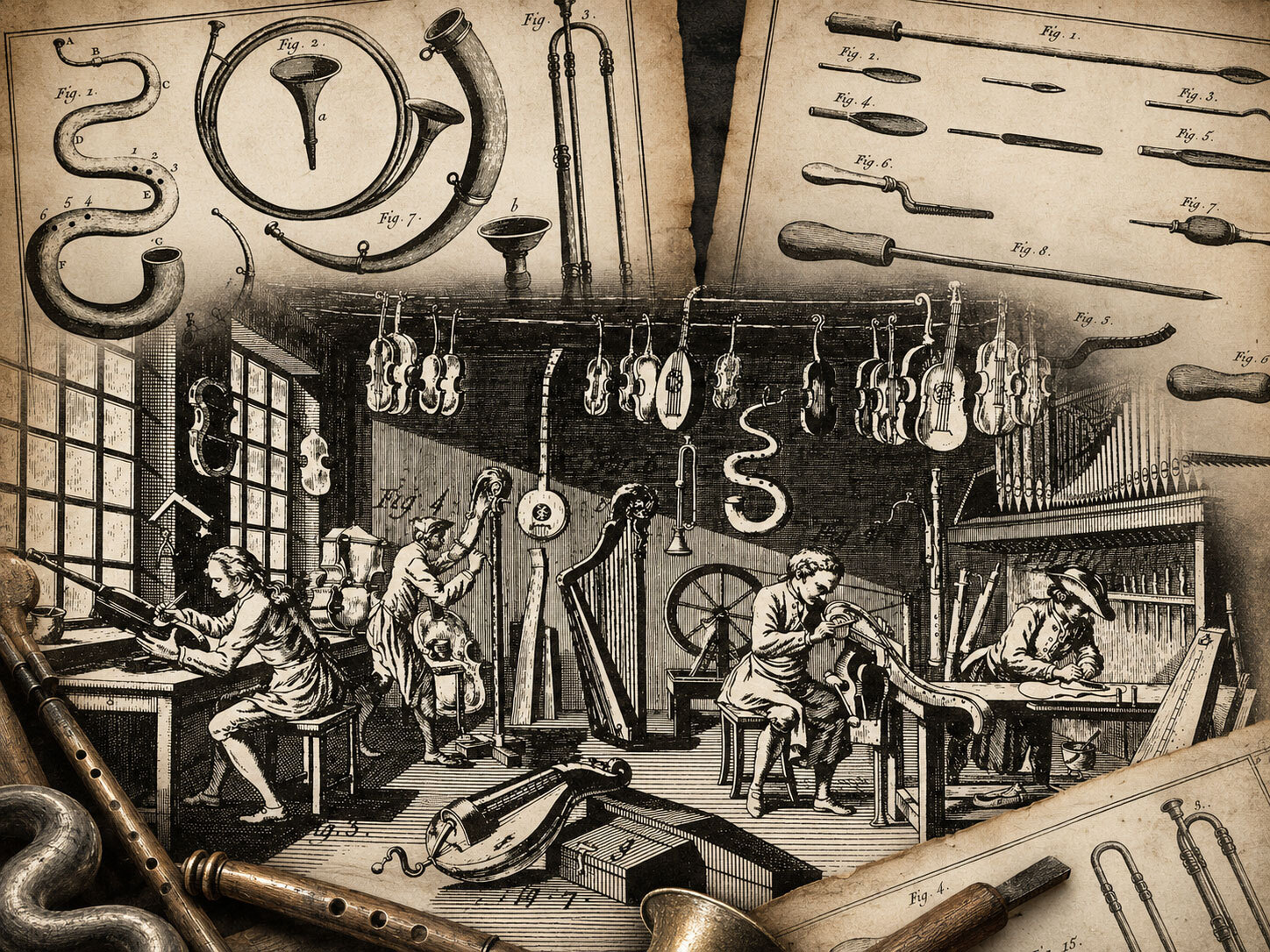
This “Methodical encyclopedia — arts and crafts” was published in Paris in 1795. In 1984 Editions Minkoff of Geneva rescued from oblivion and published in facsimile Volume IV, which concerns particularly the “Art of the musical instrument maker” (ISBN 2-8266-0295-0). The author — anonymous, unfortunately — describes the instruments in irresistible style.

The text concerning our instruments will be divided up and reproduced, starting with this issue; illustrations from the original work will be included. The book also contains 36 pages (150-186) of “Vocabulary”. Some of these descriptions, written in the style of 200 years ago, are particularly helpful to us either by helping us to understand certain changes in meaning or because the old words which have changed are, strangely, more exact than those we use today. For example:

Trumpet: wind instrument; consisting of a cup-shaped mouthpiece, two arms which carry the air and bell which forms the end of the trumpet with a flared aperture.

Extract 1¹

Musical instruments are devices invented and arranged by the art of the instrument maker to express sounds in the absence of voices, to imitate man’s naturel voice or to embellish and accompany it.

There are also instruments which create more noise than harmony, used for public summonses, and others which are used to maintain the courage of the troops on the march and in combat. Music written to be performed by devices of this sort is called instrumental.

[…]

2. Wind instruments, made to sound by means of the mouth, such as flutes, trumpet, oboes, bassoons, serpents etc. and by means of bellows, such as the various types of bagpipe [musette, chalemie, loure] and the organ.

[…]

Only here will we observe that each instrument has its own range, expression and character, with which the musician must be acquainted.

If he take the instrument beyond its true register, he will make it shrill, dull or harsh.
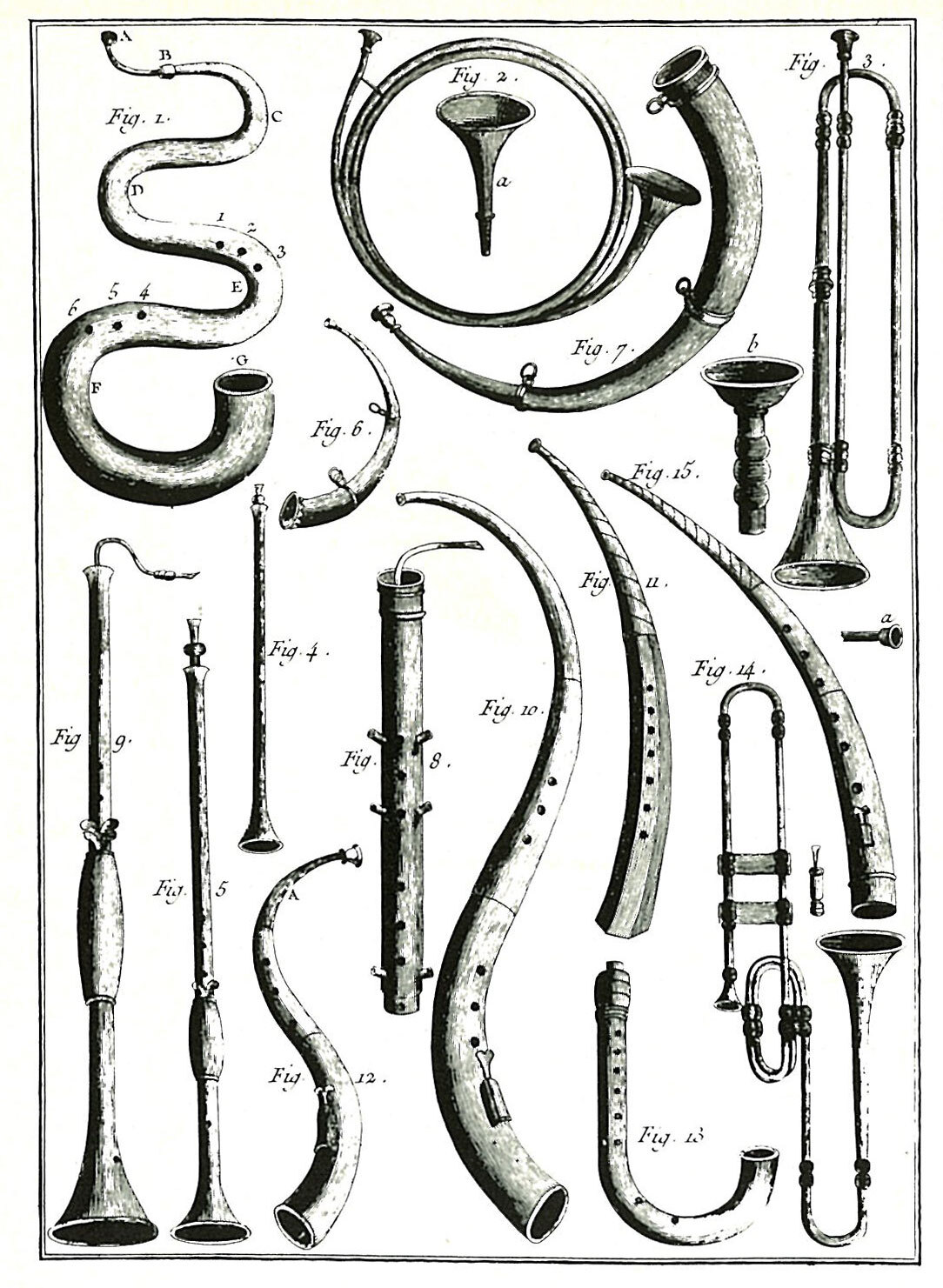
Musical Instruments, Ancient, Modern and Foreign; wind, cup-mouthpieces and reed instruments.
Musical Instruments, Ancient, Modern and Foreign; wind, cup-mouthpieces and reed instruments.

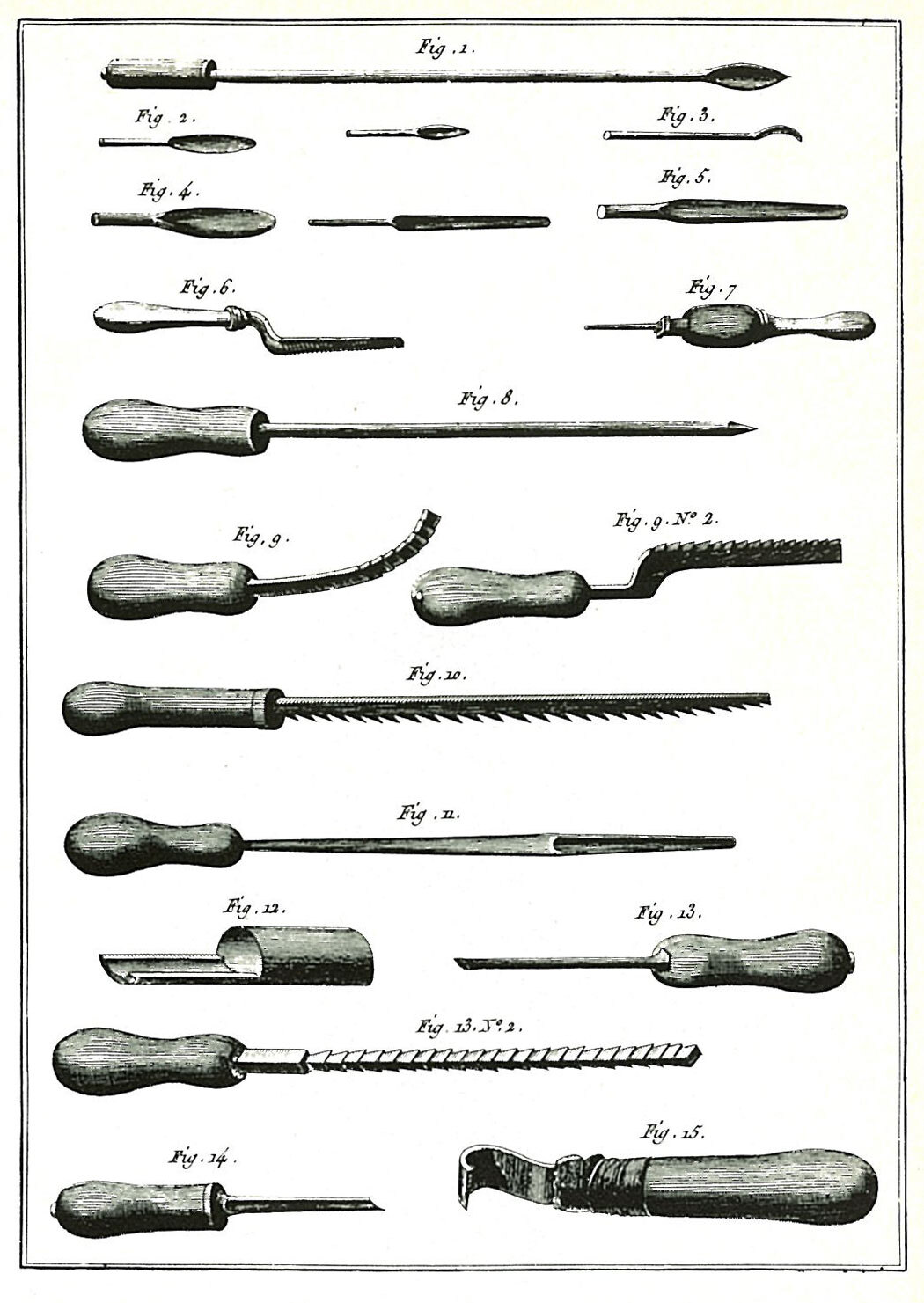
Instrument maker, tools involved in making wind instruments.

Instrument maker, tools involved in making wind instruments.

If he does not know its manner of expression, he will not use it in circumstances where it will have the greatest effect.

A most important part of a composer’s study is that of the character of the instruments. These are the voices through which he speaks to our ears.

But it is not enough to know each instrument by itself; he must also know the effect of their sounds combined with one another; sometimes a well placed horn note will suffice to produce the strongest feelings.

There is no phenomen in naturel and no passion nor feeling in man’s heart which cannot be imitated with instruments; but one cannot say that all are equally suited to all these imitations. If the high sounds of the piccolo flute are heard at times in the depiction of a tempest, they will give it great realism. The low, lugubrious sounds of the horns will give fearful notice of the arrival of ghosts and spirits. The notes of the stringed instruments must sometimes be sustained, sometimes plucked etc. [1]

Notes

¹ Our extracts contain the following symbols: the number of the page from which the extract is taken — [23]; phrases or paragraphs omitted — […].

Brass Bulletin 52, IV / 1985 pages 57–59

All content is protected by copyright © Brass Bulletin 1985–2026

Share this article

Facebook LinkedIn
Loading…

Questions & Answers

How the Digital Edition works

What does the Digital Edition include?

The Digital Edition brings together the articles already digitized as searchable online texts—not simply as scans or PDF files—along with their original illustrations, notes, authorship, issue information, and available translations. Related-article suggestions currently include only this digitized material.

Are the digital articles identical to the originals?

We preserve the original text, language, illustrations, captions, footnotes, and editorial context as faithfully as possible. The presentation is adapted for comfortable online reading, and obvious transcription or scanning errors may be corrected. The substance and character of the published article remain unchanged.

Which languages are available?

Brass Bulletin was published in English, French, and German throughout its history. Italian and Spanish translations were added from issue No. 60 onward.

On the Italian and Spanish sites, articles from issues 1–59 are therefore shown in English by default.

How often are new articles added?

New articles are added almost daily, with approximately one complete issue digitized each week. The pace may vary depending on the preparation, image work, and editorial checking required.

Why aren’t all articles available digitally?

The complete Brass Bulletin collection contains 1,246 articles published between 1971 and 2003. The full index is already available online, allowing readers to discover every article in the collection, including those whose complete text has not yet been digitized.

Digitization began in February 2026. Each article is carefully prepared for online reading, checked, and connected to its issue, authors, subjects, and illustrations. At the current pace of digitization, the complete collection is expected to be available online by February 2028.

Why do some references mention articles that are not available yet?

References in the original articles are preserved even when the material they point to has not yet been digitized. This keeps the historical and editorial record intact. As more issues are added to the Digital Edition, an increasing number of these references will lead to articles that can be read online.

Can I suggest an article or report a transcription error?

Yes. If there is an article you would particularly like to see digitized, or if you notice a possible transcription error or missing detail, please contact us. Reader feedback helps us improve the Digital Edition and prioritize useful connections within the archive.

How can I support Brass Bulletin?

Your support helps fund the preparation, verification, and online publication of the complete collection.

Subscribe to the Digital Edition

Prefer to support us without subscribing?

Make a donation

How is the digitization progressing?

We’re gradually making the Brass Bulletin available online, article by article. You can read newly digitized articles as soon as they’re ready, even before an entire issue is complete.

Visit our Digitization Roadmap to browse recent additions and see estimated availability for upcoming issues. These estimates follow our recent pace and may change.

Search Brass Bulletin.