Explore institutional access →

3 min. read

Trombone workshops

Trombone workshops

This past year I have visited and participated in many “trombone workshops”. These workshops are becoming more and more common these days: most of them are sporadic events following the International Trombone Workshop idea. This original workshop has been held annually in Nashville, Tennessee, since 1971 and the International Trombone Association was in fact a by-product of the first one.

The idea of instrumentalists getting together is probably most characteristic of brass players. The reasons for this phenomenon are varied, I am sure, and could supply material for a long research project which I would like to leave for another occasion. The fact is that the will to get together and exchange knowledge has led to the organisation of these special events.

In what follows I would like to describe in detail some workshops I attended this past year.

In Nashville, one tries to invite many players from all different areas of music (symphonic, jazz, commercial recordings, solo, etc.) and from different schools of playing. In this way, the workshop becomes a meeting and of interest not only to those coming to listen but also to those coming to play (and talk). In Nashville one could say there was almost too much:

  • Two different master classes daily. Here one has an hour where the invited player expounds his approach to playing. He can do it in any of the following ways: a recital, a lecture, answering questions or in teaching (the conventional “master class” notion). These sessions, held by small groups, permit an initial contact which could be further developed.
  • Special sessions. Lectures (with or without music) in bigger groups on various subjects: historical, acoustic, teaching, repertoire, etc.
  • Concerts. These could have a variety of styles and idioms from classical to avant-garde, jazz or free improvisation.

All these sessions follow one another so fast that there is no time to stop and think for a moment. Fortunately, they are recorded professionally¹ and available immediately afterwards. This is of interest to the participants as well as to people who were prevented from coming to the workshop. There are also peripheral activities such as chamber music, private lessons with a “star” you never dreamed of meeting, visiting the instrumental exhibition with its new products or expounding your own ideas of playing to other people.

The main problem of course is organisation. Finding a venue for all the events, for practice rooms, for sleeping and eating accommodation and a good efficient team to support all the crazy problems that are bound to occur. The artistic programme is not easy either: finding the right personalities with a reasonable mixture of old and new. This is valid for the concerts too. As far as finance is concerned, teachers in Nashville usually have only their expenses covered. This creates a good feeling all round; people come because they find it a privilege to participate and benefit personally.

Credit should go to Tom Everett, the workshop coordinator, for its success but one must not forget the contribution of the excellent team and the willing participants.

In October 1984 the first Danish workshop took place near Copenhagen at the initiative of Carsten Svanberg. It was similar to the American pattern but in smaller proportions: two days long, with a few teachers. Nevertheless, the quality of this workshop was extremely high.

One should bear in mind that these two workshops were geared to a professional audience. Therefore it would seem preferable to have a suburban setting where the participants are 100% available for all activities.

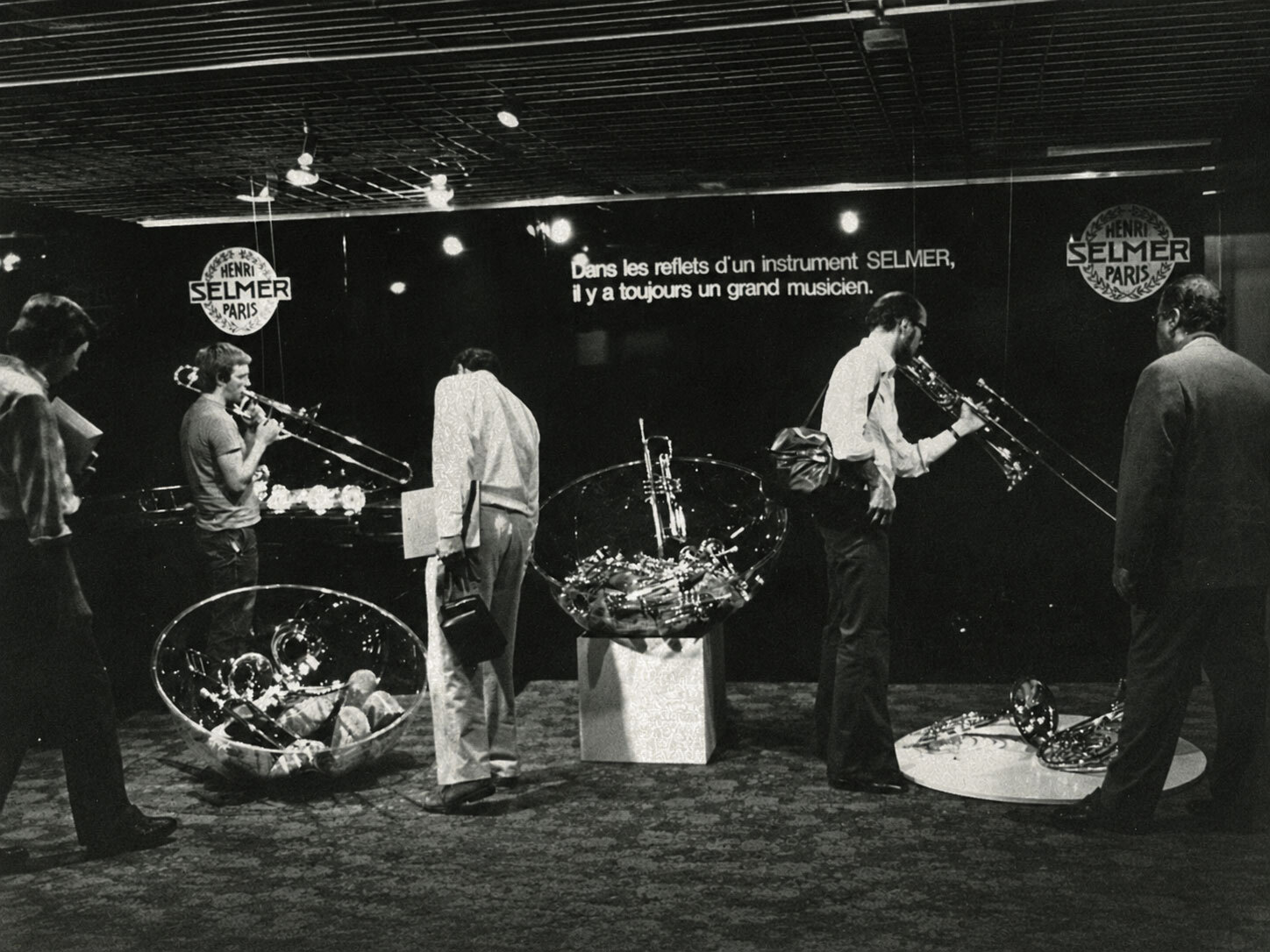
The “International Trombone and Tuba Week” which was held in Metz in June was different as far as this aspect is concerned. The site is a regional capital in eastern France known for its musical activities. All the events were held in the city and were therefore available to the general public. The musical programme was highly interesting, more concert-oriented (perhaps often too long), but the anticipated audience did not materialise. Publicity appeared too late and people outside France didn’t know of such an important event till a short time before.

The workshop was again a one-man initiative. Gilles Senon, the local trombone teacher, took advantage of the fact that this was “European Music Year” and therefore financial assistance from the Council of Europe was available to realize a personal dream.

Artistically, the programme was superb and it was possible to find internationally known teachers. Unfortunately there were not enough participants for such a big event, the local audience wasn’t sufficiently enthusiastic and even the focus of some teachers was surprisingly financially oriented... Regrettably so, since these workshops are important from the human and personal aspect as well as the musical one.

The common denominator between all these workshops was the consistently high quality and vast artistic programmes which made them unquestionably beneficial to all participants.

Notes

¹ Audio Village, Box 291, Bloomington IN 47402, USA.

Brass Bulletin 52, IV / 1985 pages 67–69

All content is protected by copyright © Brass Bulletin 1985–2026

Share this article

Facebook LinkedIn
Loading…

Questions & Answers

How the Digital Edition works

What does the Digital Edition include?

The Digital Edition brings together the articles already digitized as searchable online texts—not simply as scans or PDF files—along with their original illustrations, notes, authorship, issue information, and available translations. Related-article suggestions currently include only this digitized material.

Are the digital articles identical to the originals?

We preserve the original text, language, illustrations, captions, footnotes, and editorial context as faithfully as possible. The presentation is adapted for comfortable online reading, and obvious transcription or scanning errors may be corrected. The substance and character of the published article remain unchanged.

Which languages are available?

Brass Bulletin was published in English, French, and German throughout its history. Italian and Spanish translations were added from issue No. 60 onward.

On the Italian and Spanish sites, articles from issues 1–59 are therefore shown in English by default.

How often are new articles added?

New articles are added almost daily, with approximately one complete issue digitized each week. The pace may vary depending on the preparation, image work, and editorial checking required.

Why aren’t all articles available digitally?

The complete Brass Bulletin collection contains 1,246 articles published between 1971 and 2003. The full index is already available online, allowing readers to discover every article in the collection, including those whose complete text has not yet been digitized.

Digitization began in February 2026. Each article is carefully prepared for online reading, checked, and connected to its issue, authors, subjects, and illustrations. At the current pace of digitization, the complete collection is expected to be available online by February 2028.

Why do some references mention articles that are not available yet?

References in the original articles are preserved even when the material they point to has not yet been digitized. This keeps the historical and editorial record intact. As more issues are added to the Digital Edition, an increasing number of these references will lead to articles that can be read online.

Can I suggest an article or report a transcription error?

Yes. If there is an article you would particularly like to see digitized, or if you notice a possible transcription error or missing detail, please contact us. Reader feedback helps us improve the Digital Edition and prioritize useful connections within the archive.

How can I support Brass Bulletin?

Your support helps fund the preparation, verification, and online publication of the complete collection.

Subscribe to the Digital Edition

Prefer to support us without subscribing?

Make a donation

How is the digitization progressing?

We’re gradually making the Brass Bulletin available online, article by article. You can read newly digitized articles as soon as they’re ready, even before an entire issue is complete.

Visit our Digitization Roadmap to browse recent additions and see estimated availability for upcoming issues. These estimates follow our recent pace and may change.

Search Brass Bulletin.