Explore institutional access Explore institutional access
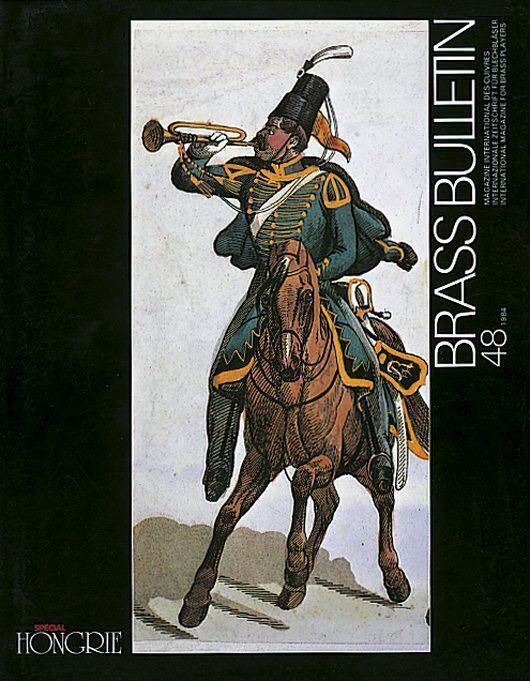
Brass Bulletin 48 - 4 / 1984
Issue
Brass Bulletin No. 48
Date
IV / 1984
Pages
104
Contents
14 articles

Out of print

All issues

Brass Bulletin No. 48

IV / 1984

Contents

14 articles

Editorial

Jean-Pierre Mathez

pp. 3

Colour enters Brass Bulletin as its fiftieth issue approaches, while Jean-Pierre Mathez reflects on continuity, readers and a magazine still evolving.

Edna White

A Woman and a Life in the Service of the Trumpet

Michel Laplace

pp. 10–16 Trumpet History

At a time when the cornet still ruled, Edna White made the trumpet a solo voice, building a career across concert halls, radio, recordings and new repertoire.

Some ways of improving the development of the lips in brass players

Sergej Gorovoj

pp. 17–19 Technique Health Research

Brass players borrow from sports medicine as Soviet electrical stimulation, acupuncture and massage test new ways to build endurance and restore overworked lips.

Special Hungary

Editorial

Jean-Pierre Mathez

pp. 23 Society

Hungary’s brass world emerges as a cultural force, where organisation, international exchange and musical ambition turn national vitality into lasting connections.

Special Hungary

Barcs 1984

First International Brass Ensemble Competition

Jean-Pierre Mathez

pp. 24–29 Competition Report

A small Hungarian town became a testing ground for brass chamber music, where young ensembles showed how quickly the discipline was coming of age.

Special Hungary

International Trumpet Competition, Budapest 1984

Timofey Dokschidser, Philip Jones, Théo Mertens

pp. 30–37 Trumpet Competition

Budapest 1984 exposed a striking gap between technical brilliance and musical maturity, while three leading trumpeters challenged what competitions truly reward.

Special Hungary

Studying music in Hungary

Jean-Pierre Mathez

pp. 38–39 Teaching Professional life

Music education, secure jobs and modest salaries shaped a Hungarian brass culture where exceptional training coexisted with striking economic realities.

Special Hungary

National Hungarian Music Center

Jean-Pierre Mathez

pp. 40–41 Report

In 1980s Budapest, one building brought rehearsal rooms, publishers, record labels, concert organisers and musicians together at the heart of Hungarian musical life.

Special Hungary

Brass Chamber Music in Hungary

Frigyes Varasdy

pp. 42–47 Repertoire History

Ancient horns, military signals and postwar ensembles meet in a Hungarian brass tradition shaped as much by education and composers as by performers.

Special Hungary

The most beautiful instruments of the National and Military Museums

Jean-Pierre Mathez

pp. 48–61 History Equipment

Budapest’s museum collections bring together Roman and Baroque trumpets, ceremonial instruments and military imagery, preserving sounds and symbols across centuries.

Special Hungary

The Trumpets in the Hungarian National Museum in Budapest

Leo Kappel

pp. 64–70 Trumpet Equipment Research

Four little-known trumpets in Budapest open a window onto Viennese makers, historical construction, pitch and the fragile survival of museum instruments.

On the Crumhorn

From Pierre Trichet’s Traité des Instruments de Musique (c. 1640)

Pierre Trichet

pp. 71–73 History Equipment

A seventeenth-century crumhorn leads from Roman lituus and alpine horns to reeds, finger holes and keys, exposing an unexpected family of curved instruments.

On record reviews

Is criticism constructive? Objective?

Uwe Wolf

pp. 75–77 Society

When taste and feeling dominate record reviews, criticism risks becoming arbitrary; Uwe Wolf argues instead for interpretations grounded enough to sustain debate.

Inventor's corner

Shaping Your Own Mouthpiece

Ninck Blok

pp. 99–100 Equipment Technique

A tiny alteration to the mouthpiece rim challenges conventional design, seeking greater upper-lip endurance without sacrificing flexibility, attack or control.

Loading…

Questions & Answers

How the Digital Edition works

What does the Digital Edition include?

The Digital Edition brings together the articles already digitized as searchable online texts—not simply as scans or PDF files—along with their original illustrations, notes, authorship, issue information, and available translations. Related-article suggestions currently include only this digitized material.

Are the digital articles identical to the originals?

We preserve the original text, language, illustrations, captions, footnotes, and editorial context as faithfully as possible. The presentation is adapted for comfortable online reading, and obvious transcription or scanning errors may be corrected. The substance and character of the published article remain unchanged.

Which languages are available?

Brass Bulletin was published in English, French, and German throughout its history. Italian and Spanish translations were added from issue No. 60 onward.

On the Italian and Spanish sites, articles from issues 1–59 are therefore shown in English by default.

How often are new articles added?

New articles are added almost daily, with approximately one complete issue digitized each week. The pace may vary depending on the preparation, image work, and editorial checking required.

Why aren’t all articles available digitally?

The complete Brass Bulletin collection contains 1,246 articles published between 1971 and 2003. The full index is already available online, allowing readers to discover every article in the collection, including those whose complete text has not yet been digitized.

Digitization began in February 2026. Each article is carefully prepared for online reading, checked, and connected to its issue, authors, subjects, and illustrations. At the current pace of digitization, the complete collection is expected to be available online by February 2028.

Why do some references mention articles that are not available yet?

References in the original articles are preserved even when the material they point to has not yet been digitized. This keeps the historical and editorial record intact. As more issues are added to the Digital Edition, an increasing number of these references will lead to articles that can be read online.

Can I suggest an article or report a transcription error?

Yes. If there is an article you would particularly like to see digitized, or if you notice a possible transcription error or missing detail, please contact us. Reader feedback helps us improve the Digital Edition and prioritize useful connections within the archive.

How can I support Brass Bulletin?

Your support helps fund the preparation, verification, and online publication of the complete collection.

Subscribe to the Digital Edition

Prefer to support us without subscribing?

Make a donation

Search Brass Bulletin.