Explore institutional access Explore institutional access
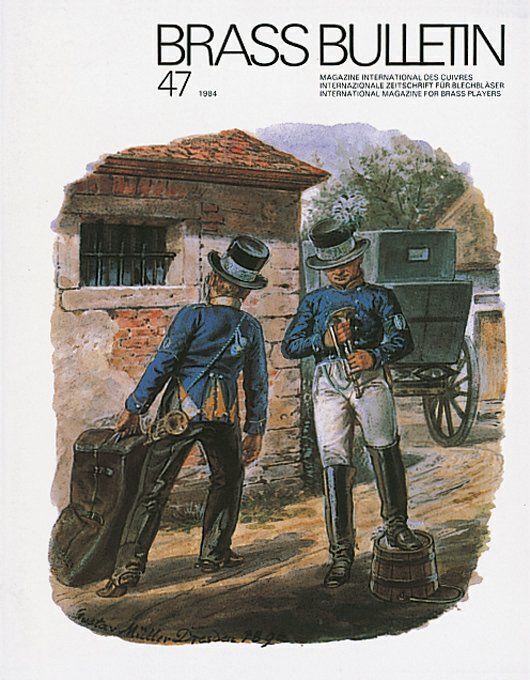
Brass Bulletin 47 - 3 / 1984
Issue
Brass Bulletin No. 47
Date
III / 1984
Pages
96
Contents
10 articles

Out of print

All issues

Brass Bulletin No. 47

III / 1984

Contents

10 articles

Editorial

A Midsummer Night's Dream

Jean-Pierre Mathez

pp. 7–10 Short story

A ghostly Arban returns in 1984 to find virtuosity thriving, instruments transformed and a brass world whose progress leaves its greatest pedagogue strangely displaced.

The trumpet in the north German postal service of the 19th century

Albert Hiller

pp. 12–18 Trumpet History

For forty years, northern German postilions exchanged the familiar post-horn for trumpets, turning postal signals into an unexpected echo of military practice.

John Fletcher

Is Big Always Beautiful?

Thomas Aitken

pp. 19–24 Tuba Encounters

As brass instruments grew larger and louder, John Fletcher saw something being lost: the individual voice, clarity and character that make a player heard.

Science in the service of music

Interview with René Périnelli

Jean-Pierre Mathez

pp. 26–29 Trumpet Teaching Research

Where trumpet teaching once relied on intuition, René Périnelli and Jean-Jacques Greffin brought physiology, medical imaging and science into daily practice.

Interview with Thomas Müller

Jeffrey Agrell

pp. 31–33 Horn Technique

The natural horn is not a retreat into the past: Thomas Müller argues that its demands on sound, technique and awareness can broaden a modern player’s craft.

Maurice Ravel and the new trombone

Michel Laplace

pp. 34–38 Trombone History Technique

Dance-band trombonists reshaped orchestral expectations in the 1920s and 30s, leaving their mark on Ravel’s Boléro and a generation of players.

The Trumpet and the Cornet in Jazz and Popular Music

Part 6 – End

Special jazz techniques

Michel Laplace

pp. 39–45 Trumpet Cornet à pistons History

Vibrato, half-valves, growls and shakes lead to a larger argument: jazz transformed trumpet technique, yet its contribution remained strikingly undervalued.

On hunting horns and other similar instruments

From Pierre Trichet’s Traité des Instruments de Musique (c. 1640)

Pierre Trichet

pp. 51–54 Horn History Equipment

Hunting horns, buccinae and cornets blur into one another as Trichet links ancient signals, shepherds, hunters and myth to the instruments of his own age.

Jazz and the Horn

Part 5

Tom Varner

Jeffrey Agrell

pp. 55–57 Horn Encounters

Choosing jazz over the orchestral path, Tom Varner confronts the horn’s stiffness, projection and unlikely place as a front-line improvising voice.

Paolo Longinotti (1913-1963)

His career

Jean-Pierre Mathez

pp. 58–69 Trumpet Encounters History

A virtuoso of Ansermet’s orchestra, piccolo-trumpet pioneer and mentor to Maurice André, Longinotti’s brilliance was matched by a devastating final chapter.

Loading…

Questions & Answers

How the Digital Edition works

What does the Digital Edition include?

The Digital Edition brings together the articles already digitized as searchable online texts—not simply as scans or PDF files—along with their original illustrations, notes, authorship, issue information, and available translations. Related-article suggestions currently include only this digitized material.

Are the digital articles identical to the originals?

We preserve the original text, language, illustrations, captions, footnotes, and editorial context as faithfully as possible. The presentation is adapted for comfortable online reading, and obvious transcription or scanning errors may be corrected. The substance and character of the published article remain unchanged.

Which languages are available?

Brass Bulletin was published in English, French, and German throughout its history. Italian and Spanish translations were added from issue No. 60 onward.

On the Italian and Spanish sites, articles from issues 1–59 are therefore shown in English by default.

How often are new articles added?

New articles are added almost daily, with approximately one complete issue digitized each week. The pace may vary depending on the preparation, image work, and editorial checking required.

Why aren’t all articles available digitally?

The complete Brass Bulletin collection contains 1,246 articles published between 1971 and 2003. The full index is already available online, allowing readers to discover every article in the collection, including those whose complete text has not yet been digitized.

Digitization began in February 2026. Each article is carefully prepared for online reading, checked, and connected to its issue, authors, subjects, and illustrations. At the current pace of digitization, the complete collection is expected to be available online by February 2028.

Why do some references mention articles that are not available yet?

References in the original articles are preserved even when the material they point to has not yet been digitized. This keeps the historical and editorial record intact. As more issues are added to the Digital Edition, an increasing number of these references will lead to articles that can be read online.

Can I suggest an article or report a transcription error?

Yes. If there is an article you would particularly like to see digitized, or if you notice a possible transcription error or missing detail, please contact us. Reader feedback helps us improve the Digital Edition and prioritize useful connections within the archive.

How can I support Brass Bulletin?

Your support helps fund the preparation, verification, and online publication of the complete collection.

Subscribe to the Digital Edition

Prefer to support us without subscribing?

Make a donation

Search Brass Bulletin.