Explore institutional access Explore institutional access

2 min. read

Inventor's corner

Shaping Your Own Mouthpiece

Inventor's corner

Mouthpieces are made on a lathe and so the rim surface is flat (and sits flat on a tabletop). Unfortunately our lips are not that flat. Our teeth form a more or less arched row. If we press the mouthpiece against our lips, we have to use them to form a cushion, otherwise pain and fatigue soon develop, as every brass player knows. With a flatter, wider rim you can press harder and longer but you loose control. You know the problem area that calls for the wider flatter rim but you know you should not give in because of the loss of flexibility, loss of attack etc. That problem area is in the middle of our upper lip. Many people can make a good cushion embouchure and have a strong lower lip yet still have pain and fatigue in the upper lip because, when they press, the circulation in the middle of the upper lip is reduced where the arch of the upper teeth is closest to the mouthpiece rim.

The problem is: how do we get rid of that painful area on our upper lip? One solution among trumpeters is — though guys feel no pain. Another solution is the Herbert Clarke mouthpiece (BRASS BULLETIN no 20, pp. 27-28); I copied it but it did not work; it was much too comfortable for my lower lip, which did not need help.

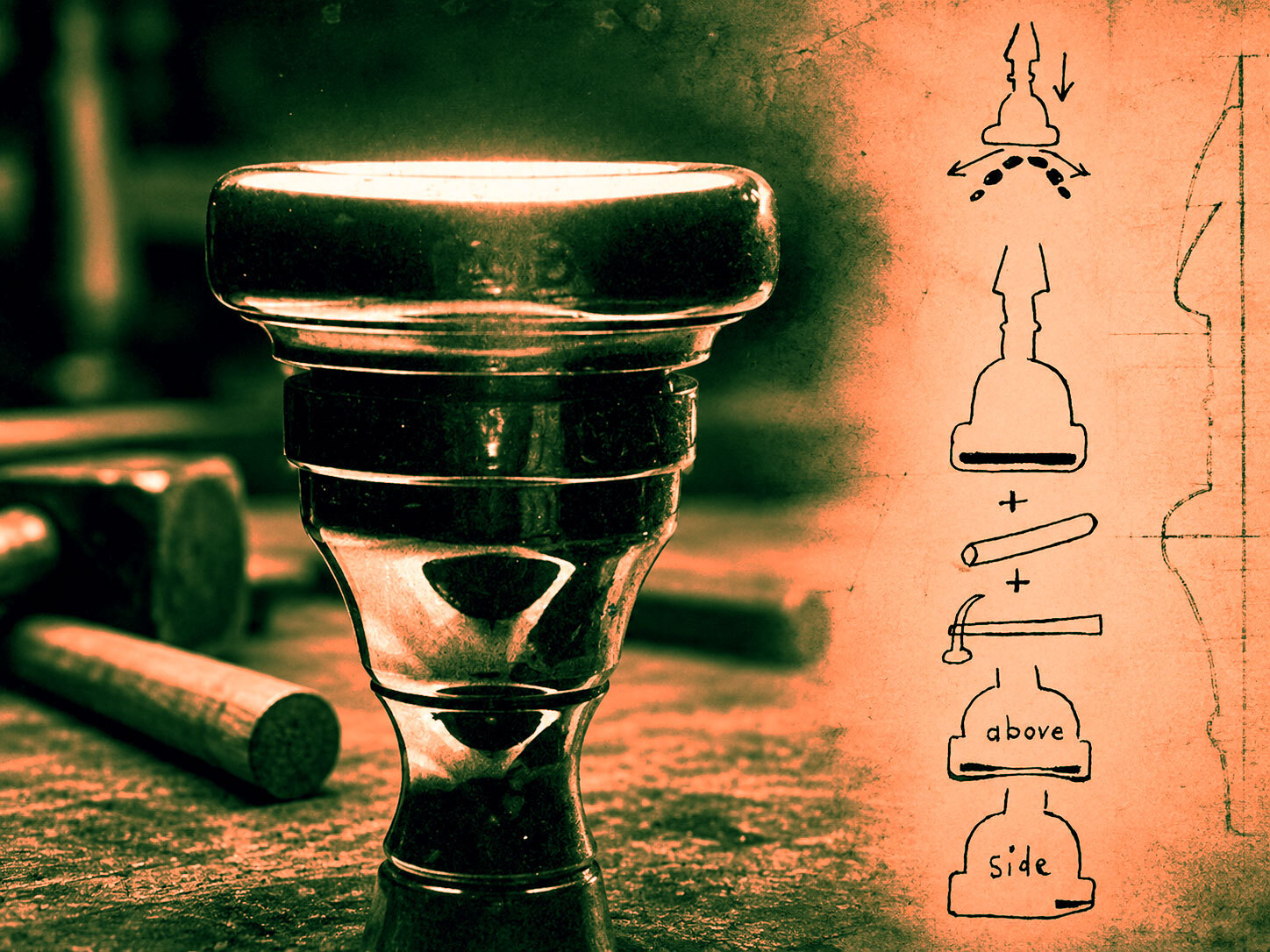
What I now do is this. I make an incision with a jigsaw in the outer wall of the mouthpiece rim about 2 mm (no more) below the highest point of the rim surface. I continue until the incision reaches round one third of the rim circumference. Then I take a piece of hard round wood (a pole with a 1’’ diameter) and hold it on top of the mouthpiece rim. One or two blows with a hammer are enough to create a slight depression in the rim surface. It is less than 1 mm but our sensitive upper lip will feel less pain and have more endurance. We now have only to solder what is left of the hole (use lead-free solder) — but chewing-gum or glue also work. Now you can use a medium rim with a good bite to its full advantage, with more endurance and better high notes. It takes some experimentation — and a few mouthpieces! — before you get the best result.

Brass Bulletin 48, IV / 1984 pages 99–100

All content is protected by copyright © Brass Bulletin 1984–2026

Share this article

Facebook LinkedIn
Loading…

Questions & Answers

How the Digital Edition works

What does the Digital Edition include?

The Digital Edition brings together the articles already digitized as searchable online texts—not simply as scans or PDF files—along with their original illustrations, notes, authorship, issue information, and available translations. Related-article suggestions currently include only this digitized material.

Are the digital articles identical to the originals?

We preserve the original text, language, illustrations, captions, footnotes, and editorial context as faithfully as possible. The presentation is adapted for comfortable online reading, and obvious transcription or scanning errors may be corrected. The substance and character of the published article remain unchanged.

Which languages are available?

Brass Bulletin was published in English, French, and German throughout its history. Italian and Spanish translations were added from issue No. 60 onward.

On the Italian and Spanish sites, articles from issues 1–59 are therefore shown in English by default.

How often are new articles added?

New articles are added almost daily, with approximately one complete issue digitized each week. The pace may vary depending on the preparation, image work, and editorial checking required.

Why aren’t all articles available digitally?

The complete Brass Bulletin collection contains 1,246 articles published between 1971 and 2003. The full index is already available online, allowing readers to discover every article in the collection, including those whose complete text has not yet been digitized.

Digitization began in February 2026. Each article is carefully prepared for online reading, checked, and connected to its issue, authors, subjects, and illustrations. At the current pace of digitization, the complete collection is expected to be available online by February 2028.

Why do some references mention articles that are not available yet?

References in the original articles are preserved even when the material they point to has not yet been digitized. This keeps the historical and editorial record intact. As more issues are added to the Digital Edition, an increasing number of these references will lead to articles that can be read online.

Can I suggest an article or report a transcription error?

Yes. If there is an article you would particularly like to see digitized, or if you notice a possible transcription error or missing detail, please contact us. Reader feedback helps us improve the Digital Edition and prioritize useful connections within the archive.

How can I support Brass Bulletin?

Your support helps fund the preparation, verification, and online publication of the complete collection.

Subscribe to the Digital Edition

Prefer to support us without subscribing?

Make a donation

Search Brass Bulletin.