Brass Bulletin is now also available in Italian and Spanish.
Brass Bulletin 45, I / 1984 page 62–65 · 3 min. read

A major chamber music work for brass?

Quintet, by Peter Maxwell Davies

A major chamber music work for brass?

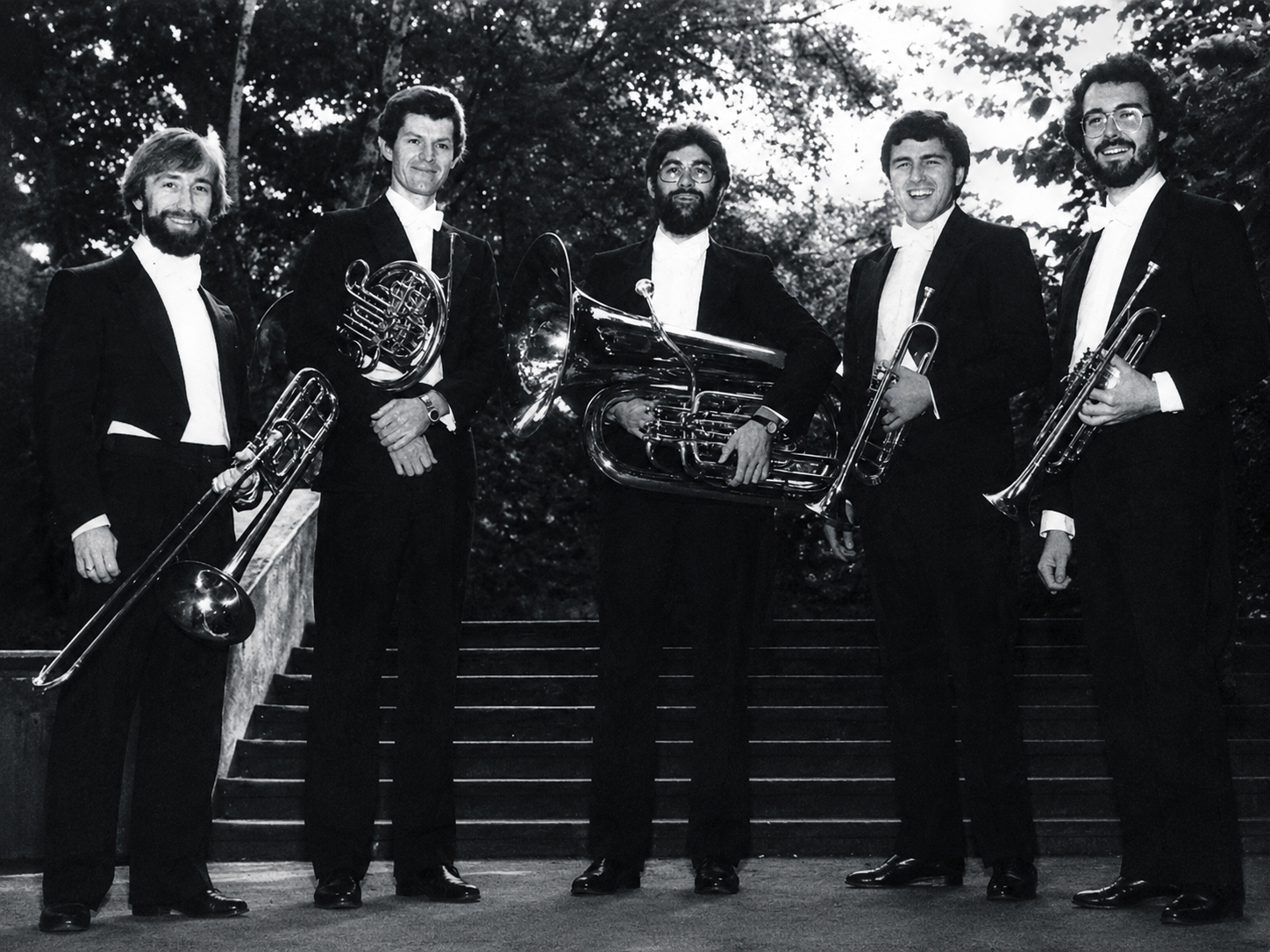
Albany Brass Ensemble: David Whitson, James Handy, James Gourlay, Paul Archibald, Graham Ashton

A damp day in January. Five youthful musicians, isolated and vulnerable-looking in a largish BBC studio, prepare to record a piece described after its first performances in America last year as “a major work of chamber music”. The composer is Peter Maxwell Davies, and his Quintet, he says, demands “over half-an-hour’s extreme concentration on the part of players and listeners alike”.

The Albany Brass discuss balance with the engineer, Martin Page. “We usually have a horn mike, here.” (The horn is naturally quieter than the others and, perversely, points the wrong way.) Martin prefers to use one mike only. “They paid a lot of money for those mikes, they don’t want them damaged”, cracks Jim Gourlay from the depths of his tuba. James Handy looks worried. He has a heavy and responsible day ahead, for the horn, as Andrew Porter in The New Yorker, is the principal singer in the piece from whose line the harmony grows up and down.

Paul Archibald, first trumpet and an evangelist for brass music, is thrilled to be playing this work. It’s not just the prestige of the composer, it’s the musical and technical challenges — complexities of rhythm, extremes of range and agility — the piece poses. “Composers usually write stuff they think will fit brass. I say, ‘Let him write his music and we’ll learn to play it.’ When I rang Max’s agent and told her we wanted to do the first British performance, she doubted we’d manage it.”

Defiantly, they have worked, sometimes with the composer, for months. “It’s impossible to count your way through this music — you just have to know it and feel it.”

Their concert performance in December attracted attention and praise from many leading critics. “Some said this was one of Max’s best pieces yet. For them to think that about a brass work is terrific.”

They are rehearsing the opening, a angular horn melody which will run through each of the three movements, when Peter Maxwell Davies, impish in leather jacket and cap, arrives, and the quiet voice of producer Stephen Plaistow asks from the control room if they’re ready for a take. Tuning is checked, Paul plays a quiet arpeggio. The red light goes on.

The play-back is both intensely serious — players marking their parts, producer and composer noting mishaps — and hilarious. “That was close!” says Jim Gourlay, defending one of his high-flying passages. A trumpet squawk provokes laughter and pointing fingers.

Balance is not right. The trumpets are holding themselves in but horn and trombone are too quiet. Seating is adjusted and Martin allows a horn mike.

In the second take, the slow introduction has a hushed intensity which was missing before. Paul wonders whether they’re together. Max tells him not to worry. But he wants the horn whoops (like much else in this piece — the linear tension, the trills, snarls and whirling arabesques — these remind me of the second symphony) to be the loudest thing in their section.

Another retake. The allegro, a restlessly contrapuntal scherzo, thins down to dancing solos on tuba and trombone, low, growling A♭ and a high, fading D♭. Jim Gourlay plays «Polly, put the kettle on» and everyone adjourns to the canteen.

The second movement, in double variation form, begins with the same horn melody as the first, growing into a long, murderously exposed solo, decorated with wide-intervalled double appoggiaturas. “A real smash”, Paul calls it in sympathy.

It needs several takes. “Is it just a bit tentative?” asks Max. “Can you push it harder?”

“It’s the chops”, says James Handy, flexing them illustratively.

Gradually they cross the tightrope. There are few signs of nervous tension. James goes for one stamping walk around the studio, but Stephen Plaistow is smilingly unruffled, Max full of ebullient goodwill.

The music is richly expressive in its virtuosity. There are also fine, simple effects: the quiet dotted trumpet pulse of the first variation, which will end the movement dramatically; an irregular rhythmic figure played in harmony by groups of three; a staccato walk for first trumpet over slowly moving lower parts. Max particularly enjoys the very simple bars which begin the coda. “You don’t think you dare write it, but you do and it works.”

He was initially reluctant when the Empire Quintet (members of the Boston Symphony Orchestra, which premiered his second symphony) asked him for a piece. “I didn’t know them as players and I frankly didn’t realise what virtuosity was possible on brass instruments other than the trumpet.” He had in fact been positively prejudiced against the tuba. “But when I heard them I changed my mind.”

Is virtuosity essential?

“Not exactly. But writing for a new medium extends me, and I want to extend the medium and the players as well.”

After lunch the lads rip straight into the last movement, a dancing allegro vivace with a slow, chorale-like section further exploring the opening shapes of the work before a brilliant conclusion.

Everyone is fairly happy, but the players cry “Let’s do it again!” with the eagerness of a Gershwin ingénue. After another take and a patch in the slow movement, they seem to be planning further improvements.

“I don’t think they realise the session’s over”, murmurs Stephen Plaistow. “They’d go on all night if we let them.”

“They haven’t moaned about their lips once”, says Max incredulously. He thanks everyone and leaves.

Over a final coffee, Stephen Plaistow sums up. “I’ve listened to one piece of music all day and I haven’t been bored once.”

All content is protected by copyright © Brass Bulletin 1984–2026

Share this article

Facebook LinkedIn
Loading…

Search the Brass Bulletin archive.