6 min. read
Nerves, Pills and Doping
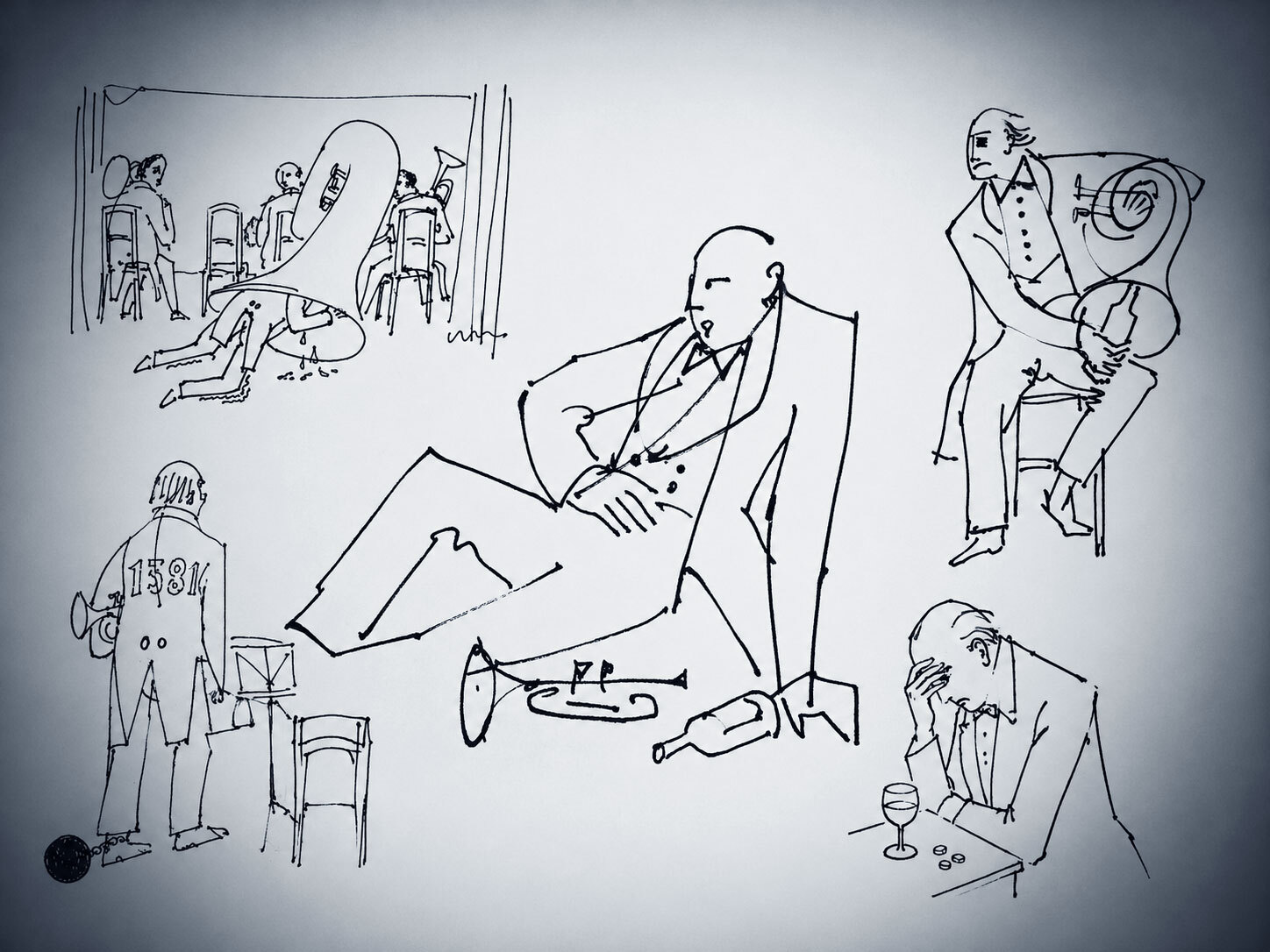
Editor's Note
Dr. Christian Baechler of Geneva here takes up a subject already discussed by Thomas Stevens and Dr. Wilfred Buck — whose articles have already provoked lively and sometimes contradictory responses from our readers — and in so doing addresses a problem which we think extremely important and topical. This is why we have decided to bring it to your attention with a special cover.
Whereas — as we read recently in these pages — Hans Pizka prides himself on not knowing what nervousness is, the great majority of ''normal'' musicians know its negative effects only too well. Some people fight these with yoga exercises, others with alcohol, others by prayer — others at the cost of their physical and mental health.
Dr. Baechler speaks as a professional, and with a sympathetic clear-sightedness. Here, to begin with, he sets out the vital elements which define this burning issue. He has furthermore undertaken, as far as his competence allows, to answer your questions, observations and criticisms. He is willing to take up particular points which you may raise.
We are therefore opening a special section, Nerves, Pills and Doping, with the aim of enabling each musician to make his own way in the face of the awful fear which public musical performance can cause.
Don't hesitate to react! Send us your views (we will request anonymity where requested). [jpm]
Nerves, Pills and Doping
I was very interested to read the articles by Mr. Stevens and by my colleague Dr. Wilfred Buck (BRASS BULLETIN no. 37, p. 8 and no. 39, p. 23) and would like to make my own personal contribution to the subject, as both doctor and amateur trumpeter.
It seems to me that nervousness, the ''miracle pill'' and doping are three fundamental ideas which should be separated and defined as clearly as possible. We must at all costs avoid comparing and confusing realities which have nothing to do with one another. The unfortunate conclusion which might result from this could be catastrophic, or at least stupid, as Mr. Stevens warns in the last paragraph of his excellent article.
1. Nerves
On the subject of stage-fright Mr. Stevens and Dr. Buck have spoken, with good reason, of nervousness or stage-fright, the dry mouth, the body's response to sudden tension, the rise in heartbeat, the moist hands, the unintentional vibrato and even of the defensive reaction, even of flight. For my own part I could add my own personal symptoms (tight throat, cold sweat, sleeplessness or high blood pressure) but I have no desire to dwell on something which is as tedious as it is depressing. Suffice it to say that my nerves and I see too much of each other.
As we have seen, the tell-tale signs of nervousness are many, and every instrumentalist can describe them easily. What we must recognise is that all these symptoms have the same origin: fear, but that they must be separated into two quite distinct groups:
A) those symptoms called ''psychological'' and
B) those symptoms called ''somatic''.
A) By ''psychological'' symptoms is understood the group of manifestations characterised by states of anxiety or mental tension, such as fear, insomnia, states of depression, drop in intellectual effectiveness or modifications of behaviour in an exposed situation, musical or otherwise.
B) By ''somatic'' symptoms is understood the group of manifestations produced at the organic level or, more simply, those symptoms of an essentially physical nature such as for example a rise in the rate of heartbeat, the wildly pounding heart, various kinds of sweating, dryness of the mouth, acute diarrhoea, breathing difficulties and changes in blood pressure of sometimes alarming proportions.
We may then divide the victims of nervousness into three categories:
a) those who suffer psychological symptoms almost exclusively (cf. A above);
b) those who suffer somatic symptoms almost exclusively (cf. B above);
c) those, the great majority, who combine psychological and somatic symptoms in various proportions.
Who gets nerves?
Brass Bulletin 40, IV / 1982 pages 4–9
All content is protected by copyright © Brass Bulletin 1982–2026