Explore institutional access Explore institutional access
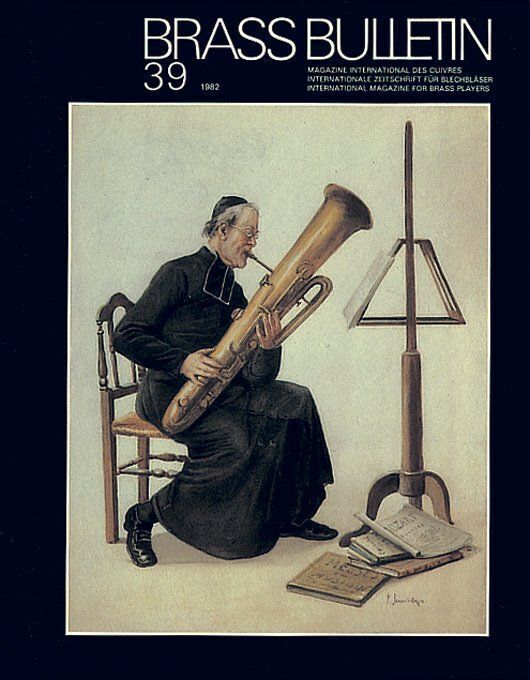
Brass Bulletin 39 - 3 / 1982
Issue
Brass Bulletin No. 39
Date
III / 1982
Pages
84
Contents
9 articles

Original inserts

World News Journal

Out of print

All issues

Brass Bulletin No. 39

III / 1982

Contents

9 articles

Editorial

Jean-Pierre Mathez

pp. 4–5 Instrument Makers Equipment

Behind a musician’s instrument lies a quiet industrial battle, as European, American and Japanese makers compete to shape the future of brass playing.

Early Brass Instruments and Restoration

Ursula Menzel

pp. 6–12 History Equipment

Restoring historic brass instruments means deciding what to preserve, what to undo and how modern methods can serve objects shaped by another musical age.

James Stamp, subtle teaching

Alfred Willener

pp. 14–21 Trumpet Teaching Technique

Intonation, held notes and mouthpiece work shape James Stamp's subtle approach to trumpet playing, where listening and physical economy guide technique.

A Miracle Pill for Stage Fright?

Wilfried Buck

pp. 23–25 Health

What happens when performance anxiety is treated like a medical condition rather than a musical one, and where does that boundary ultimately lead?

The French Hunting horn, its history, its technique and its music

Daniel Bourgue

pp. 26–38 Horn History Technique

Centuries-old hunting signals still shape performance today, where technique, ritual and oral tradition preserved a musical language unlike any other brass practice.

The Streitwieser Foundation Historic Trumpet Museum

Sue Scott

pp. 39–43 Trumpet History Equipment

A private collection built through one musician's lifelong search became an unexpected center for brass history, where every instrument carries a story beyond its display.

The hunting horn

Jacques Poncet

pp. 45–47 Horn History Repertoire

Long-held beliefs about the French hunting horn are challenged as forgotten playing practices and Baroque traditions reshape its early history and repertoire.

Thoughts on the Bass Trombone

Jean Gotthold

pp. 49–51 Trombone Technique Equipment

Long before modern standards took hold, bass trombones existed in many forms, raising questions that still shape orchestral writing and performance today.

Jean-Baptiste Prin (1669-1742)

A tromba marine virtuoso

Albert Hiller

pp. 53–58 Trumpet History Repertoire

A forgotten string instrument leads to an unexpected treasury of Baroque trumpet music, challenging long-held assumptions about repertoire and performance.

Loading…

Questions & Answers

How the Digital Edition works

What does the Digital Edition include?

The Digital Edition brings together the articles already digitized as searchable online texts—not simply as scans or PDF files—along with their original illustrations, notes, authorship, issue information, and available translations. Related-article suggestions currently include only this digitized material.

Are the digital articles identical to the originals?

We preserve the original text, language, illustrations, captions, footnotes, and editorial context as faithfully as possible. The presentation is adapted for comfortable online reading, and obvious transcription or scanning errors may be corrected. The substance and character of the published article remain unchanged.

Which languages are available?

Brass Bulletin was published in English, French, and German throughout its history. Italian and Spanish translations were added from issue No. 60 onward.

On the Italian and Spanish sites, articles from issues 1–59 are therefore shown in English by default.

How often are new articles added?

New articles are added almost daily, with approximately one complete issue digitized each week. The pace may vary depending on the preparation, image work, and editorial checking required.

Why aren’t all articles available digitally?

The complete Brass Bulletin collection contains 1,246 articles published between 1971 and 2003. The full index is already available online, allowing readers to discover every article in the collection, including those whose complete text has not yet been digitized.

Digitization began in February 2026. Each article is carefully prepared for online reading, checked, and connected to its issue, authors, subjects, and illustrations. At the current pace of digitization, the complete collection is expected to be available online by February 2028.

Why do some references mention articles that are not available yet?

References in the original articles are preserved even when the material they point to has not yet been digitized. This keeps the historical and editorial record intact. As more issues are added to the Digital Edition, an increasing number of these references will lead to articles that can be read online.

Can I suggest an article or report a transcription error?

Yes. If there is an article you would particularly like to see digitized, or if you notice a possible transcription error or missing detail, please contact us. Reader feedback helps us improve the Digital Edition and prioritize useful connections within the archive.

How can I support Brass Bulletin?

Your support helps fund the preparation, verification, and online publication of the complete collection.

Subscribe to the Digital Edition

Prefer to support us without subscribing?

Make a donation

Search Brass Bulletin.