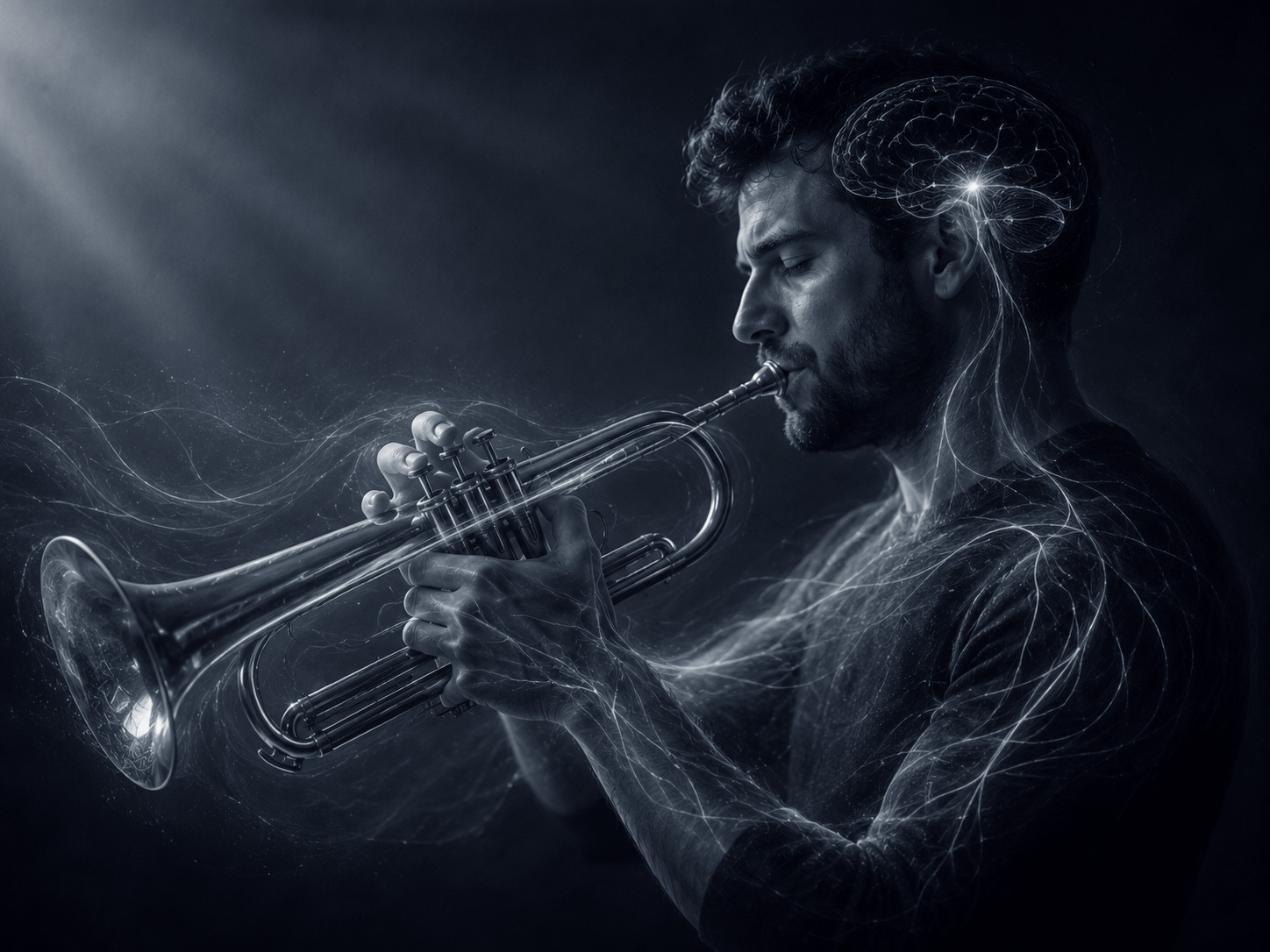
I do not mean to minimise the role of our instrument; it is important, that is undeniable; but I think that the other instrument, the one that does everything, is even more important. That is why I think it is essential to get to know the first (our body) thoroughly before the second. And I have noticed very often that people do not know themselves, have no awareness of their body and therefore no awareness of the superfluous tensions which have already been in their body for a long time.
How these superfluous tensions are created
When we produce a muscular contraction in order to produce a physical effort, the contracted muscle or group of muscles relaxes quite naturally after the end of the effort. One could say that, the stronger the muscular contraction, the more complete will be the ensuing natural decontraction. If, on the other hand, the contraction is weak, the ensuing relaxation will be of poor quality.
When we play our instrument, we use certain essential muscles with a tone which is generally sufficient to make them decontract by themselves after the effort. But frequently, together with them and often through a memorised reaction, other muscles contract quite without our wishing them to and quite unnecessarily and this contraction will not be sufficient to bring about their proper decontraction. These slight contractions thus continue after the work is over and they accumulate so progressively that we become accustomed to permanent tension, slight at first, then stronger and stronger, while remaining quite unaware of it.
When these contractions affect several muscles, they represent a constant expenditure of energy, a considerable expenditure which we could save in order to put it to better use.
Hence the importance of balancing the muscle and nerve tone and of directing and localising activity exclusively in the muscles concerned. And this localisation can only be done by learning to "feel" one's body, to feel it from inside, to recognise first of all the difference between relaxed and contracted muscle, then to control one's muscles, tensions and contractions by oneself, and to master this by simple awareness, to know, control, direct and dominate oneself.
We know that for us wind players virtuosity depends on good synchronisation between breath, lips, tongue and fingers. Harmony of gesture and movement depends on the state of muscles and nerves. Our virtuosity can only be improved by our being aware of these "gestures and movements" (breath, lips, tongue, fingers) and by being in a position to control and dominate them in order to bring about the required synchronisation.
Being present in every part of the body is the secret of technique, agility and instrumental virtuosity.
In "unravelling" some of the finger problems (fingers tense, too soft, too heavy, badly synchronised, etc.), the cause must often be looked for at the level of contractions.
There is no doubt that for most instrumentalists fluency of fingering is indispensable. To a large extent virtuosity depends on it. Superfluous contractions in the shoulder muscles are often solely responsible for blocks in the fingers — and how many instrumentalists have become accustomed to keeping their shoulders tensed without even noticing it? The reverse is also true: if the fingers are tense, the hand is tense and this tension passes to the arm and generally ends in the trapezius muscle of the shoulder. Since contraction is symmetrical — i.e. if the left arm is tense, there will inevitably be tension in the right arm (you can observe this in writing, for example, when the non-writing hand will be tense, or in carrying a bucket of water in your right hand, when the left hand and arm will be contracted) — there will be tension in both shoulders, not only in the shoulder corresponding to the tensed fingers. It may not be felt in the other shoulder but it will still be present.
If we now try to relax the shoulders by means of exercises and dynamic or static relaxation, we are using symptomatic therapy without getting to the root of the problem. Before relaxing a tension, therefore, we must try to feel what is causing it in order to get rid of it completely.
Above all do not let us forget that, when one part of the body is contracted, a constriction of the blood vessels takes place, which means that the blood no longer circulates normally; the result is poor oxygenation of the muscle tissues and poor elimination of waste matter.
Mental relaxation
It is well known that all mental tensions and contractions have certain repercussions on the body: cares, worries, fears, anxieties, stresses, conflicts and inhibitions have an effect on the body and prevent deep relaxation just as body tensions have an effect on the psyche which can produce a sort of unconscious psychological block precisely in the area of expression, creativity and the externalisation of the artist's sensitivity.
Furthermore all the unnecessary contractions will produce a flood of unnecessary thoughts, and vice versa. If, for example, you are involved in a conversation which irritates you excessively, try to have a few seconds' quiet break and take note of the tense state of your body. If you are used to relaxation and you are able to relax, you will certainly see that your shoulders drop and that a salutary and very pleasant relaxation (how beneficial) then takes place. And you will certainly be surprised to find that this physical relaxation has made your mental excitation (irritation) disappear or abate considerably.
To sum up:
— mental tension (irritation) generates physical tension;
— physical relaxation brings a state of mental relaxation (a return to calm).
I am certainly convinced — and that is why I have devoted a chapter to relaxation with numerous related exercises in the second half of my *book — that we wind players really have to know our body, to be able to control and direct its actions, to know how to harmonise and synchronise all the parts of our body which make our instrument work, in order to be able to express and manifest ourselves.
This is certainly done through the intermediary of our instrument but above all thanks to a free, relaxed body and mind, thanks to a human machine which is completely under our control, thanks to a perfect balance between body and mind.