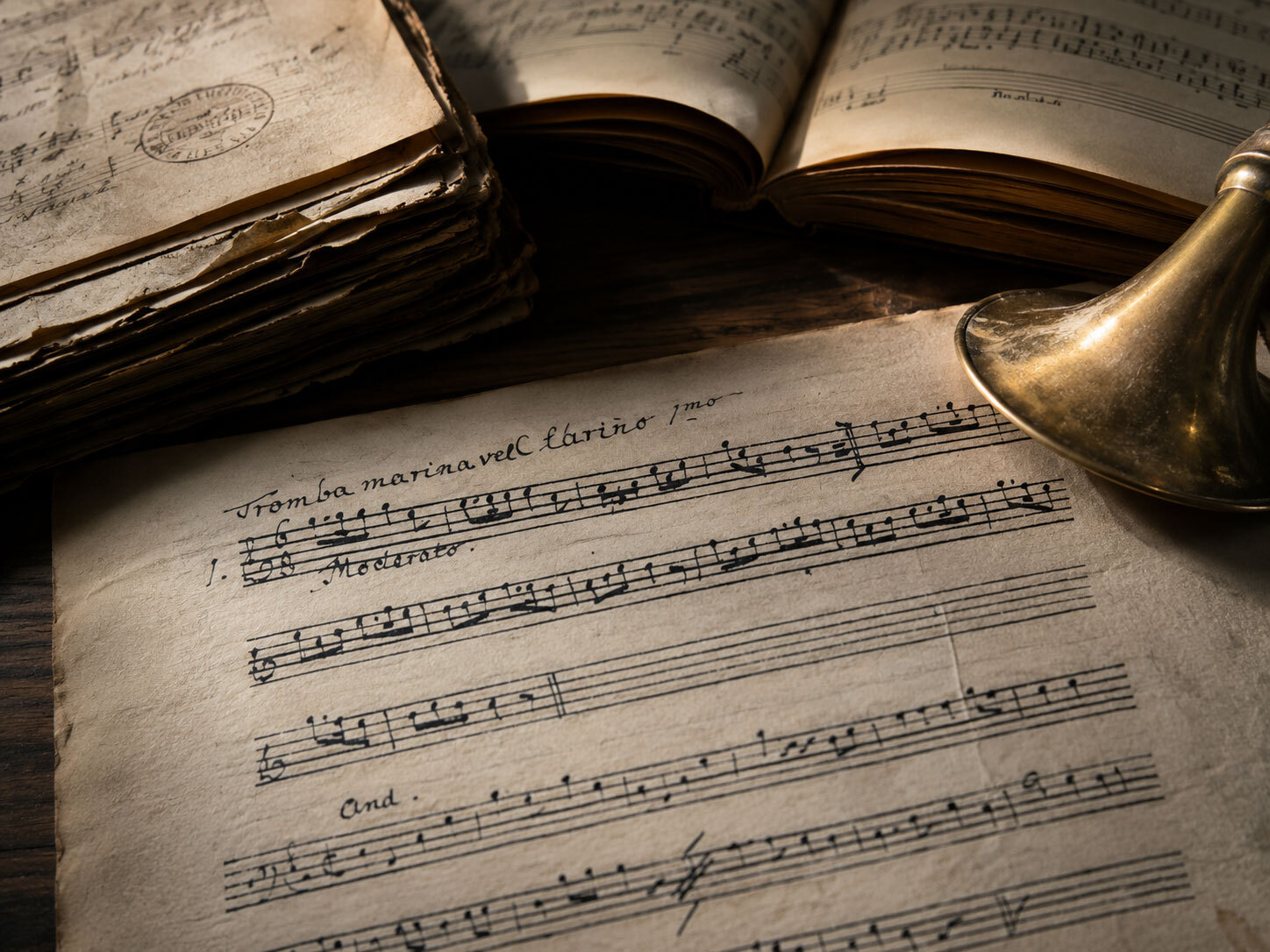
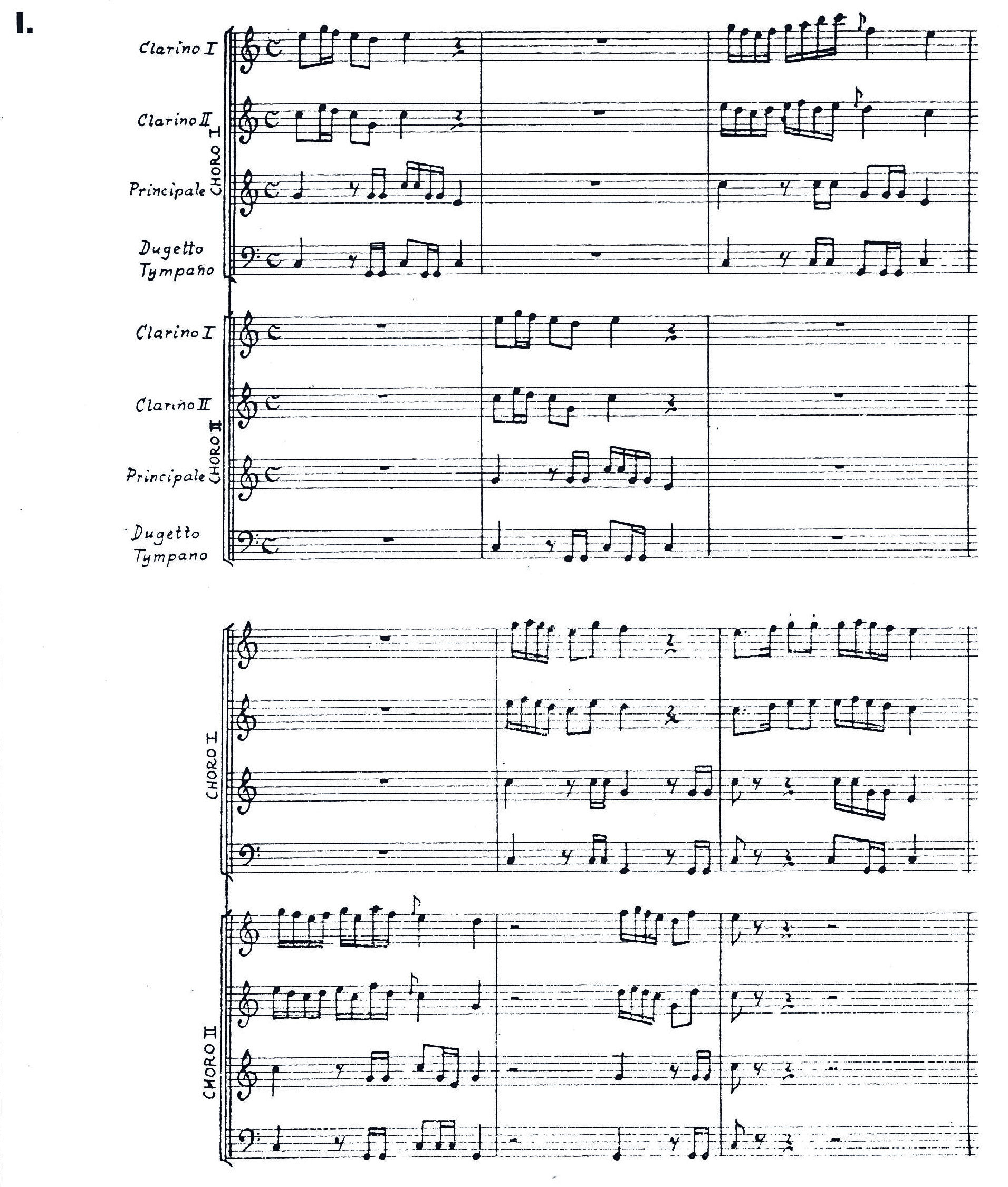
I. Anonymous (Weyarn, c. 1780)
Reference: WEY 675/Nr. 3
Published by R. Münster in the Mozart-Jahrbuch 1960/61, pages 210 ff., under the name of the composer Ott. Procession for two four-part trumpet choirs with timpani.
II) Ferdinand Donninger (1716-1781)
Five Processions for 4 Ciarini and Timpani (D major)
Donninger joined the service of the royal house of Thum and Taxis in 1755. His processions from the days of the Perpetual Imperial Diet in Regensburg form a part of his divertissement A Representation of a Musical Sea-Battle.
This charming work (a forerunner of Beethoven's Wellington's Victory and Tchaikovsky's Solemn Overture 1812!) portrays the preparation for battle with marches and processions. The "sea-battle" forms the conclusion and climax; drums and trumpets, spatially separated, imitate cannon and musket fire.
The five processions—stored in the Royal Court Library in Regensburg—were discovered when the royal house needed music for the 1800th anniversary of the city of Regensburg.
Particularly interesting is the 1st procession, entitled Morgenseegen (Example II).
The 5th procession makes great demands on the 1st tp. (sounding e''').
These pieces are published by E. H. Tarr.
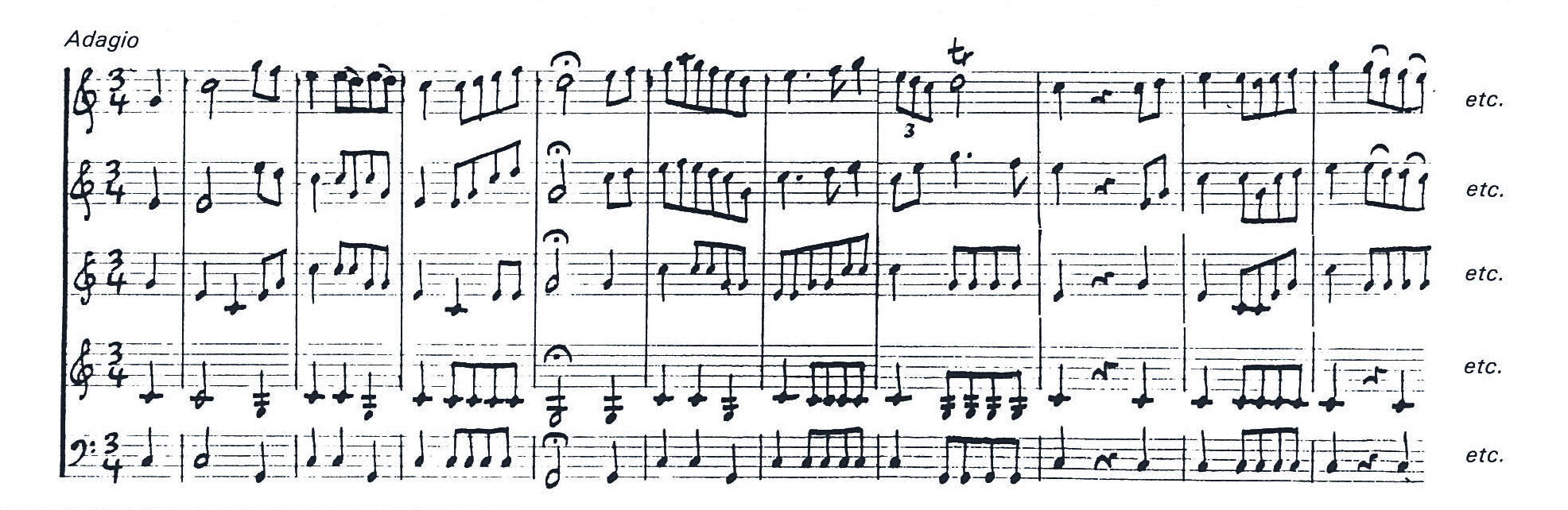
II. Ferdinand Donninger (1716-1781)
No. 1 of the five processions from Musical Representation of a Sea-Battle for 4 Clarini and timpani (Extract from the score provided by E. H. Tarr).
III) Processions from the Bavarian State Library in Munich
1. Anonymous, Six Processions for four Trompani
The term "Trompano" for trumpet is unusual; in fact this is the usual combination of 2 Clarini, principale and timpani, since Trompano IV merely doubles the two timpani notes. It is also noticeable that five of these short pieces in two sections end with a coda.
Three of these fine pieces have been recorded by E. H. Tarr (EMI SMC 91421 The Art of the Trumpeter); he is also going to publish the scores.
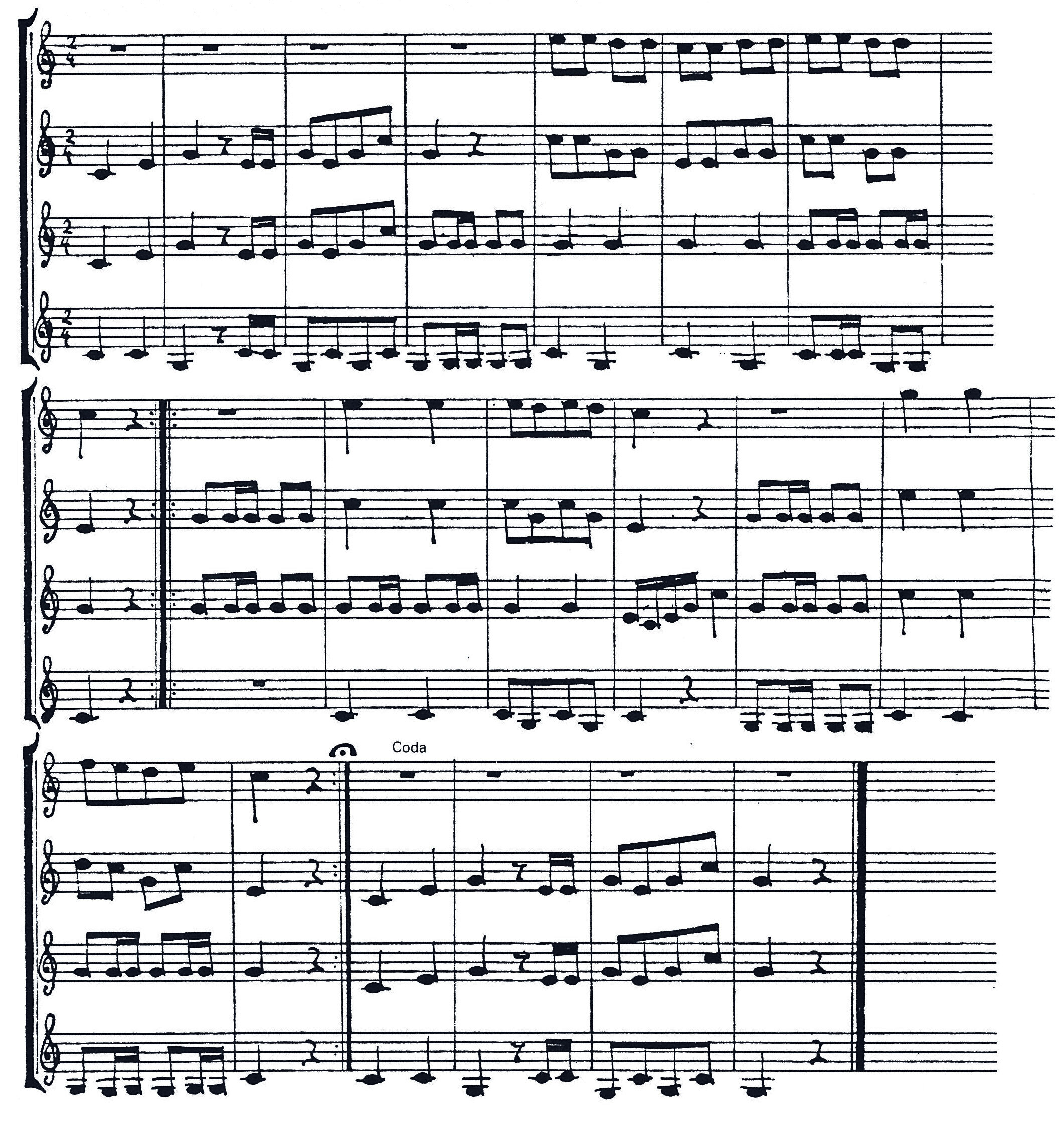
III.1 Anonymous (18th century)
No. 3 of the six processions for four "Trompani" from the Bavarian State Library.
2. Anonymous, Six Processions for 3 or 4 Clarini (Mus. Mss. App. 2023)
These simple pieces, probably from the church in Schnaitsee, have only e'' as their highest note and are therefore also suitable for military bands.
3. M. Mösl, Six Processions for 3 or 4 Trumpets, Timpani, Organ Solo, Trombone ad libitum (end of the 18th century)
These pieces were printed in Augsburg with no date. Unfortunately only the obbligato organ part has been preserved. By consulting the processions of Max Keller, of whom I shall have more to say later, I have been able to provide an approximate reconstruction of the trumpet and timpani parts. Each procession contains piano sections where the organ plays without the trumpets.
4. Johann Dessary, Two Processions for Ciarino I/II (in C), Principale (in C), Tromba (in G), Tromba (in D) and Timpani (C and G)
The trumpets in various pitches indicate a desire for greater freedom of modulation, a desire which is even more marked in an anonymous work from the Weyarn foundation: "March and Introduction to a Kyrie in D" for Ciarino I in D, tromba I in A alto, tromba II in A basso, chromatic trumpet I in A alto, tromba I in G, tromba II in D, horn in D (ciarino II, chromatic trumpet II, organ and timpani are missing).
The missing parts have been reconstructed and published by our cathedral organist Eberhard Kraus. (This work was composed at the beginning of the 19th century).
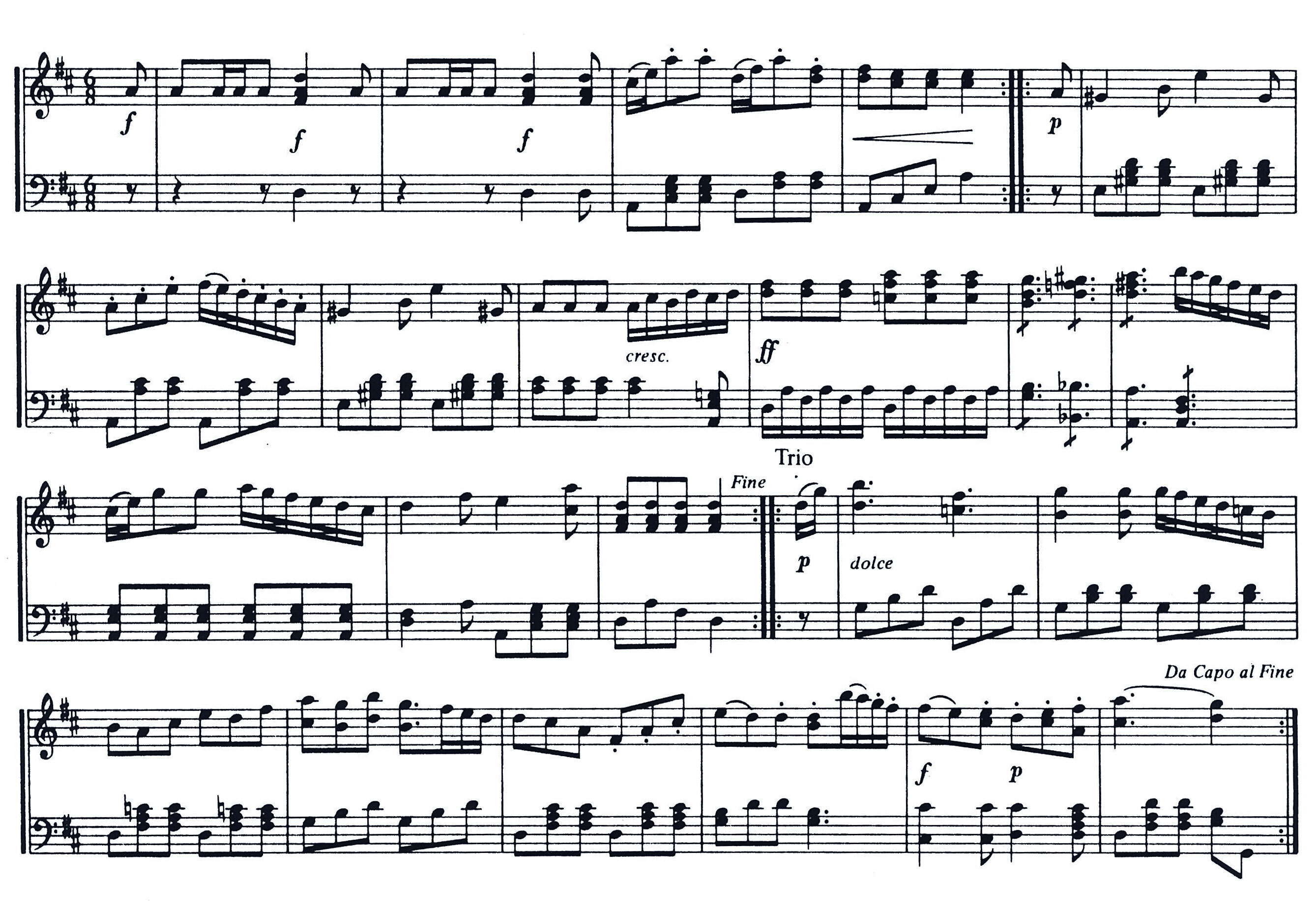
III.3 M. Mösl (c. 1800), Aufzug
From: 6 Processions for 3 or 4 Trumpets, Timpani and Organ Solo, Trombone ad libitum, Augsburg (BStBM, Music Collection) (organ part).
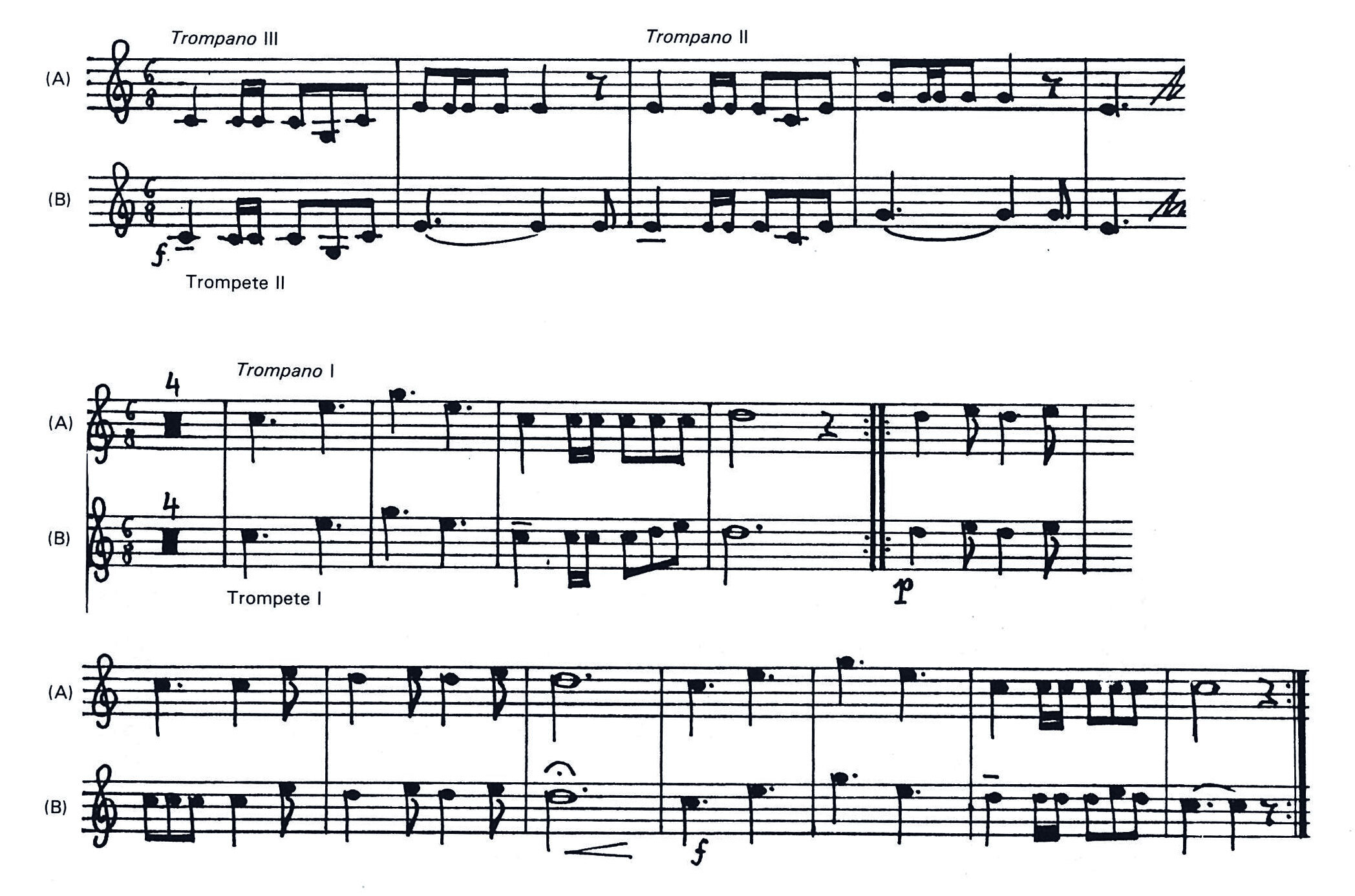
III.1 and IV. Compare: "Trompano" procession no. 4 (A) and Dingolfing procession no. 1 (B).
IV) The 96 Processions of the Tower Trumpeters of Dingolfing in Lower Bavaria
These pieces, also in two sections, for 3 natural trumpets and timpani, come from around 1800. The tower trumpeter Kasimir Gegenfurtner (died 1866) copied the processions down in 1874 in order to preserve them for posterity. The originals came to Berlin at the beginning of this century for research purposes. Unfortunately I have not yet been able to find the complete collection¹¹.
Six of these processions have already been published, however:
— nos. 1 to 5 in Ludwig Plass: Es blasen die Trompeten (Potsdam 1935, pp. 19–23);
— No. 43 in H. J. Moser: Tönende Volksaltertümer (Berlin 1935, pp. 25–26).
The great similarity between the first procession and the fourth "Trompano" procession from Munich is striking and cannot be coincidental (Examples III and IV).
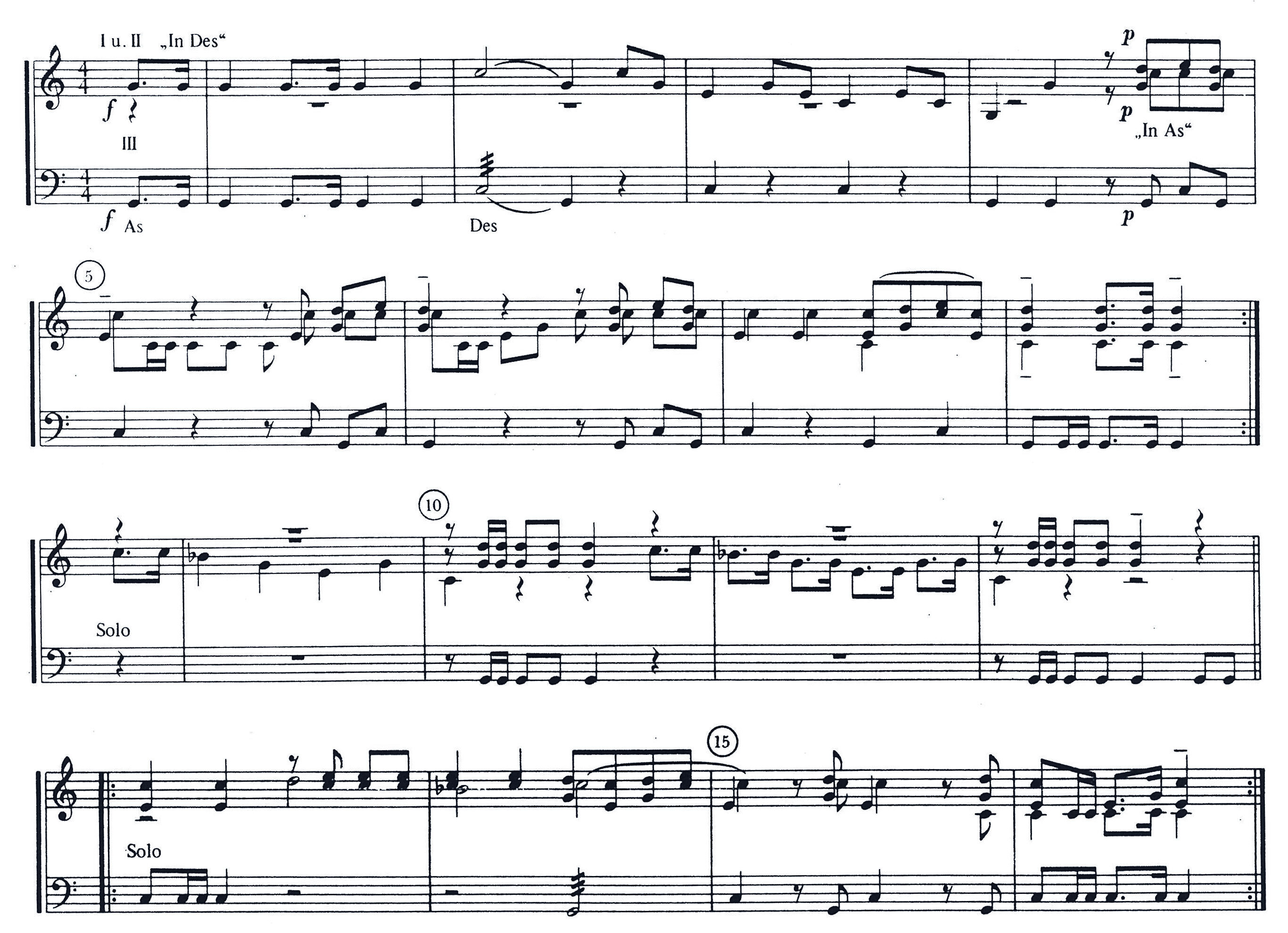
IV. Four-part procession of the Tower Trumpeters
From: Tönende Volksaltertümer, published by Hans Joachim Moser, Berlin-Schöneberg 1935, pp. 25–26.
From Dingolfing/Ndb., c. 1800, transcribed by Stadttürmermeister Kasimir Gegenfurtner in 1847.
V) Max Keller (1770-1855): Six Short Simple Processions for 2 Clarini, Principale, Timpani and Organ ad libitum
The remarkable thing about these pieces from Altötting is their late date of composition: 1834! They are thus a companion piece for the three processions (fanfares) by the Austrian knight Sigismund von Neukomm (1778-1858), which were composed in 1833. The highest note required in both compositions is only g''.
In spite of their late date Keller's processions are pure 18th century. The first procession contains in its first two bars the melody of a Bavarian folksong (Example V).
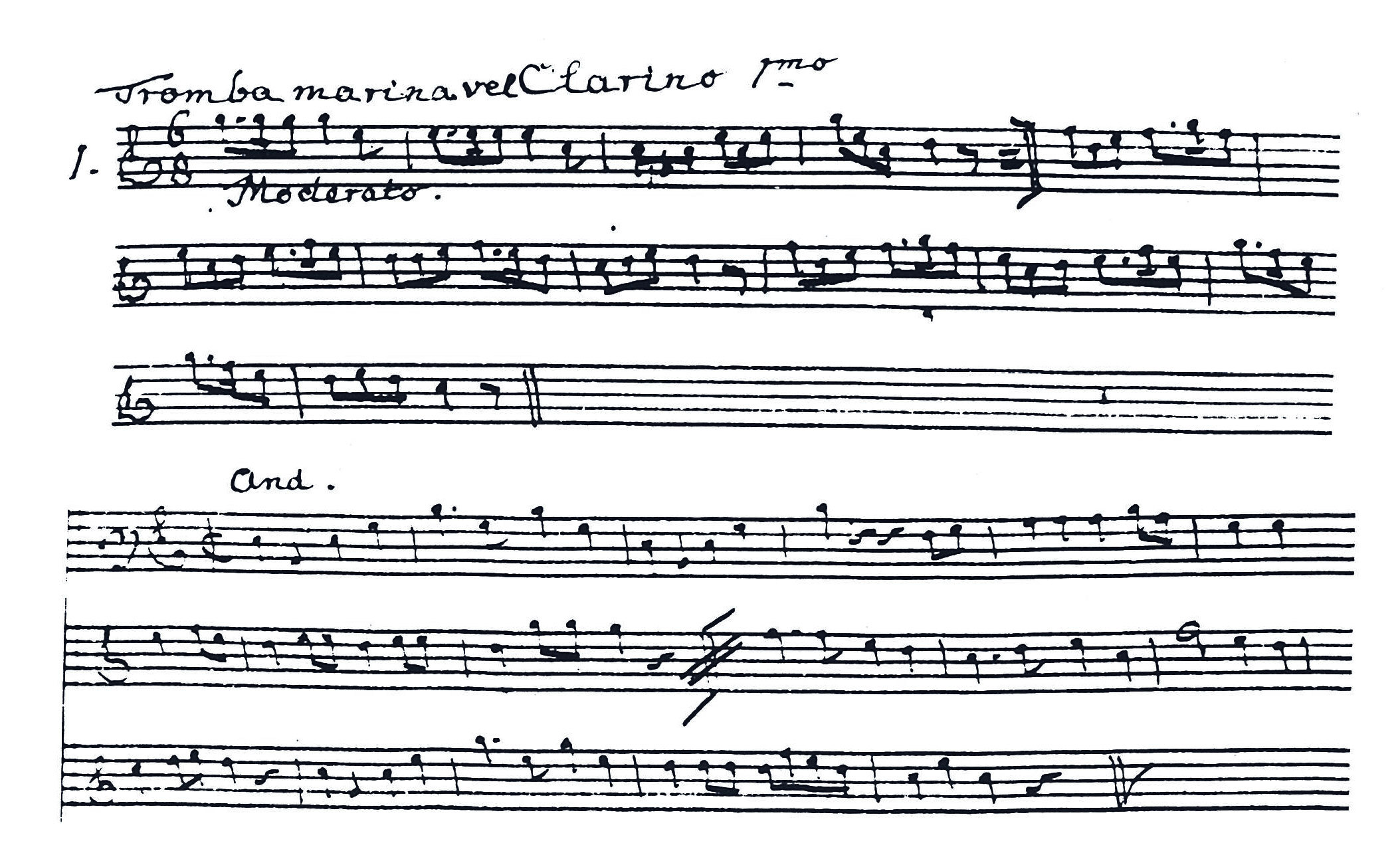
V. Max Keller (1770-1855)
No. 1 and no. 3 of the six processions for 2 Clarini, principale and organ ad libitum, Clarino 1.
Another interesting point is that, according to the title-page and the heading on the parts, instead of the trumpet (clarino) a tromba marina (known in German as Nonnengeige—"nuns' fiddle") can be used; this instrument consists of a resonating body made of wood on which a single strong string is stretched. When a fiddle bow is drawn across this, the resulting note resembles a trumpet.
Max Keller's processions will be published and recorded by E. H. Tarr. Neukomm's processions have been published by D. Townsend through Mercury Music.
As the 19th century progressed, so military bands took over the function of the old corps of trumpets. The reasons for this are to be found in the general decline of the art of clarino playing, but mainly in the changing tastes of the times. Occasionally, however, we still find compositions which recall the great days of processional music, as for example:
— Anonymous, "Traditional Processions from the Munich Oktoberfest". One of these is to be found in Ludwig Plass's volume mentioned above;
— Konrad Max Kunz (1812-1875), "Processions for 4 Natural Trumpets and Timpani" op. 15 for the 700th anniversary of the city of Munich.
Because of the space available I have had to restrict myself to the essentials. I would be delighted if my essay were able to contribute in some way to a revival of the Bavarian trumpet music I have presented.