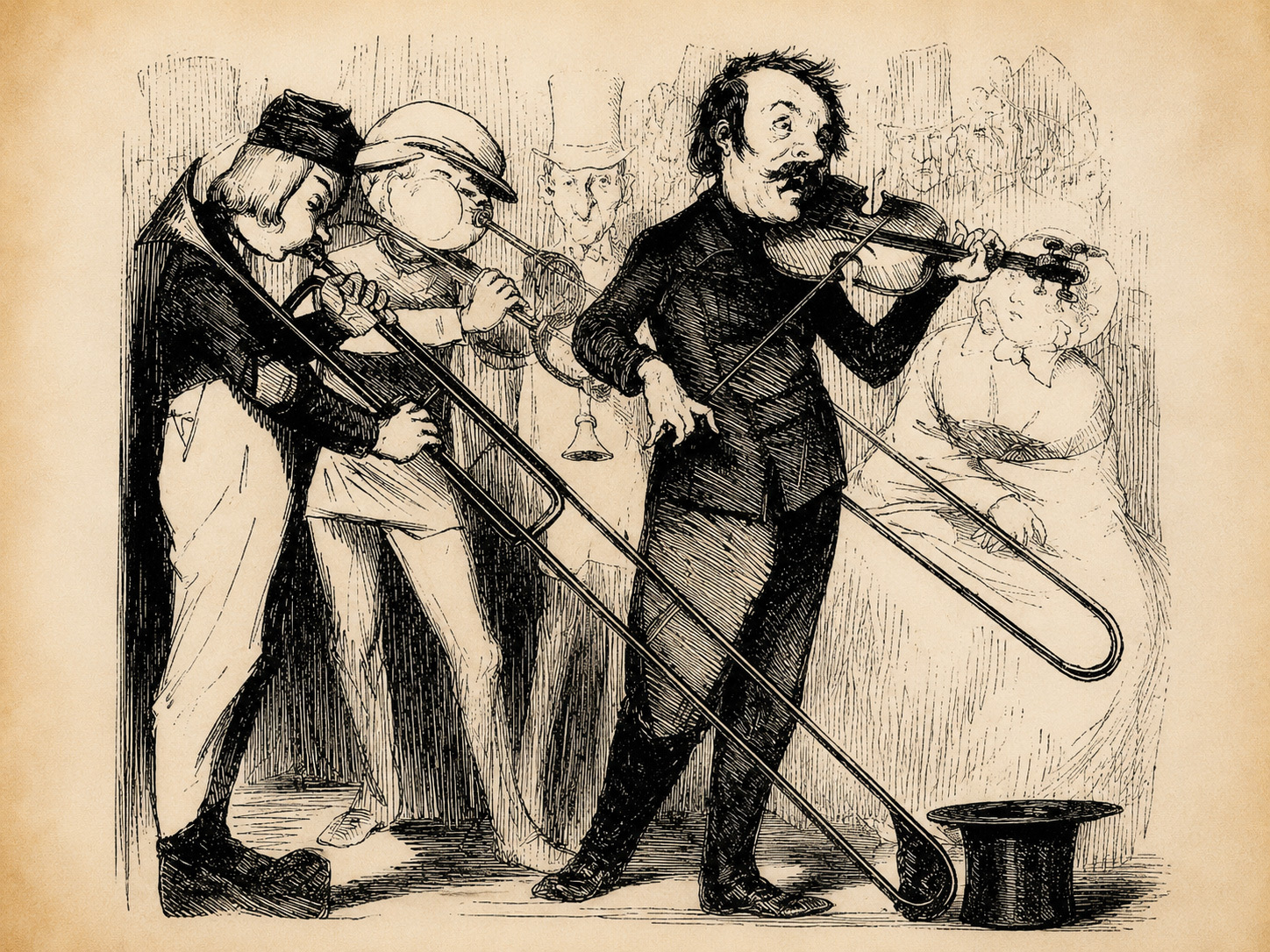
Indeed it seems to me that, in spite of the humdrum use made of it, this tremendous instrument should be compared to a hare one has marched with for three hundred years without ever noticing its beauty. I have therefore come today to tell you of some of my further reflections, and to submit them to the examination of your wisdom, nay your genius; I have come, furthermore, to present to your enlightened spirit the question which preoccupies me.
I prefer this method to public announcements, at the risk of remaining liable for my costs and of seeing my compositions remain unsold for ever. I think it right, furthermore, to tell you in advance that I decline to take part in any eventual analysis, direct or otherwise, in the spheres of mathematics, physics or even chemistry on this subject.
The basic trombone, with slide and without valves, such as is made by Monsieur Darche, 7 rue des Fossés-Montmartre, and as used in army Regiments, seems to me the most powerful and most perfect of all known musical instruments. It is, beyond any doubt, always in tune with itself; compared with the violin, or any other string instrument of the same kind, it has this advantage over them. With it only one note (the B♭) is fixed a priori when the slide is closed and it is a matter of the greatest simplicity to vary it by as much as a semitone to tune with the orchestra.
With the violin, the viola, the quinton, the violoncello and the double bass several notes must be prepared whereas the Trombone artist, for whom practically nothing is fixed in advance, is fortunate in knowing that for him everything lies in the execution and that he is thus better placed to communicate his soul and all his feelings to his audience!
If one discounts the consequences of this different arrangement, one is bound to admit that the Trombone, like the violin and even more than the violin, is always in tune if one knows how to play it; whereas the other vehicles of musical thought: those which by having holes, valves, keys, hammers, bellows, etc. offer the apparent advantage of ready made notes (especially pianos), are always and everywhere utterly and completely out of tune and incomplete since none of them takes account of the difference which exists, for example, between an A and a B♭.
May I be so bold as to bring to your attention, in this connection, my sixth piece³, in which I have striven to convey an understanding and, what is more, a feeling for a well placed comma? I wish to take this opportunity of craving my judges' indulgence for this most recent production, given my complete ignorance of the most basic rules of musical composition and the inadequacy of my views on the preparation, use and resolution of the most simple discord.
Neither would I compare the Trombone to the orchestral Horn, whose muffled sounds have so little volume, projection and range; I would not compare it to the hunting horn, which has so few resources and so few notes at its disposal. As far as that is concerned I would say only that those of the landed gentry and their sons who spend their leisure learning this last-named instrument would do better in my opinion to devote a few hours of study each day to the Trombone. They would thus become able to play all sorts of tunes instead of making do with Good King Dagobert and a few inconsequential Fanfares at hunt meetings.
This would, no doubt, be the place to say something about that language of music and of land and sea signals which I mentioned at the end of the Note quoted above; but I am only too aware of how feeble is my knowledge of acoustics, telegraphy and music and, let me repeat, I leave to my scientific masters the task of establishing and coordinating the ideas for development which these thoughts may contain.
If because of its antiquity the Trumpet were to be contrasted with the Trombone in view of its devastating action at Jericho and of the part it is daily given in sculpture, painting and poetry, then I would cry with the poet: Down with the Trumpet and long live the Trombone!
The latter contains by itself seven trumpets within it, one in each position! Just think of the number seven; think of Newton; think of the Apocalypse! According to all the painters of the past the Trumpet of the Angel of Destruction is unique; the Trumpet of Renown, if we are to believe Mr. Arouet, has two mouthpieces; but the Trumpet of the Last Judgement, of the Age, of the Revolution of 1830, will be worth seven, and that Trumpet will be a Trombone!
On the Trombone one can play all the melodies, airs and popular songs one will, provided they be of a simple and musical conception and provided (of course) that they are within the range of the instrument. One can play it on foot, on horseback, in a carriage, on a boat, in a train; I have played it swimming on the surface in fifteen feet of water.
The Trombone offers a range of about three octaves with an uninterrupted chromatic succession and, I must emphasise this point, the ability to distinguish commas. It outdoes every other instrument by the nature, quality and volume of its sound.
I might add in this connection that, four or five months ago, while visiting an island in the Loire at Nantes, I was able, quite alone, to make some sailors dance on the deck of their ship, anchored at a distance of perhaps a league away. All I had to do was play for them with a favourable wind, that well known bourrée from the Auvergne: The Cuckoos Are Fat! Name me another instrument capable of producing such results!
Although the Trombone is called upon, by virtue of the broad, majestic, ringing character of its sound — noisy if you will — to produce grand effects in the open air, I might add that it also seems to me to possess, should the Player wish it, another type of sonority enabling it to give its song a gentler, mellower, sadder colour, full of expression and feeling.
In each of its positions it gives a perfect major Chord, with some other notes within or outside this chord. It is thus eminently suited to purely harmonic effects by the correlation and fusion of the most important of these various chords.
Several notes are played quite naturally in two or three different ways; this is of considerable help in performance. No other Instrument whatever seems to me better suited to giving a pure and exact rendering of Enharmonic passages.
I would add that, given the present state of our perception and knowledge, a piece of music especially composed by a master and performed in a church by eight, ten, twenty, thirty or fifty Trombones would seem to me instinctively to be the finest piece of music one could possibly conceive.
Here, Gentlemen, I shall curb the flow of my reflections. I shall not do so, however, without drawing your attention to the Trombone Methods of Messieurs Dieppo and Vobaron, the former having, through the regularity of his exercises, so admirably demonstrated the Seven Trumpets concealed within the trombone tubing, and the latter having been long aware, through the harmonic purity and great variety of his Studies, of the importance of his Instrument and of the dignity of the part which it was called upon to play in the future of music.
I would also mention the useful works by Messieurs Cornette and Rauda which have, I hope, now been sufficiently rewarded by the approval of an all too limited public.
I trust I may also be allowed to state publicly my indebtedness to my teacher, Monsieur Record, Trombone at the Royal Italian Opera of Paris.
Please be assured, Gentlemen, of the respectful silence and submission with which I shall await the decisions of your supreme judgement, and that I have the honour to remain
Your humble and obedient servant,
Auguste Léonard,
Pupil of the Royal Imperial Polytechnical College (1812-1814), entered 38th in the list of merit at the end of the second year and listed for duty in the Artillery (retired), now Apothecary at Paris, 5 rue Sainte-Anne.
We trombonists may be surprised to find the merits of our instrument so well detailed over a hundred years ago.
Monsieur Léonard de la Tuilerie published A Preparatory Method for the Trombone — a work to teach the performance of this instrument, hitherto well known but little appreciated, including a large number of Airs by various composers for the use of artists and amateur musicians.
We feel he was in too much of a hurry and wanted immediate success. A few months later he drew up a Notice to the Public which reveals his despair.
Notice to the Public
On the subject of my Country-Dance Quadrilles for Trombone Alone.
Since 22nd January 1846, when I made my first publication, I have heard of no one responding to the appeal I then made to pay greater attention to the Trombone, a hitherto much neglected instrument in my view.
Let me establish a few facts:
By today, 16th February 1847, I have scarcely sold 40 sous' worth of the Musical Works I have had engraved, at great expense, I may say. What is more: when I speak of the trombone, I am considered ridiculous and people practically laugh in my face. Only a few artists seem to frown and say nothing.
I have a certain habit of pondering on the human race⁴ and of considering times to come; I imagine that the following may happen:
Either my ideas will be adopted or they will not.
If they are not, I will remain silent and my pains, my time, my money, my work, my activities, all will be wasted.
If they are, I will be maligned.
I have spoken.
Paris, 16th February 1847.
A. Léonard de la Tuilerie
Pharmacist, Trombone
in the 10th Legion
Rue Sainte-Anne no. 5, first floor
Unfortunately we have not been able to find out how this little story ended but there are certainly still people around today who feel the same. They want to further the cause of their (brass) instrument. Has the situation changed?