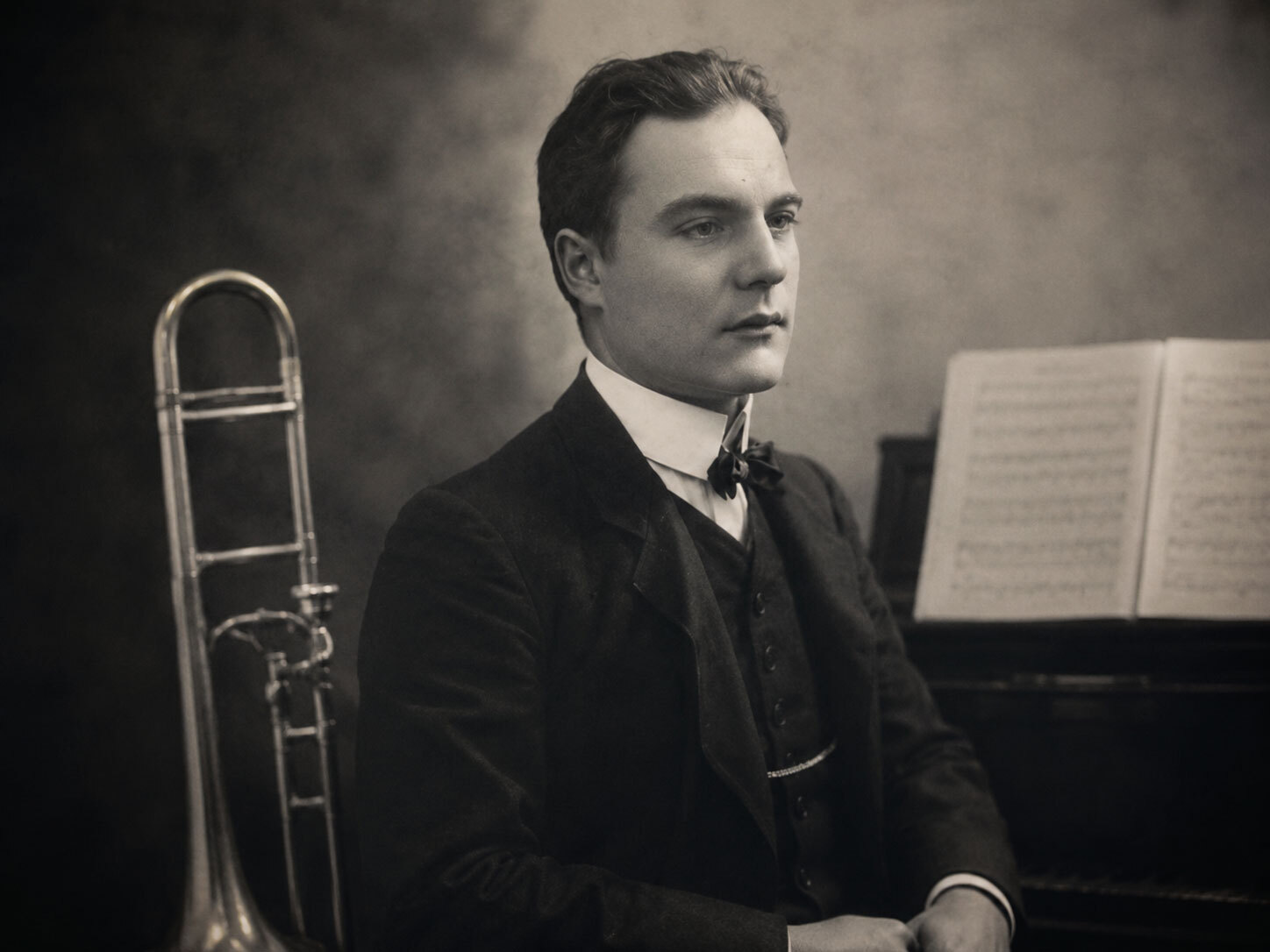
After the revolution of 1917, together with the trumpeter Tabakov, the clarinettists Rozanov and Volodin and the horn players Foloduyev and Usov, he took an important part in the activities of the theatre. He was also closely involved with the remarkable orchestra which went by the name of Persimfans. Persimfans is an acronym for Pervyy simfonicheskiy Ansambl', the "First Symphony Orchestra" of the Moscow Soviet, a symphony orchestra which performed without a conductor. Set up at the instigation of the Conservatoire professor Tseytlin, and consisting of solo players from the Bolshoi as well as staff and students from the Conservatoire, it functioned in Moscow from 1922 until 1932.
In spite of these successes as a performer, Blazhevich began to feel more and more drawn to teaching and became Professor of Trombone as well as of the Military Bandmasters' Course at the Moscow Conservatoire and also conductor and artistic director of the State Wind Band formed in 1937.
The thirties were the most productive time in his teaching career. His activities ranged from the most practical—teaching and demonstrating trombone, where one of his main technical interests was in the position of the mouthpiece on the lips—through the provision of material for both teaching (methods for trumpet and wind instruments as well as for trombone) and performance (13 trombone concertos and numerous arrangements) to organisational work—starting the bandmasters' course at the Conservatoire and setting up wind bands of all kinds; one for students at the Conservatoire, others for amateurs in factories and finally the State Wind Orchestra.
Vladislav Mikhaylovich's legacy to the trombone world is thus very varied: not only his compositions, many of which are now firmly established in the standard repertoire, but also the fine trombonists he trained (Shcherbinin, Grigor'yev and others) and the impetus he gave to the wind band movement in the Soviet Union.