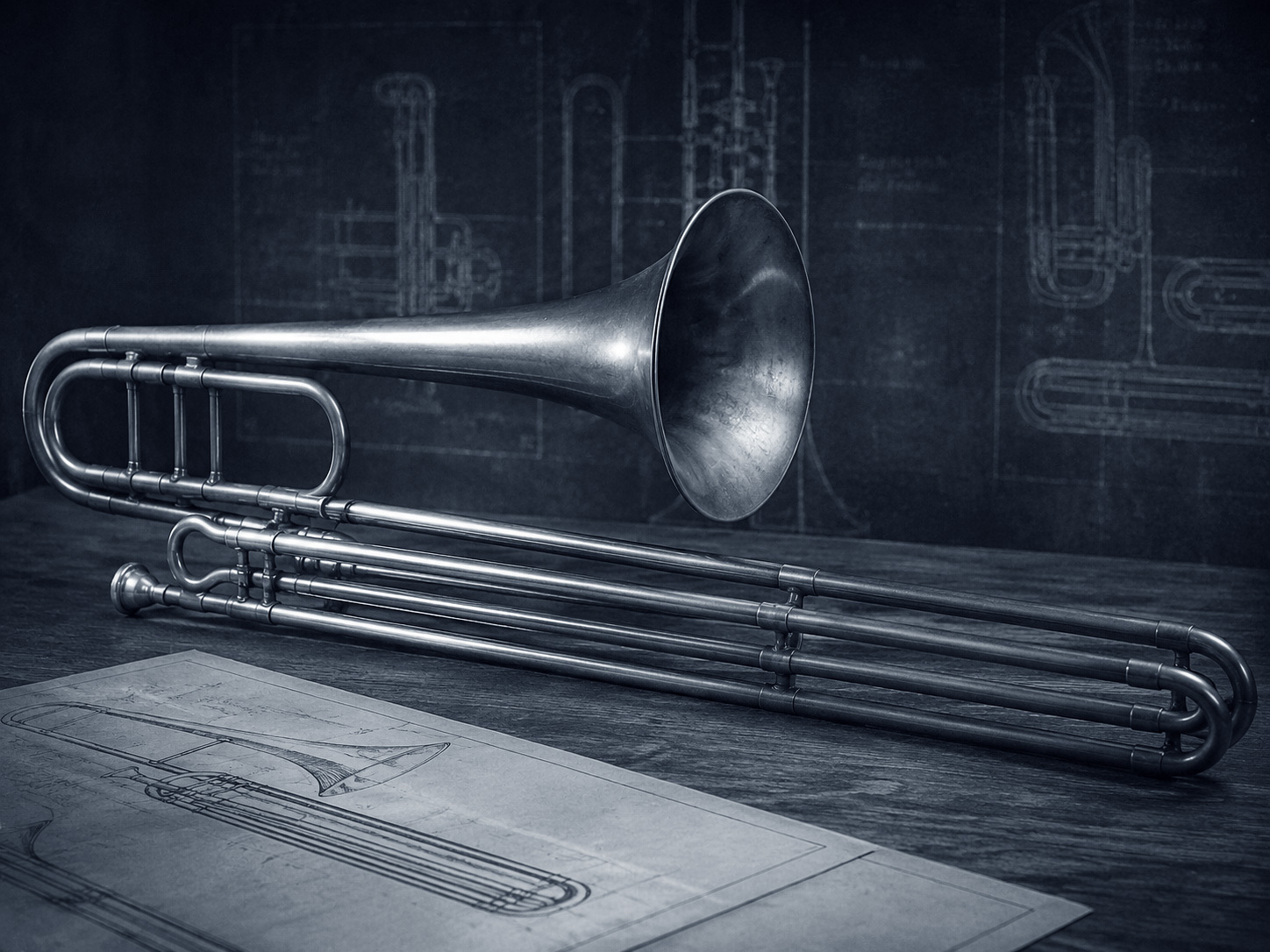
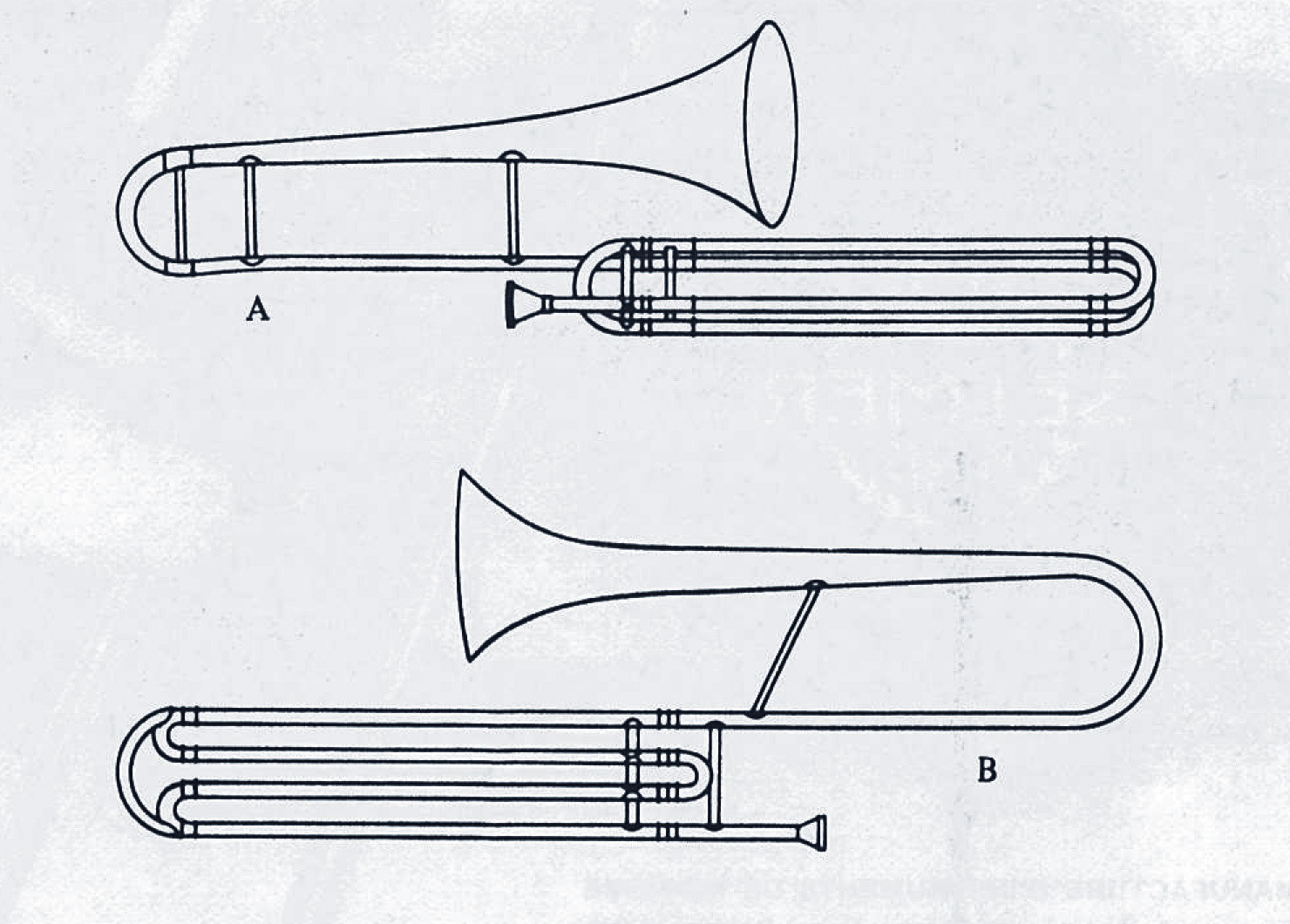
A. Double-slide Bass trombone, Halary system
B. Double-slide Bass trombone, Fontaine-Besson system
Jazz, a product of the 20th century, which has captured the hearts of millions upon millions of people, combines folk improvisation with all the devices of “learned music” and has made demands of the utmost complexity on musicians. Musicians, striving to keep up with the constantly rising professional standard, have had constantly to increase their working range on all instruments, extend their virtuosity to previously unheard-of limits and master new rhythms, changes of metre and melodic lines never played before, and extreme registers.
One does not have to go far to find examples. Look at the classical teaching methods for brass and woodwind instruments. Thus in the world-famous Complete Grand Method for Cornet and Trumpet the author, Jean-Baptiste Joseph Laurent Arban, describes as “difficult” on the trumpet the register A2 to D3. What would this eminent teacher have to say if he could hear how today’s trumpeters pick up their instruments and play C4 with ease, or start the well-known “Flight of the Bumble-Bee” from Rimsky-Korsakov’s opera The Tale of Tsar Saltan on G3.
This same “Flight of the Bumble-Bee” is already being played by trombonists too (I.M. Polyatskin at the All-Union Competition for Wind-Players in Moscow in 1941, and P.V. Lipkin on graduating from the Urals Conservatoire in Sverdlovsk in 1952 et al.).
Improving playing standards is an important matter. But probably even more important is to provide and prepare what one might call the “material basis” for this. And it is no coincidence that it is precisely in the 20th century that woodwind players are changing over to French systems which reveal unprecedented technical possibilities to the musicians.
Oboists, clarinettists and bassoonists succeed in mastering double-tonguing and increase their speed of execution. Trumpeters have started to play on more advanced instruments. The piston-valves used now — in effect the old mechanism, revived at a new technical standard — have proved to be lighter, more convenient and better for sound production than the old rotary valves. Horn players have acquired double horns with four or five valves. Tuba players with piston-valve tubas have acquired a truly flute-like agility.
As for trombonists, along with perfecting cantabile and expressive cantilena playing (think of the remarkable achievements of the unforgettable Tommy Dorsey), attempts have been made to increase this ancient instrument's technical possibilities and range — in the first instance by adding an Eb valve to the already widely used F valve.
Trombones with F and Eb valves and their problems
The purpose of both F and Eb valves is essentially the same: to make notes in long positions easier to play.
In spite of the originality and excellent sonority of the trombone there is nevertheless one weak or vulnerable feature in its design: the necessity of moving the slide over relatively long distances. Playing within the range of positions 1 to 4 causes no great problems, but moving the slide from the 1st position to the 5th, 6th or 7th (in the case of the last, a distance of more than 60 cm or 2 ft) is not really convenient, takes quite a considerable time and creates serious technical difficulties.
To this may be added the fact that trombonists are making increasing use of alternative positions, which provides a way of avoiding many slide movements especially in the upper half of the register. In the most recent tutors (that of V. Ushak, and others) considerable attention is paid to this.
But still the problem cannot be considered solved.
The fact is that many trombonists, particularly first trombonists, prefer to use trombones without an F or Eb valve. These instruments have a brighter sound, while the introduction of the extra tubing in the valves has a noticeable effect on the beauty of the sound (as does the use of alternative positions). In addition to this there are some shifts (1st to 5th position, for example) which cannot be altered by using the valve. And in the extreme low register, too, long slide movements are unavoidable.
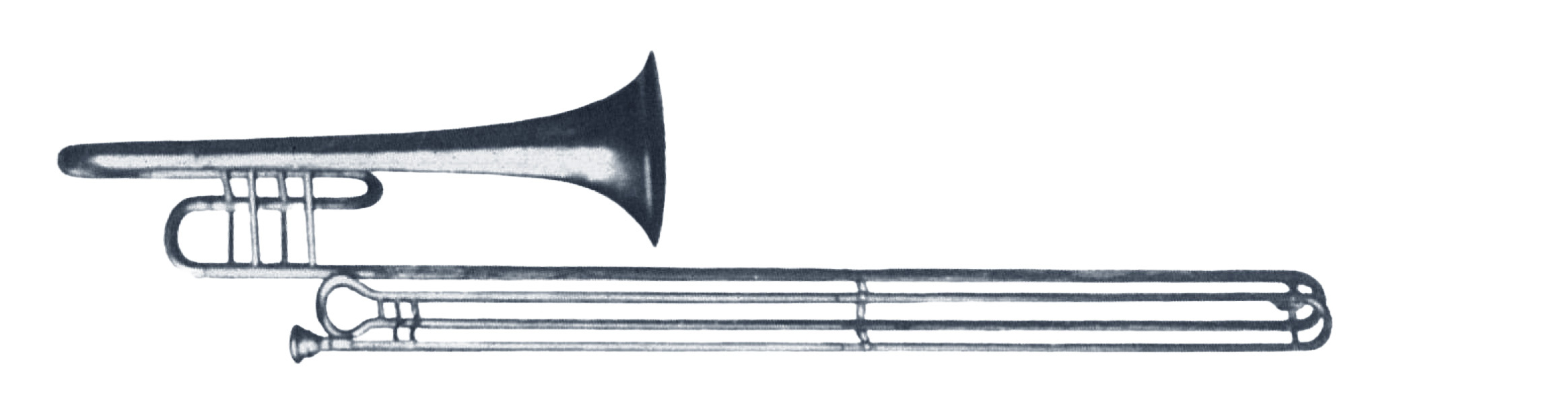
Contrabass in C. This instrument, preserved as a curiosity, was at one time known to London orchestral players as “King Kong”. (Boosey and Co., London, c. 1830.)
The double-slide trombone: a genuine alternative
There is a saying that the old tricks are the best ones.
That is what happened in the case of the piston-valve trumpet. It seems something similar must happen with the trombone.
It is well known that, to lower a note on a brass instrument by a semitone, the length of its tubing must be increased by 1/15 of its overall length. In the case of the tubing of the tenor trombone — for that is now the most common type — equal to 275 cm in length, this increase is 275 : 15 ≈ 18.3 cm.
But, bearing in mind that a trombone slide moves on two tubes at once, the distance between the 1st and 2nd positions is approximately 9.15 cm. The distance between the 2nd and 3rd positions is, accordingly, [(275 + 18.3)] : 15 and again divided by 2 ≈ 9.8 cm. And so the distance increases each time. Between the 6th and 7th positions the slide movement ≈ 13.5 cm. The length of the overall slide movement (1st to 7th position) is approximately 66 cm.
In the designs we would like to recall there was a simple but very effective way of reducing the distance between positions by half, namely, by making the slide move along four tubes at once. This device was used on bass and contrabass trombones, these being the largest and most difficult to use.
In particular the double-slide contrabass trombone made in 1880 by Boosey & Co., London, and the Halary and Fontaine-Besson system bass trombones are well known.
I have taken the photograph of the former from Philip Bate: The Trumpet and Trombone (Ernest Benn, London; W.W. Norton, New York 1978).
Halving the distance between positions makes it possible to move more quickly from one position to another and radically increases the instrument's technical possibilities. To give a graphic example: it would be possible to play notes now lying in the 7th position — i.e. more than half a metre (2 ft) from the start of the slide movement — just as if they lay no further than the present 4th position (approximately 30 cm or 1 ft).
All the advantages would appear to be present. And yet double-slide trombones have not become widespread. Why not?
The main reason would appear to have been manufacturing difficulties. To obtain in such a device sufficiently high quality to guarantee free movement simultaneously on four telescopic tubes, when the work is done by hand, is a difficult matter.
Another, perhaps considerable, disadvantage is the introduction into the instrument's design of two further bends which might to some extent affect the sound quality of the trombone.
These, then, are the only factors I can see which can have had a negative effect on the fate of the instrument. As you can see, they are not many. It is therefore particularly unfortunate that because of them — or more probably because people are accustomed to the old methods, do not want to interest themselves in something new and suffer from a kind of inertia — the manifest advantages of a most forward-looking design have not been realised.
We should note right away that, in the 100 years since the first models of these now forgotten instruments appeared, technology has advanced so far that the manufacture of freely moving pairs of mated tubes and the choice of suitable friction-reducing materials cannot, one might think, pose any particular problems.
Furthermore, the widespread use of F and Eb valves, with quite a lot of bends (and of quite a small radius, too), and of alternative positions, has so accustomed the ear to the corresponding changes in trombone sound that the influence of the bends in the tubing cannot have a great effect on the sound quality in our perception of it.
One has heard a cornet (which has two more bends than a trumpet), if well made, with a large bore and played by an excellent musician, sound no worse, and perhaps even brighter, than a trumpet. In any case the difference was not great, not fundamental.
But then what advantages this undeservedly forgotten type of trombone possessed!
Firstly it makes it possible to do away with the Eb valve altogether, to avoid encumbering the instrument with this extra weight and to free the player from having to use his left thumb. The overall weight distribution of the trombone, in view of the greater compactness of the design and the absence of the need for long slide movements or for pointing the instrument downwards to reach the 7th position, would certainly be more constant, more convenient and not subject to any substantial changes.
But the main point is the shortening of the slide movements. Distances of approximately 4.5 cm in the short positions and 6 to 6.5 cm in the long positions can be covered, as has already been mentioned, twice as quickly as the 9 to 13 cm distances on current instruments.
Consequently, let us repeat, the speed of execution in passage work is doubled. The longest movement, about 30 cm (or 1 ft), can be made considerably more easily, without strain, than the present one of 66 cm (or over 2 ft). A light hand technique assumes great importance here.
Furthermore, the trombonist's lip is relieved of the risk of being jarred when the slide is moved quickly from 7th position to 1st.
But that is still not all. Shortening the distance between positions makes it possible to introduce an 8th, and perhaps even a 9th position (this can be determined by experiment). In addition to extending the instrument's range downwards by a semitone or even a tone, this increased number of positions would make it possible to use radically different positions, and in the most difficult places, too.
Shifts from 1st to 7th position could successfully be replaced by a shift from 8th to 7th position, executed without strain — and in approximately the same place as 6th and 5th position lie now.
All this creates the necessary conditions for abandoning the use on technical grounds of the F valve as well, and for thus simplifying the instrument's design as its technical possibilities increase.
Alternative positions are considerably more varied and convenient on a double-slide trombone. The 8th position, as well as adding yet other lip trills, also increases the possibilities of playing “pure” legato without any glissando (for example)
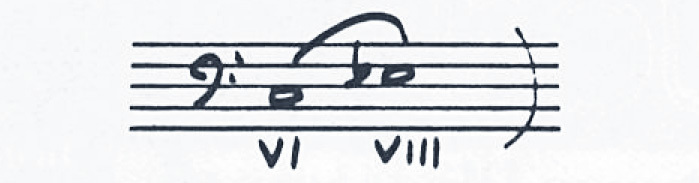
and of playing with “pure” legato such passages as
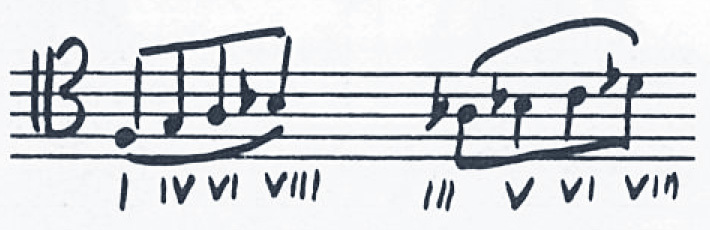
as well as many others.
There are also increased possibilities for glissando, that technique unique and natural to the trombone alone of all the wind instruments. Glissandos of up to a fifth and possibly even more can be played on a double-slide trombone.
The very fact that the instrument has the potential to double its present capabilities should bring this variant to the attention of all those who are interested in the playing of this ancient instrument.
Has the time not come to investigate properly what this undeservedly forgotten design is capable of?
We can well imagine in theory what could be achieved on a double-slide trombone and we realise the peculiarities there would be in playing it and in developing right-hand technique, legato and trills.
It is now up to firms of instrument makers to take an interest in this forgotten variant and to revive it in line with the standards of the latest achievements of instrumental skill, taking the most recent acoustic requirements into consideration.
Players must be given the chance to try out the double-slide trombone properly — not the bass, but the ordinary tenor — to test it once again in all types of playing technique, preferably by equipping several orchestras (playing light music and serious music) with them.
And then life itself will finally decide the fate of the double-slide trombone.