Explore institutional access Explore institutional access

8 min. read

Mikhail Innokentiévitch Tabakov (1877-1958)

Founder of the Soviet trumpet school

A towering figure of trumpet history: Tabakov shaped generations—including the legendary Timofei Dokchitzer—and laid the foundations of the Soviet trumpet school.
Mikhail Innokentiévitch Tabakov (1877-1958)

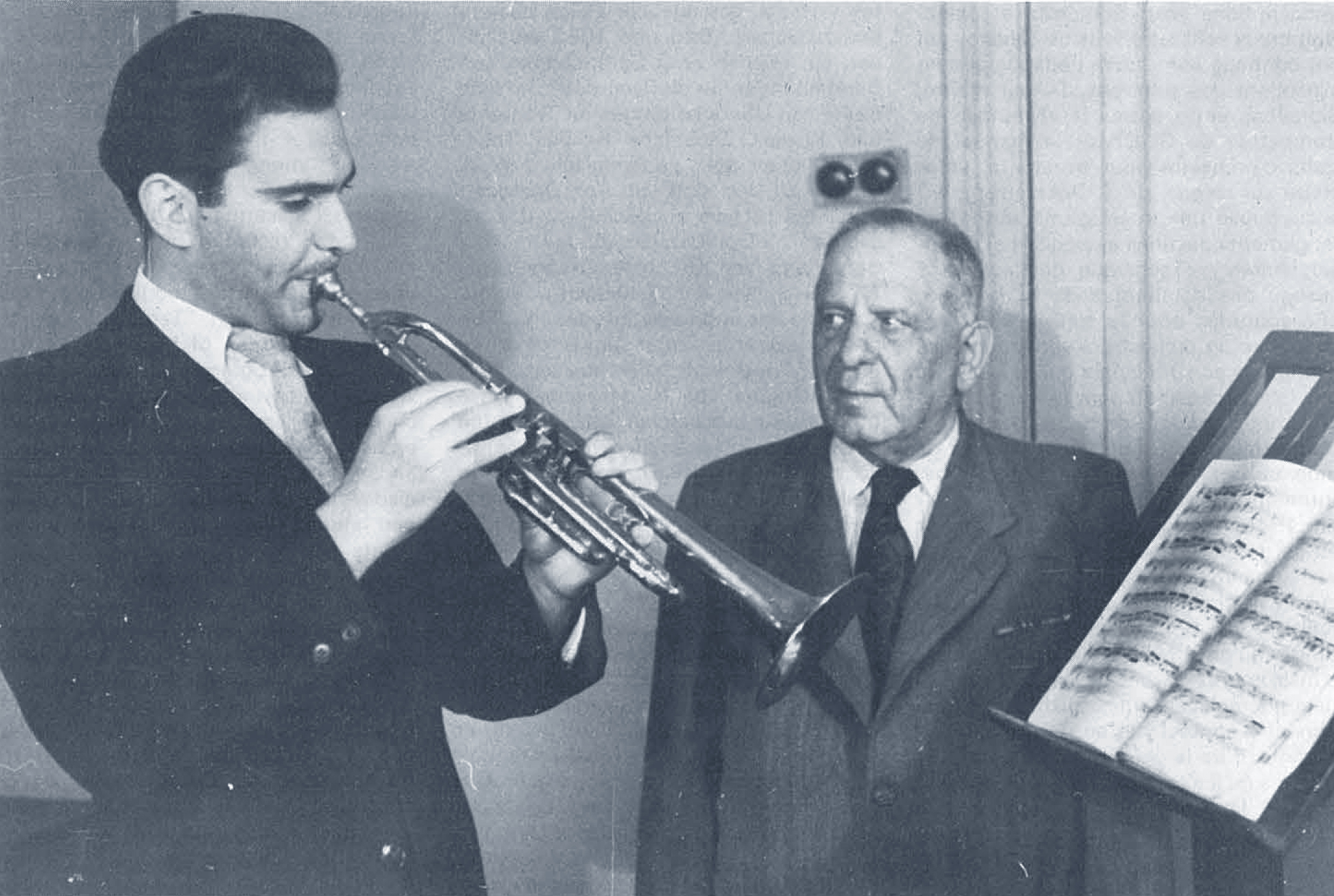
Prof. Mikhail I. Tabakov and young Timofei Dokchitzer (1950).

Re-cast after the translation by Romain Brot of articles by G. Orvid and S. Riaouzov.

The name of M. I. Tabakov, eminent artist of the USSR, doctor, art critic and professor, is entered in the history of Soviet musical culture as one of the most illustrious soloists who played a wind instrument, founder of the trumpet school and teacher of an important number of excellent musicians. Already in 1924, the great Russian singer Leonid Sobinov wrote to him on the occasion of his jubilee these prophetic lines: “You are not only a virtuoso who does marvellous things with a powerful instrument, knowing how to extract from it sounds as menacing as a storm or as tender as a lullaby, but you are also an authentic and inspired musician. These two united qualities allow us to hope that the name of Prof. Tabakov will remain immortal at the Conservatory, as creator of a school and teacher of a host of brilliant musicians.”

Sobinov wasn’t mistaken. In the course of 50 years activity, Tabakov formed several generations of musicians amongst whom eminent teachers as well as instrumentalists who worked in the best opera orchestras and symphonic ensembles, and of whom a certain number have been prizewinners of the Soviet Union as well as international competitions. It suffices for us to mention G. Orvid, T. Dokschitzer, S. Ieriomin, L. Yuriev, N. Polonsky, V. Shtsholokov, K. Sérostanov, I. Viltshinsky, N. Yavorsky, I. Stepanov, A. Gandel...

M. I. Tabakov was not only a remarkable teacher and gifted with an immense talent, but also an inspired artist whose whole life was dedicated to work. Born in 1877 in Odessa, he obtained at the age of 14 the post of solo trumpeter in the symphony orchestra of Yalta! Then he worked in the symphony orchestras of Sebastopol, Tiflis, Rostov-on-the-Don. From 1896 he was in Moscow, with the theatre orchestra of the “private” opera. The following year he was classed first at the auditions for the famous Bolshoi orchestra. He was 20 years old. There he made the acquaintance of V. Brandt, famous trumpet virtuoso, and begins to take lessons with him. In 1903, V. Brandt surrendered the post of solo trumpeter to him, which he was going to hold for more than 40 years.

Continue reading

Access the full Digital Edition.

Brass Bulletin 22, II / 1978 pages 61–70

All content is protected by copyright © Brass Bulletin 1978–2026

Share this article

Facebook LinkedIn
Loading…

Questions & Answers

How the Digital Edition works

What does the Digital Edition include?

The Digital Edition brings together the articles already digitized as searchable online texts—not simply as scans or PDF files—along with their original illustrations, notes, authorship, issue information, and available translations. Related-article suggestions currently include only this digitized material.

Are the digital articles identical to the originals?

We preserve the original text, language, illustrations, captions, footnotes, and editorial context as faithfully as possible. The presentation is adapted for comfortable online reading, and obvious transcription or scanning errors may be corrected. The substance and character of the published article remain unchanged.

Which languages are available?

Brass Bulletin was published in English, French, and German throughout its history. Italian and Spanish translations were added from issue No. 60 onward.

On the Italian and Spanish sites, articles from issues 1–59 are therefore shown in English by default.

How often are new articles added?

New articles are added almost daily, with approximately one complete issue digitized each week. The pace may vary depending on the preparation, image work, and editorial checking required.

Why aren’t all articles available digitally?

The complete Brass Bulletin collection contains 1,246 articles published between 1971 and 2003. The full index is already available online, allowing readers to discover every article in the collection, including those whose complete text has not yet been digitized.

Digitization began in February 2026. Each article is carefully prepared for online reading, checked, and connected to its issue, authors, subjects, and illustrations. At the current pace of digitization, the complete collection is expected to be available online by February 2028.

Why do some references mention articles that are not available yet?

References in the original articles are preserved even when the material they point to has not yet been digitized. This keeps the historical and editorial record intact. As more issues are added to the Digital Edition, an increasing number of these references will lead to articles that can be read online.

Can I suggest an article or report a transcription error?

Yes. If there is an article you would particularly like to see digitized, or if you notice a possible transcription error or missing detail, please contact us. Reader feedback helps us improve the Digital Edition and prioritize useful connections within the archive.

How can I support Brass Bulletin?

Your support helps fund the preparation, verification, and online publication of the complete collection.

Subscribe to the Digital Edition

Prefer to support us without subscribing?

Make a donation

Search Brass Bulletin.