Explore institutional access Explore institutional access
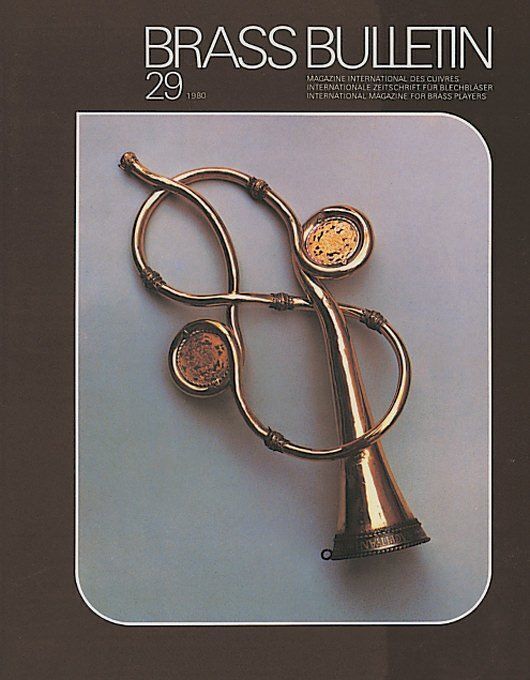
Brass Bulletin 29 - 1 / 1980
Issue
Brass Bulletin No. 29
Date
I / 1980
Pages
108
Contents
13 articles

Out of print

All issues

Brass Bulletin No. 29

I / 1980

Contents

13 articles

Editorial

Jean-Pierre Mathez

pp. 13–15 Society Teaching

At the dawn of the 1980s, Brass Bulletin challenges institutional habits, avant-garde rigidity and brass pedagies through a direct appeal to younger musicians.

The Trumpet in the USA

Part 3

Gadgets I

Thomas Stevens

pp. 17–18 Trumpet Equipment

From Schilke soundposts to piccolo trumpet extensions, American performers turned technical frustrations into specialized tools for modern playing.

ASA-Method

Rolf Quinque

pp. 19–22 Trumpet Technique Teaching

From Bach’s clarino tradition to modern piccolo trumpet playing, extreme high-register technique is tied here to breath support, pressure control and disciplined endurance.

Dynamics in the 80's

Roger Bobo

pp. 23–26 Acoustics Society

From Reykjavik to the Hollywood Bowl, rising concert hall scale and amplified culture reshape orchestral sound, leaving acoustic limits exposed.

Five generations of mouthpiece specialists

Werner Christoph Schmidt

pp. 27–34 History Instrument Makers

From Höchstädt to Markneukirchen and beyond, five generations of Schmidts shaped brass mouthpiece design through craft, anatomy and evolving orchestral demands.

Zen and the Art of Horn playing

Part 4 – End

Jeffrey Agrell

pp. 35–40 Horn Health

From meditation to distance running, horn playing becomes a way of quieting mental noise, linking breath, concentration, and daily life.

Brass instruments from the musical town of Graslitz

Rudolf Limmer

pp. 41–48 History Instrument Makers

From 18th-century Graslitz to postwar Bavaria, brass makers rebuilt a vanished musical industry around Miraphone, preserving craft through exile and industrial change.

A woman trombonist, Yvelise Girard

Women and Brass

Jean Douay

pp. 49–52 Trombone Society Professional life

From Paris conservatories to police bands, a young trombonist confronts isolation, scrutiny and ambition as women slowly enter the brass world.

Tower-watchmen and night-watchmen in Bohemia

Vaclav Hoza

pp. 57–60 History Society

From Hussite suspicion of musicians to tower signals over Bohemian towns, horns and trumpets shaped civic life, danger warnings and ritual memory.

Relaxation and musical performance

Michel Ricquier

pp. 61–66 Health Teaching

Breath, fingers and muscular tension form a hidden technical chain in wind playing, as Michel Ricquier links virtuosity to bodily awareness.

The founders of the French Trumpet School

Merri Franquin, Eugène Foveau and Raymond Sabarich

Michel Laplace

pp. 67–80 Trumpet History Teaching

Franquin, Foveau and Sabarich appear through their Paris careers, teaching legacies, recordings and role in shaping modern French trumpet playing.

Anton Hansen (1877-1947)

Part 3 – End

Father of trombone playing in Scandinavia

Per Gade

pp. 81–94 Trombone History Teaching

From Sibelius to Paris, Anton Hansen’s later career links Scandinavian trombone playing with French repertoire, teaching, and orchestral reform.

The Trumpet

An exhibition at the Trumpeter's Castel in Bad Säckingen

Kurt Janetzky

pp. 103–105 Trumpet History Event

Natural trumpets from Verona, Nürnberg and Vienna framed a 1979 gathering in Säckingen linking Baroque practice, collecting culture and modern playing.

Loading…

Questions & Answers

How the Digital Edition works

What does the Digital Edition include?

The Digital Edition brings together the articles already digitized as searchable online texts—not simply as scans or PDF files—along with their original illustrations, notes, authorship, issue information, and available translations. Related-article suggestions currently include only this digitized material.

Are the digital articles identical to the originals?

We preserve the original text, language, illustrations, captions, footnotes, and editorial context as faithfully as possible. The presentation is adapted for comfortable online reading, and obvious transcription or scanning errors may be corrected. The substance and character of the published article remain unchanged.

Which languages are available?

Brass Bulletin was published in English, French, and German throughout its history. Italian and Spanish translations were added from issue No. 60 onward.

On the Italian and Spanish sites, articles from issues 1–59 are therefore shown in English by default.

How often are new articles added?

New articles are added almost daily, with approximately one complete issue digitized each week. The pace may vary depending on the preparation, image work, and editorial checking required.

Why aren’t all articles available digitally?

The complete Brass Bulletin collection contains 1,246 articles published between 1971 and 2003. The full index is already available online, allowing readers to discover every article in the collection, including those whose complete text has not yet been digitized.

Digitization began in February 2026. Each article is carefully prepared for online reading, checked, and connected to its issue, authors, subjects, and illustrations. At the current pace of digitization, the complete collection is expected to be available online by February 2028.

Why do some references mention articles that are not available yet?

References in the original articles are preserved even when the material they point to has not yet been digitized. This keeps the historical and editorial record intact. As more issues are added to the Digital Edition, an increasing number of these references will lead to articles that can be read online.

Can I suggest an article or report a transcription error?

Yes. If there is an article you would particularly like to see digitized, or if you notice a possible transcription error or missing detail, please contact us. Reader feedback helps us improve the Digital Edition and prioritize useful connections within the archive.

How can I support Brass Bulletin?

Your support helps fund the preparation, verification, and online publication of the complete collection.

Subscribe to the Digital Edition

Prefer to support us without subscribing?

Make a donation

Search Brass Bulletin.