12 min. read
Vassily Gueorguievitch Brandt (1869–1923)
Biography
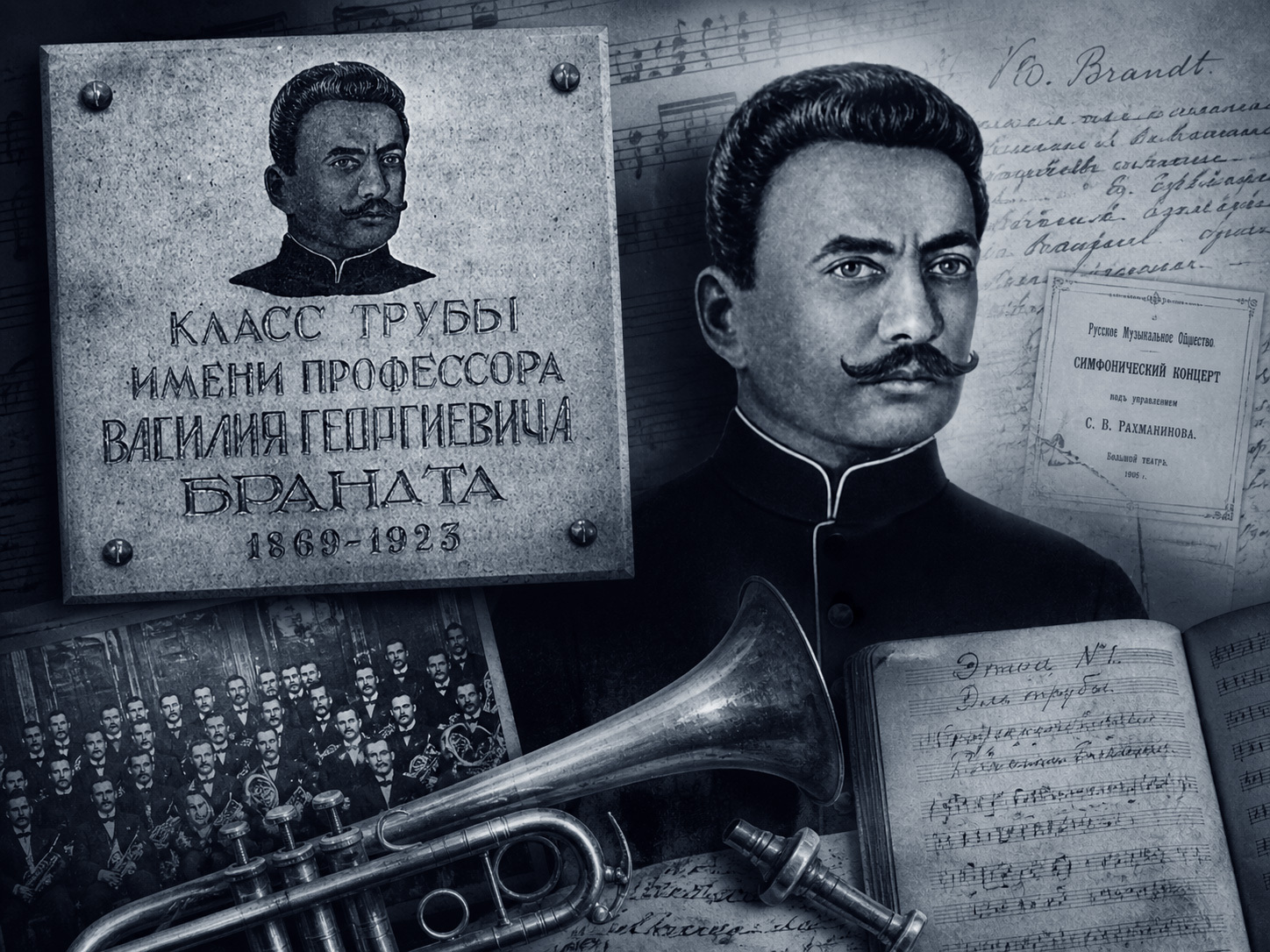
Vassily Gueorguievitch Brandt (1869–1923)
When I started to take an interest in V. G. Brandt, I was fortunate enough still to be able to find some people who had known him well or who had been students of his. As almost nothing was written about him, my record of their anecdotes provided the basis for my further research in archives and private collections.
A most lively and interesting account of Brandt is given by one of his most famous and most gifted pupils, Pyotr Yakovlevich Lyamin, who died ten years ago at the age of 85 and who entered Brandt’s class at the Moscow Conservatoire in 1906 and in 1909 played the cornet, trumpet and bass trumpet parts in the Stravinsky ballets during Diaghilev’s Russian seasons in Paris.
The end of the nineteenth century and the beginning of the twentieth saw the rise of the Russian school of wind players. They had great difficulty in gaining recognition in the face of the foreigners who monopolised our theatre orchestras in the time of the Tsars. Czech and German musicians held the upper hand at that time. Already, however, Russian musicians were beginning to make a name for themselves. In this connection the name of V. G. Brandt is of symbolic importance because he handed the torch of talent to his pupil, M. I. Tabakov, future founder of the Soviet school of trumpet playing.¹
Vasilij Gyeorgyevich (Karl Wilhelm) Brandt was born in Coburg in Bavaria in 1869 and began his musical studies at the school for orchestral musicians run by Zimmermann, the court conductor. He left this school in 1887 and was appointed first solo trumpet of the Helsinki Philharmonic Symphony Orchestra and teacher in the music courses instituted by Professor Kayanus.
In 1890 the Bolshoi Theatre advertised the post of first trumpet. Brandt went to Moscow from Finland but arrived too late. The appointment was made, the post of first trumpet was taken, and Brandt was advised to re-apply later but he implored the jury to hear him for five minutes in any case.
The narrative continues with Brandt’s decisive audition at the Bolshoi, his rise within the orchestra, and the emergence of his influence as performer, teacher, and central figure in Russian trumpet playing.
Brass Bulletin 26, II / 1979 pages 59–68
All content is protected by copyright © Brass Bulletin 1979–2026