Ofrezca Brass Bulletin en su universidad, conservatorio o biblioteca Descubra el acceso institucional

3 min de lectura

Parte 3

Instrument Makers in USA

C. G. Conn Ltd. Abilene, Texas

Instrument Makers in USA

C. G. Conn Ltd.

Back to quality

Conn is probably the oldest name in brass instrument making in the United States.

In 1875 the first Conn, Charles Gerard, a good cornet player, patented a mouthpiece with a rubber rim which he had developed for his own use after suffering a lip injury. In the same year in Elkhart, Indiana, he and his partner Eugen Dupont founded the firm of Conn-Dupont which, in addition to these mouthpieces, was soon making instruments as well. In 1887, his business now called the C.G. Conn Company, he took over the well known firm of Isaac Fiske in Worcester, Massachusetts. Business was excellent for twenty years until Conn’s fortunes changed and he gave up. In 1915 he sold his company to Carl D. Greenleaf, who carried it on as C.G. Conn Ltd. Mail order gave way to the use of specialist retailers, production was rationalised and in some areas production lines were introduced. In 1980 the business was taken over by MacMillan, the printers and publishers, who moved the factory to Abilene, Texas, for reasons of cost.

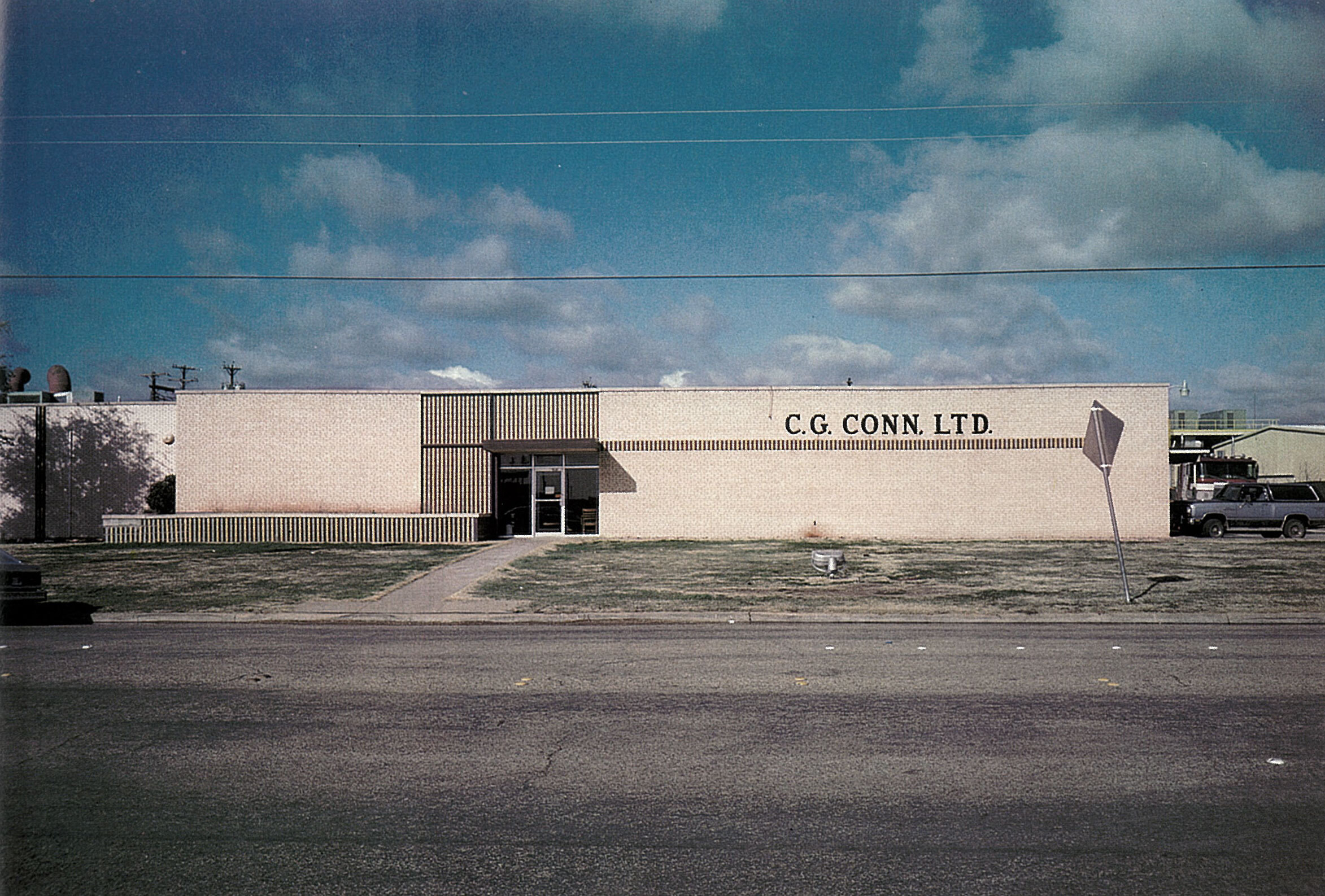
The company premises

The company premises

Since 1980 the firm has belonged to the Mardan Corporation of Elkhart, Indiana. The present owner, Mr. Daniel J. Henkin, can state with satisfaction that he has succeeded in winning back the ground lost in the preceding ten years.

Conn’s brass instruments are produced in three locations. Production of top-of-the-line models is concentrated in Abilene while production of student instruments is divided between the remaining capacity in Abilene and the two Nogales works: Nogales, Sonora, Mexico, makes components and the neighbouring town of Nogales, Arizona, USA, checks and assembles them. Student trumpets and cornets (as well as saxophones, flutes and piccolos) come from Nogales, other student instruments from Abilene. Conn points out that all components are made in the company’s own factories — the fibreglass sections for the light-weight sousaphones, for example, are made at the case factory in Goshen, Indiana.

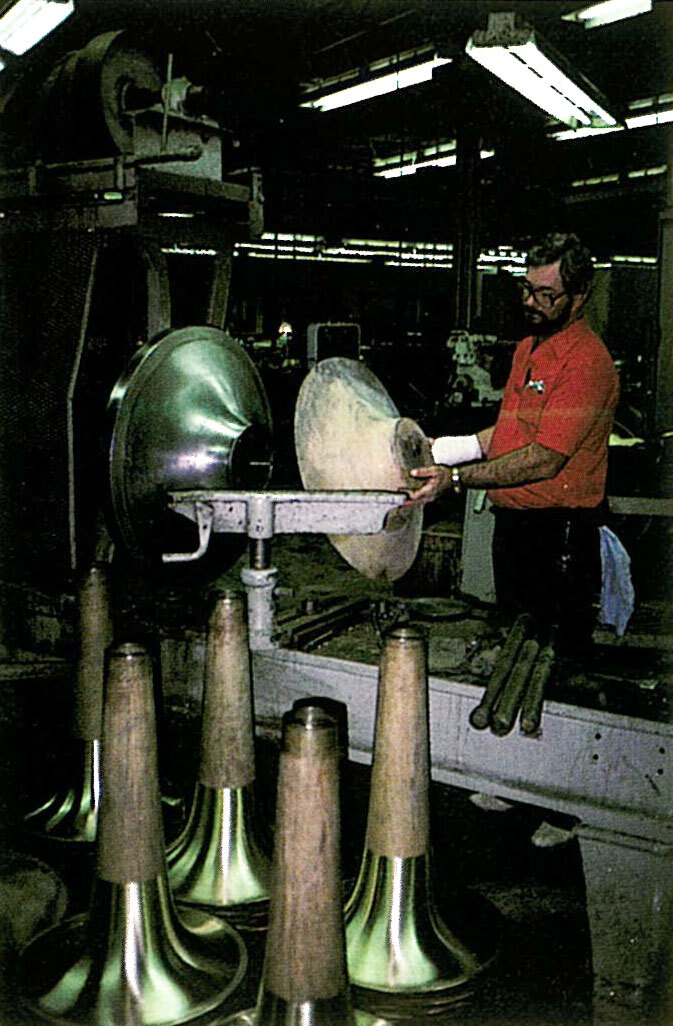
Foreman with a finished bell and the steel template
Foreman with a finished bell and the steel template

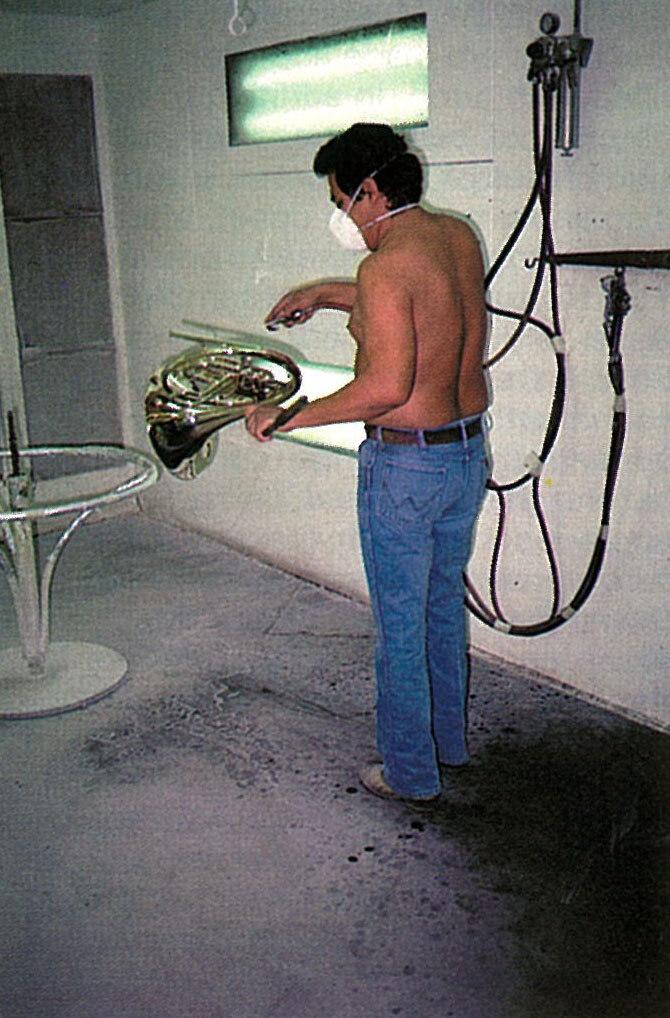
Lacquering a horn
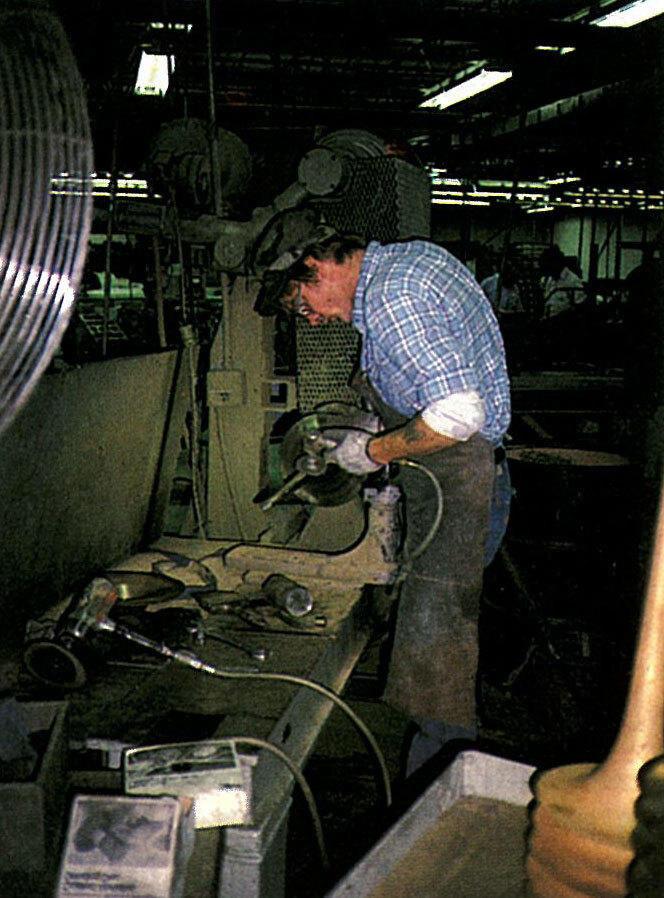
Lacquering a horn

Polishing a bell

Polishing a bell

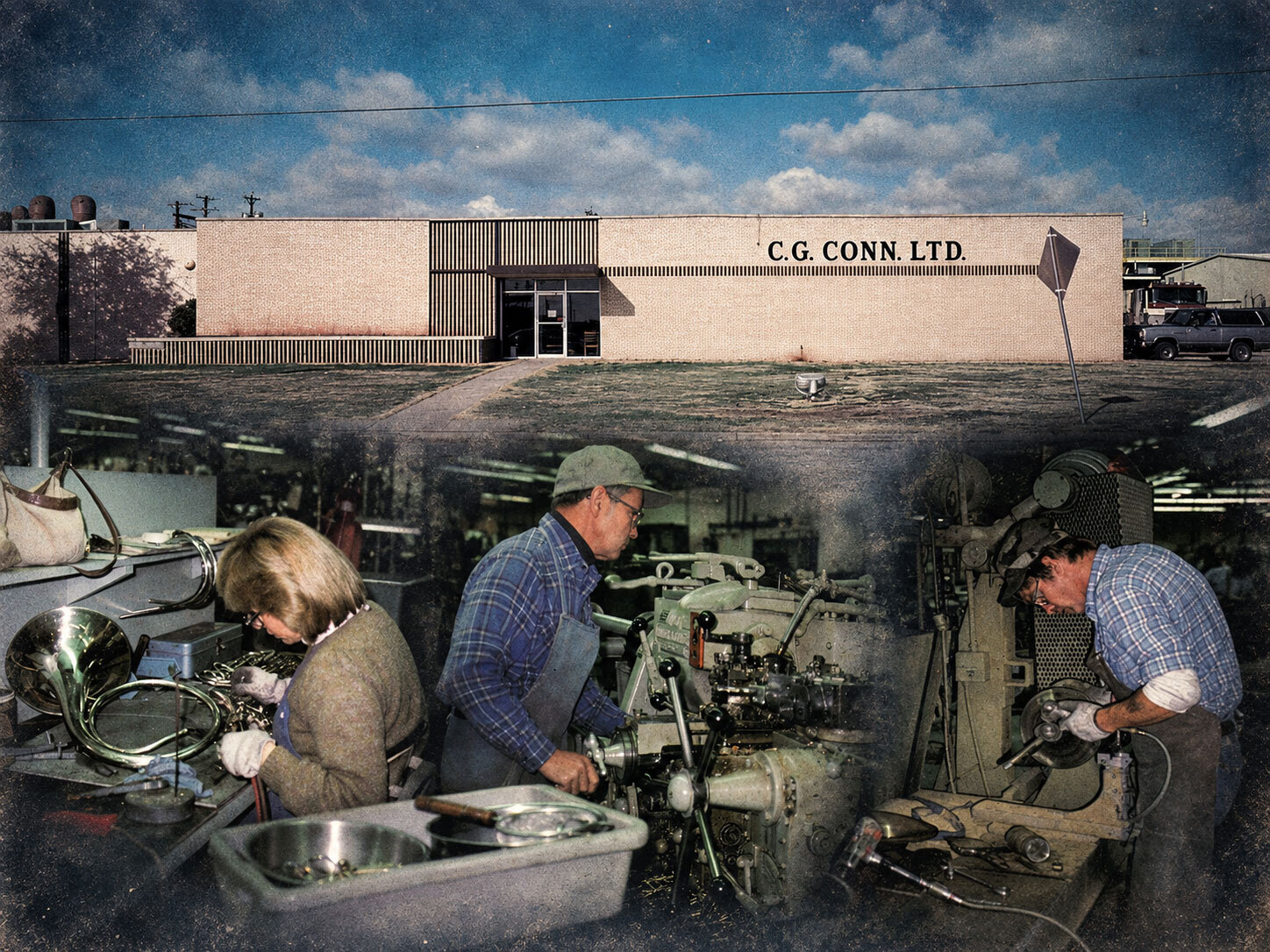
The Abilene factory is a long single-storey building. In the Machine Product Department small parts such as inner and outer slides, ferrules, braces etc. are made exclusively on fully automated lines in batches of more than 1500. With mouthpieces, for example, only the backbore remains to be cut. Next comes the Fabrication Department, where conical tubes are made and then bent while filled with pitch. In addition to this large batches of bell sections are produced; two pieces of sheet brass, cut to size (a disc and a truncated cone), are shaped, welded together, annealed and adjusted. The instruments are assembled in the Assembly Department, polished in the Buffing Department and cleaned in ultra-sound baths. They are then disassembled and the openings carefully sealed before the individual parts receive an epoxy lacquer finish. Next they are passed between infrared panels which bake the sprayed-on lacquer at a temperature of around 150°C (300°F). The Final Assembly Department re-assembles, adjusts and checks the finished instruments.
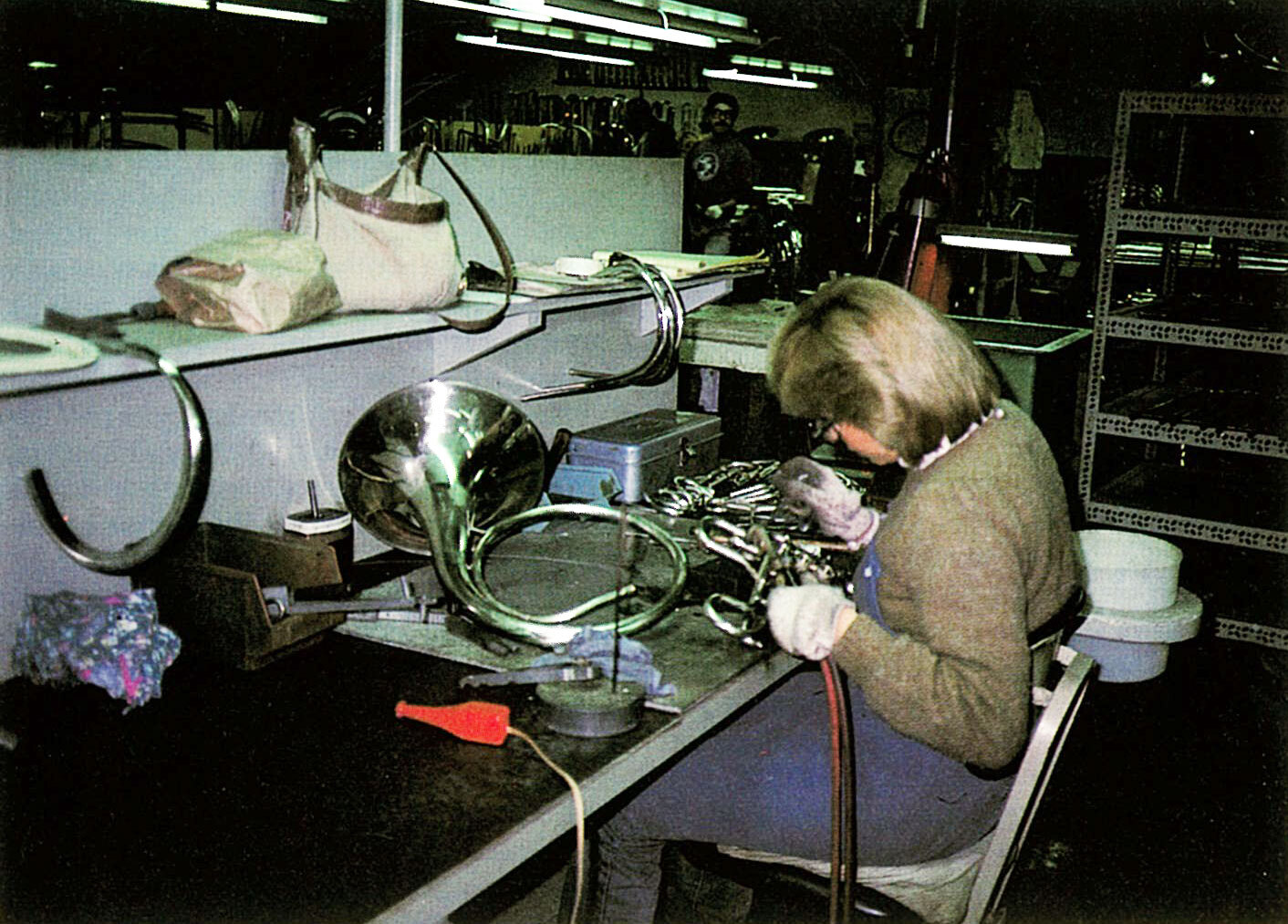
Soldering work on a horn

Soldering work on a horn

The employees are local. Moves from one department to another are rare, most employees staying where they were apprenticed on first joining the company. Officials were kind enough to show me a copy of the firm’s union agreement, which covers relationships between the firm and its employees in great detail. The agreement covers all those involved in production, from the caretaker to the specialists and supervisors, the individual points to be applied without discrimination in respect of sex, age, race, colour, creed, origin, physical and mental disability or union membership.
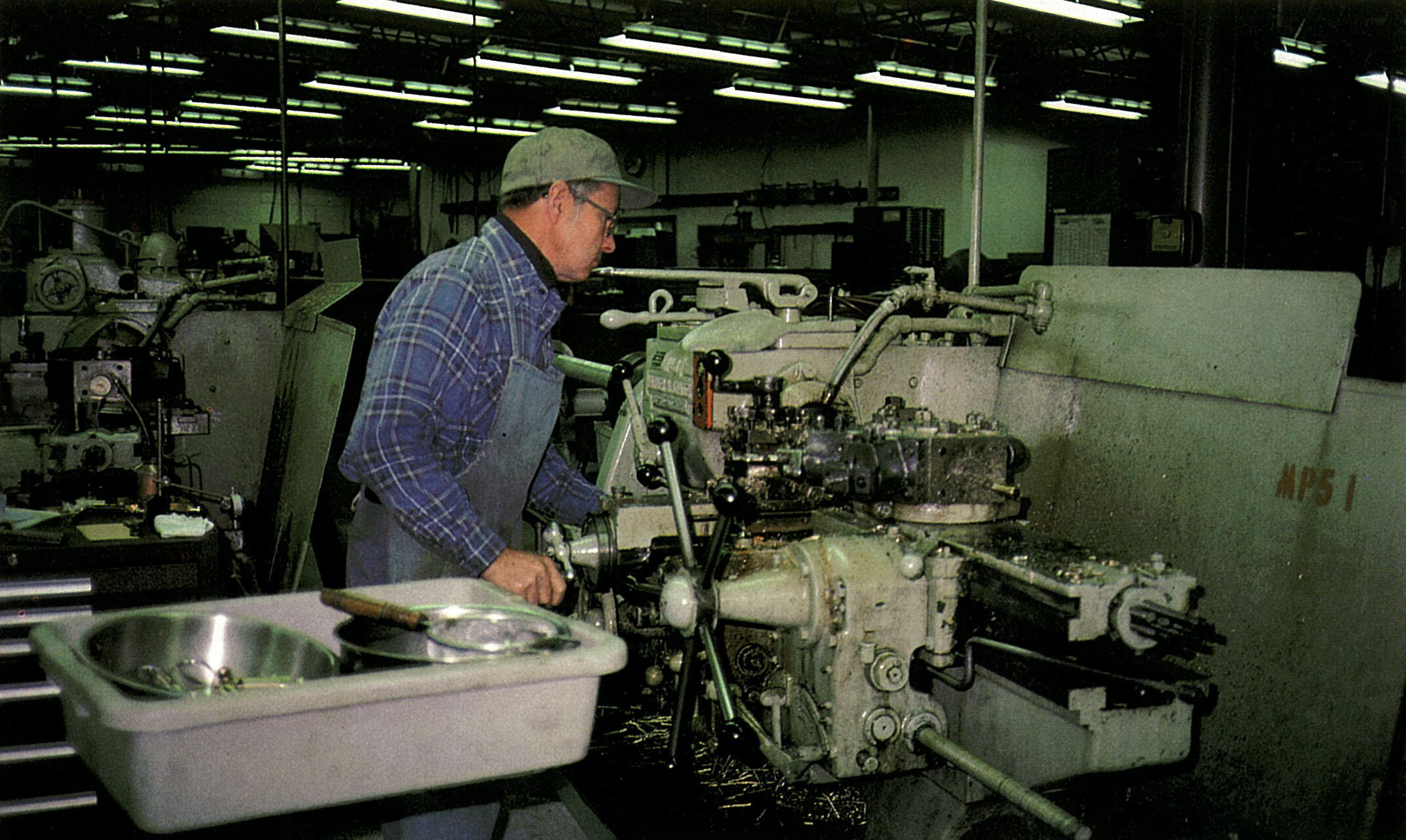
Small-scale series work on the lathe

Small-scale series work on the lathe

A new employee is confirmed in his job after sixty days’ probation. The normal working week is forty hours, Monday to Friday. Hourly rates with premiums for shift work are agreed in advance for three-year periods for each individual work process and for the probationary period and for subsequent periods of employment of two or six months or more. The ratio between the pay-rates for the simplest and the most demanding jobs is approximately 1:2. The union renounces the use of strikes and the company renounces the use of lockouts. There is a precisely defined arbitration procedure for dismissals and disputes. The individual employee’s seniority within the firm is very important since, in the event of layoffs, the ‘‘last-in-first-out’’ rule applies. Annual leave is one to two weeks per year in the first two years, rising to three weeks in the ninth year, plus ten paid holidays a year, one of which is the employee’s own birthday. Conn and the union have equal control over the employees’ pension fund, which provides a modest pension in old age and in the event of invalidity.

These details are very brief, of course, but they do give some idea of the conditions of employment in a company of this kind in the southern U.S.


C.G. Conn Ltd.
5520 North First Street Abilene, Texas, 79603

Interview with: Lyndia Oman, General Manager

Employees: 125
Production: 12’000 - 15’000 instruments per year

The firm of C.G. Conn Ltd. belongs to the Mardan Corporation of Elkhart, Indiana, which also includes the following companies:

C.G. Conn Ltd., Abilene and Nogales
Artley Flutes, Nogales, Arizona
Goshen Case, Goshen, Indiana
Scherl + Roth, Cleveland, Ohio
Continental Music, Atlanta, Georgia, and Reno, Nevada
King Music Company, Cleveland, Ohio

Brass Bulletin 51, III / 1985 páginas 54–58

Todo el contenido está protegido por derechos de autor © Brass Bulletin 1985–2026

Compartir este artículo

Facebook LinkedIn
Cargando…

Preguntas y respuestas

Cómo funciona la edición digital

¿Qué incluye la edición digital?

La edición digital reúne los artículos ya digitalizados como textos legibles y consultables en línea —no simplemente como escaneos o archivos PDF— junto con sus ilustraciones originales, notas, autoría, información del número y traducciones disponibles. Las sugerencias de artículos relacionados incluyen actualmente solo este material digitalizado.

¿Los artículos digitales son idénticos a los originales?

Conservamos con la mayor fidelidad posible el texto original, el idioma, las ilustraciones, los pies de imagen, las notas y el contexto editorial. La presentación se adapta para facilitar la lectura en línea y pueden corregirse errores evidentes de transcripción o escaneado. El contenido y el carácter del artículo publicado permanecen inalterados.

¿Qué idiomas están disponibles?

Brass Bulletin se publicó en inglés, francés y alemán a lo largo de toda su historia. Las traducciones al italiano y al español se añadieron a partir del número 60. Por este motivo, en los sitios italiano y español los artículos de los números 1 a 59 se muestran en inglés de forma predeterminada.

¿Con qué frecuencia se añaden nuevos artículos?

Se añaden nuevos artículos casi a diario, con aproximadamente un número completo digitalizado cada semana. El ritmo puede variar según el trabajo de preparación, tratamiento de imágenes y revisión editorial necesario.

¿Por qué no están disponibles todos los artículos en formato digital?

La colección completa de Brass Bulletin contiene 1.246 artículos publicados entre 1971 y 2003. El índice completo ya está disponible en línea y permite descubrir todos los artículos de la colección, incluidos aquellos cuyo texto íntegro todavía no ha sido digitalizado.

La digitalización comenzó en febrero de 2026. Cada artículo se prepara cuidadosamente para la lectura en línea, se revisa y se vincula con su número, sus autores, sus temas y sus ilustraciones. Al ritmo actual de digitalización, se prevé que la colección completa esté disponible en línea en febrero de 2028.

¿Por qué algunas referencias mencionan artículos que todavía no están disponibles?

Las referencias de los artículos originales se conservan aunque el material al que remiten aún no haya sido digitalizado. De este modo se mantiene intacto el contexto histórico y editorial. A medida que se incorporen más números a la edición digital, un número creciente de estas referencias conducirá a artículos que podrán leerse en línea.

¿Puedo sugerir un artículo o informar de un error de transcripción?

Sí. Si hay algún artículo que le gustaría especialmente ver digitalizado, o si detecta un posible error de transcripción o algún dato que falta, póngase en contacto con nosotros. Los comentarios de los lectores nos ayudan a mejorar la edición digital y a establecer prioridades útiles dentro del archivo.

¿Cómo puedo apoyar a Brass Bulletin?

Su apoyo ayuda a financiar la preparación, verificación y publicación en línea de la colección completa.

Suscríbase a la Edición Digital

¿Prefiere apoyarnos sin suscribirse?

Haga una donación

¿Cómo avanza la digitalización?

Estamos poniendo Brass Bulletin a disposición de los lectores en línea, artículo por artículo. Pueden leer los artículos recién digitalizados en cuanto estén listos, incluso antes de que se complete un número entero.

Consulten nuestro calendario de digitalización para descubrir las últimas novedades y las fechas estimadas de disponibilidad de los próximos números. Estas estimaciones se basan en nuestro ritmo reciente y pueden cambiar.

Busca en Brass Bulletin.