4 min. read
ARD Music Competition in Munich in 1986
Once again trumpet, after six years
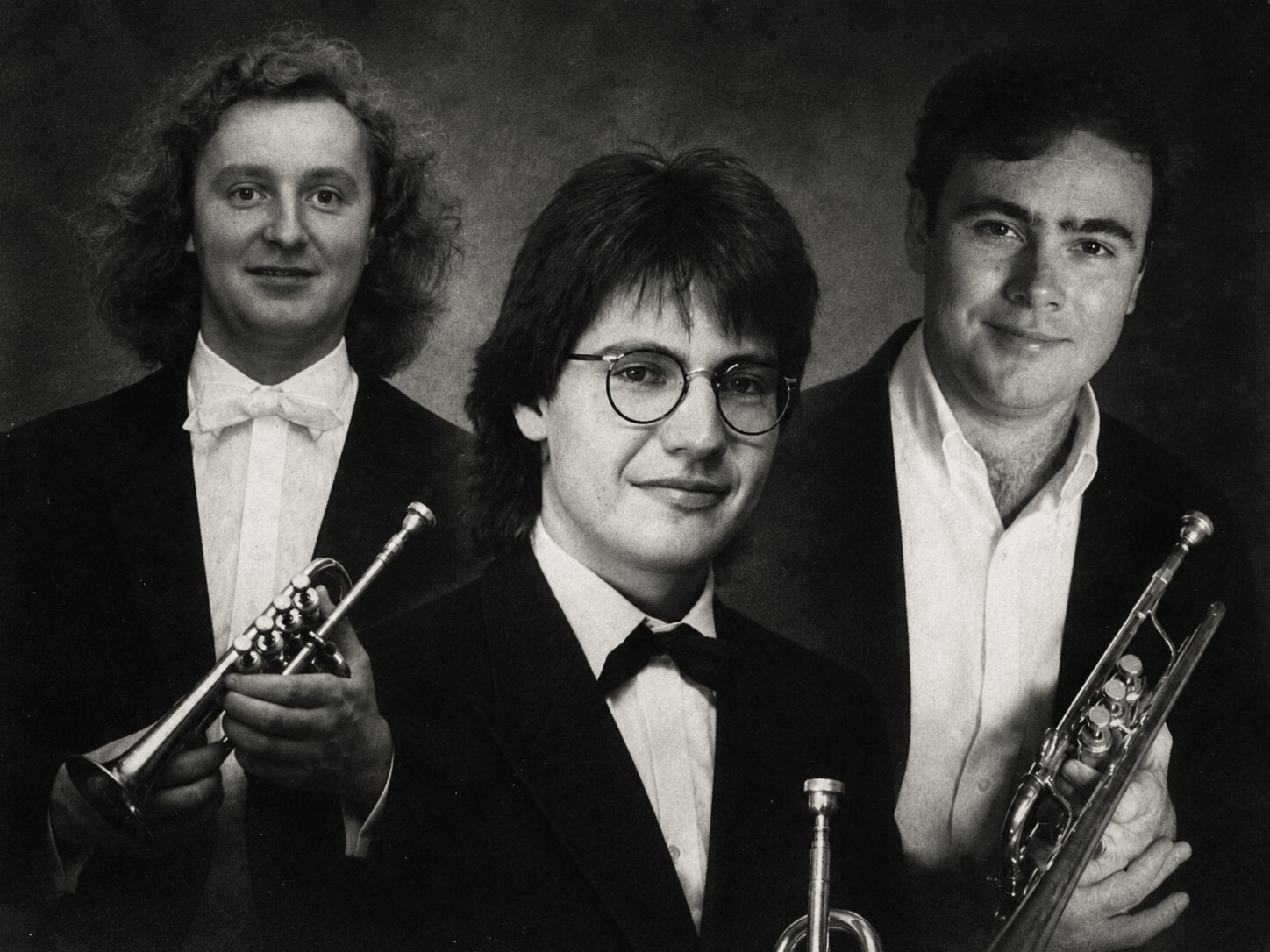
Reinhold Friedrich, Urban Agnas, George Vosburgh
Once again a trumpet competition took place within the framework of the 34th International Music Competition of the Broadcasting Corporations of the German Federal Republic 1986, between 3rd and 12th September in Munich.
The ARD Music Competition has a particularly good reputation among the international contests. In my opinion, there are three reasons:
- There are four rounds in all, so that candidates who continue have ample opportunity to show all the facets of their personalities. 2) The voting system of the internationally constituted jury is neither partisan nor subject to manipulation. 3) Candidates are judged first of all on musical grounds and only secondarily on technical ones. The criteria of judging: technique, musical presentation, and artistic personality.
This year the jury consisted of Ludwig Güttler (GDR), Stefan Hadrys (Poland), Paul Lachenmeir (GFR), Bo Nilsson (Sweden), Joachim Pliquett (GFR), Edward H. Tarr (USA), and Guy Touvron (France). Gerd Starke (GFR), a non-trumpeter, was president. Timofei Dokshitser (USSR), who had originally been announced, was unable to attend because of illness.
In 1986, 68 candidates (about double the total of 1980!) had registered, and 47 actually showed up for the first round. They came from the following countries: USA (8 candidates), GFR (7), France (6), Japan (5), Canada, Belgium (4 each), Sweden (3), as well as Austria, Czechoslovakia, Denmark, Great Britain, Italy, Luxembourg, Poland, Spain, and Taiwan (1 candidate each). The required piece was the Hummel concerto in the original key of E Major (1st and 2nd movements). As a second piece one could choose between R. Henderson's “Variation Movements” or R. Emig's “Theme and Variations”, both for unaccompanied trumpet. The two pieces had to be played without pause, one after the other, in any order. Emig was considerably easier than Henderson and was chosen by only four candidates, none of whom was picked for the second round.
The fact that the Hummel concerto was required to be performed in E instead of the easier (and incorrect) key of E♭ seems to have stimulated the fantasy both of the participants and also of many instrument makers. No less than six different pitches of trumpet turned up: E (26 times, of these 14 from Chicago and 5 from Hamamatsu), D (9), C (9), as well as B natural, B♭, and A (1 time each). The E trumpets were preponderately lengthened F trumpets (19 cases) rather than shortened E♭ trumpets (5). About half the candidates playing on E trumpets had serious intonation problems. For this reason it was not a surprise to see proportionally more candidates surviving the first round who played on a larger instrument: 6 out of 26 players of the E trumpet, but 6 out of 21 players of trumpets in D (2), C (3), and B natural (1). The pitch of B natural seemed to be the best: not only is the fingering in F major, but the player also has at his disposal all the shadings which a larger instrument has to offer. The young man playing the B trumpet (a C trumpet with a shortened B♭ mouthpipe and tuning slide) also turned out to be the second-prize winner ... but we should not anticipate the final results. The A trumpet demonstrated here, a German B♭ trumpet with lengthened slides, had a muffled sound.
Brass Bulletin 56, IV / 1986 pages 7–11
All content is protected by copyright © Brass Bulletin 1986–2026