Explore institutional access Explore institutional access

1 min. read

Miroslav Kejmar

Portrait in brief

Miroslav Kejmar

Miroslav Kejmar

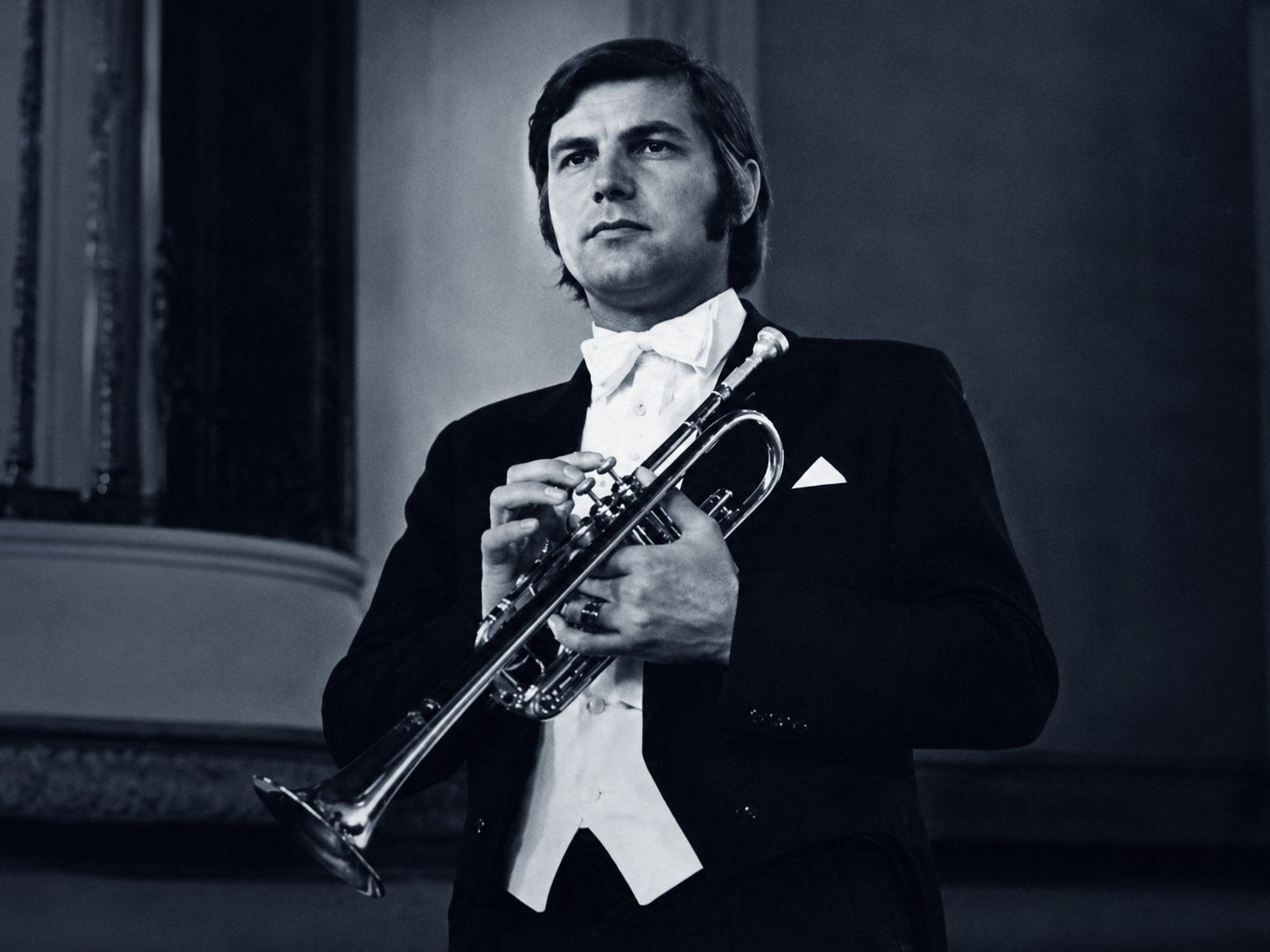
At the tender age of 10 Miroslav Kejmar took the most important decision of his life: he swapped his fiddle for a trumpet. The man “whose lip is a gift from God” (according to one of his teachers) can scarcely have any cause to regret it now.

Not yet 40, citing Adolf Scherbaum and Maurice André as his models, Kejmar's list of recordings does him proud, including as it does such feats as Bach's 2nd Brandenburg Concerto, one of the concertos of J.M. Molter and the first recording of the incredibly difficult concerto by Franziskus Querfort (all on the Panton label). He can be heard in Supraphon recordings of Bach's Suite in D and Handel's Fireworks Music. Apart from the Baroque his other preference is for contemporary works (he quotes Jolivet, Bozza, Arutiunian, Goedicke and Peskin).

He has recorded Joéka Matěj's trumpet concerto (Supraphon) and concerto for trumpet, horn and trombone (Panton), and Petr Eben's Vox clamantis (Panton).

Kejmar's concert schedule is just as busy. With the Czech Philharmonic, where he has been solo trumpet since 1972, he has played the Haydn concerto among other things, and has appeared with other orchestras in Prague, Brno and Bratislava as well as with the Bucharest Philharmonic. He also plays with the Prague Baroque Ensemble, the Prague Brass Soloists and other chamber groups. Even the dance bands of Karel Vlach and Václav Hybs can count on him.

This versatile man with the textbook embouchure comes from Kladno (born 1941), studied with Václav Pařík and Václav Junek in Prague from 1962, and learned his trade in operetta and film orchestras before joining the Czech Philharmonic in 1970. His main instrument is a Bach C; he also plays instruments in Bb, Eb (for Haydn and Hummel) and a Selmer Bb piccolo, which is particularly splendid.

Brass Bulletin 31, III / 1980 page 99

All content is protected by copyright © Brass Bulletin 1980–2026

Share this article

Facebook LinkedIn
Loading…

Questions & Answers

How the Digital Edition works

What does the Digital Edition include?

The Digital Edition brings together the articles already digitized as searchable online texts—not simply as scans or PDF files—along with their original illustrations, notes, authorship, issue information, and available translations. Related-article suggestions currently include only this digitized material.

Are the digital articles identical to the originals?

We preserve the original text, language, illustrations, captions, footnotes, and editorial context as faithfully as possible. The presentation is adapted for comfortable online reading, and obvious transcription or scanning errors may be corrected. The substance and character of the published article remain unchanged.

Which languages are available?

Brass Bulletin was published in English, French, and German throughout its history. Italian and Spanish translations were added from issue No. 60 onward.

On the Italian and Spanish sites, articles from issues 1–59 are therefore shown in English by default.

How often are new articles added?

New articles are added almost daily, with approximately one complete issue digitized each week. The pace may vary depending on the preparation, image work, and editorial checking required.

Why aren’t all articles available digitally?

The complete Brass Bulletin collection contains 1,246 articles published between 1971 and 2003. The full index is already available online, allowing readers to discover every article in the collection, including those whose complete text has not yet been digitized.

Digitization began in February 2026. Each article is carefully prepared for online reading, checked, and connected to its issue, authors, subjects, and illustrations. At the current pace of digitization, the complete collection is expected to be available online by February 2028.

Why do some references mention articles that are not available yet?

References in the original articles are preserved even when the material they point to has not yet been digitized. This keeps the historical and editorial record intact. As more issues are added to the Digital Edition, an increasing number of these references will lead to articles that can be read online.

Can I suggest an article or report a transcription error?

Yes. If there is an article you would particularly like to see digitized, or if you notice a possible transcription error or missing detail, please contact us. Reader feedback helps us improve the Digital Edition and prioritize useful connections within the archive.

How can I support Brass Bulletin?

Your support helps fund the preparation, verification, and online publication of the complete collection.

Subscribe to the Digital Edition

Prefer to support us without subscribing?

Make a donation

Search Brass Bulletin.