Discoveries for brass players, once a month. Join our free newsletter →

1 min. read

This article is free.

Special GDR

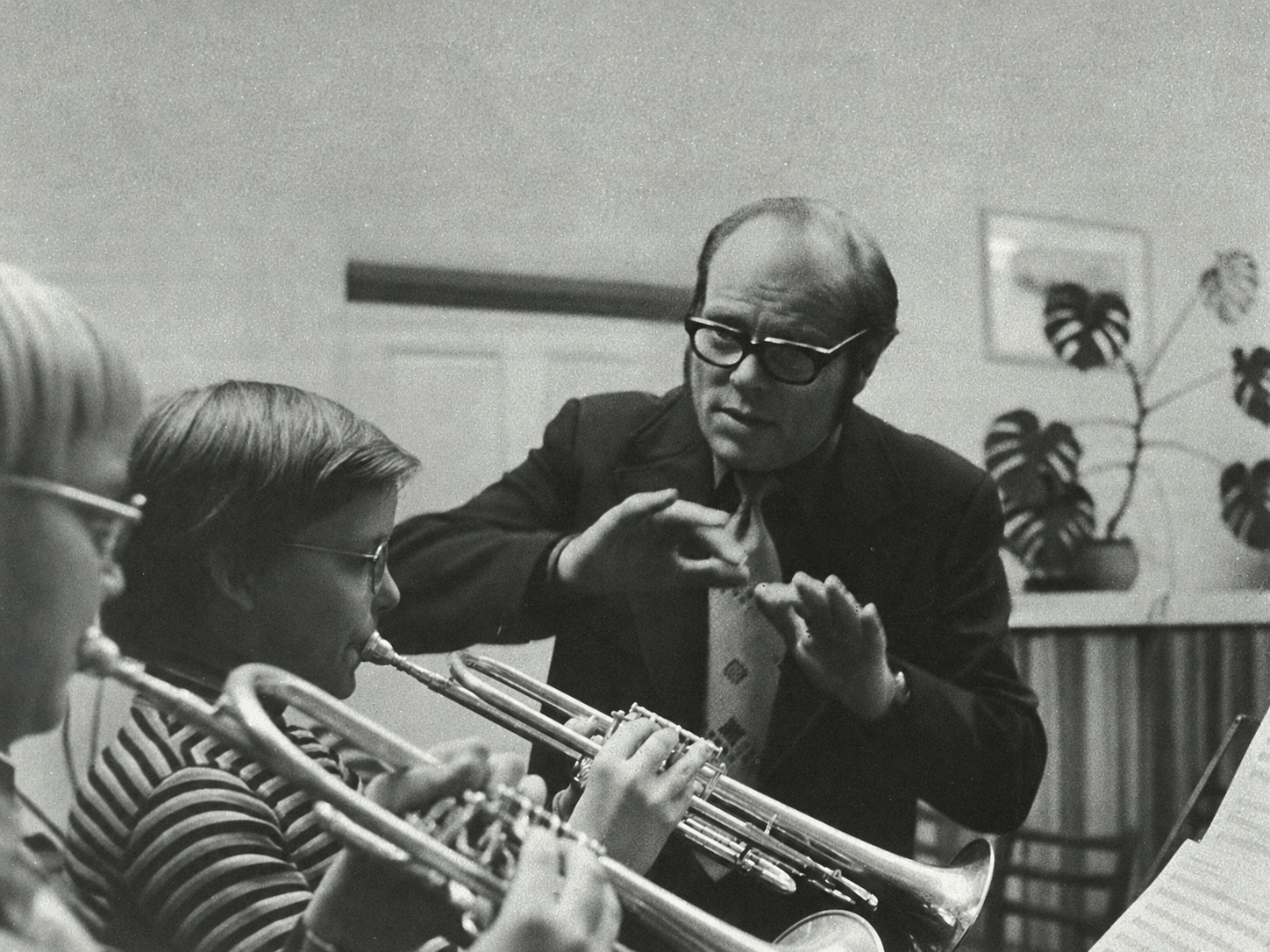
Hans-Joachim Krumpfer or: teaching as a vocation

Hans-Joachim Krumpfer or: teaching as a vocation

Hans-Joachim Krumpfer

The GDR educational system has made it possible to introduce progressive phased training extending over several years.

Hans-Joachim Krumpfer is one of the architects of this development in East German instrumental training, which is based not only on traditional, purely musical pedagogical criteria but also on scientific physiological and psychological data.

His teaching career began in Berlin in 1956. He very soon specialised in instrumental teaching with children and obtained remarkable results. In 1976 he was appointed head of the wind department at the specialised “Hanns Eisler” College of Music and became professor there in 1982.

It is his teaching that has enabled many musicians to take key jobs throughout the country.

He has published many educational works (through the Deutscher Verlag für Musik and Hofmeister in Leipzig) and his articles on scientific research in instrumental teaching are regarded as authoritative.²

Anyone involved and interested in teaching brass instruments will benefit from contact with this man who has acquired extraordinary experience over the years.

Prof. Hans-Joachim Krumpfer, Hönower Str. 17, DDR-1144 Berlin. ☎ 37-5-27 73 81.

Notes

¹ H.-J. Krumpfer was born in Elsterwerda, near Dresden, in 1928 and studied at the Dresden College of Music, where his trumpet teachers were Eduard Seifert and Wilhelm Simon (then solo trumpet at the Staatskapelle). From 1954 to 1956 he was solo trumpet at the Halle Philharmonic and from 1956 to 1967 1st solo trumpet at the Berlin Symphony. He made many solo appearances, especially on piccolo trumpet. In 1962 he received the highly respected German title of Kammervirtuos. He sits on many competition juries in the GDR and abroad.

² BRASS BULLETIN will publish the most interesting passages shortly.

Brass Bulletin 60, IV / 1987 pages 45–46

All content is protected by copyright © Brass Bulletin 1987–2026

Share this article

Facebook LinkedIn
Loading…

Questions & Answers

How the Digital Edition works

What does the Digital Edition include?

The Digital Edition brings together the articles already digitized as searchable online texts—not simply as scans or PDF files—along with their original illustrations, notes, authorship, issue information, and available translations. Related-article suggestions currently include only this digitized material.

Are the digital articles identical to the originals?

We preserve the original text, language, illustrations, captions, footnotes, and editorial context as faithfully as possible. The presentation is adapted for comfortable online reading, and obvious transcription or scanning errors may be corrected. The substance and character of the published article remain unchanged.

Which languages are available?

Brass Bulletin was published in English, French, and German throughout its history. Italian and Spanish translations were added from issue No. 60 onward.

On the Italian and Spanish sites, articles from issues 1–59 are therefore shown in English by default.

How often are new articles added?

New articles are added almost daily, with approximately one complete issue digitized each week. The pace may vary depending on the preparation, image work, and editorial checking required.

Why aren’t all articles available digitally?

The complete Brass Bulletin collection contains 1,246 articles published between 1971 and 2003. The full index is already available online, allowing readers to discover every article in the collection, including those whose complete text has not yet been digitized.

Digitization began in February 2026. Each article is carefully prepared for online reading, checked, and connected to its issue, authors, subjects, and illustrations. At the current pace of digitization, the complete collection is expected to be available online by February 2028.

Why do some references mention articles that are not available yet?

References in the original articles are preserved even when the material they point to has not yet been digitized. This keeps the historical and editorial record intact. As more issues are added to the Digital Edition, an increasing number of these references will lead to articles that can be read online.

Can I suggest an article or report a transcription error?

Yes. If there is an article you would particularly like to see digitized, or if you notice a possible transcription error or missing detail, please contact us. Reader feedback helps us improve the Digital Edition and prioritize useful connections within the archive.

How can I support Brass Bulletin?

Your support helps fund the preparation, verification, and online publication of the complete collection.

Subscribe to the Digital Edition

Prefer to support us without subscribing?

Make a donation

How is the digitization progressing?

We’re gradually making the Brass Bulletin available online, article by article. You can read newly digitized articles as soon as they’re ready, even before an entire issue is complete.

Visit our Digitization Roadmap to browse recent additions and see estimated availability for upcoming issues. These estimates follow our recent pace and may change.

Search Brass Bulletin.