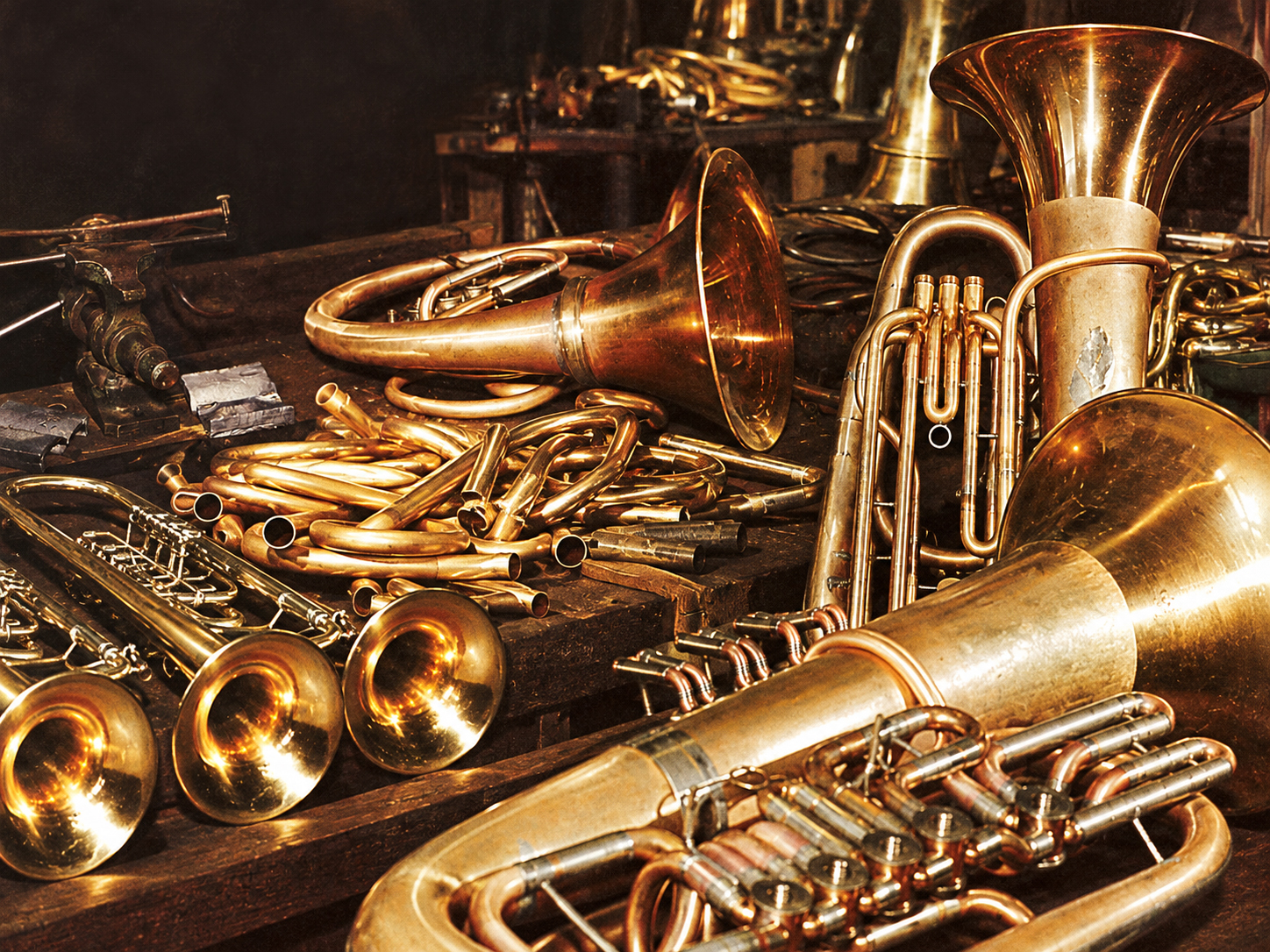
The instruments produced
Around 1820 orchestral horns, invention horns, posthorns, hunting horns, bugles trumpets and trombones were being made, with valve instruments accounting for about 20% of the total production. Makers working on valve instruments included Carl Schuster, C. August Brauer and C. August Zoebisch but the majority of craftsmen built valveless instruments: trombones, hunting horns, posthorns, natural trumpets in B♭ with assorted crooks as well as invention horns in high B♭. Keyed bugles with six to nine keys were also produced.
Rise in standards
Increasing specialisation and the introduction of machines played a decisive role in raising quality standards in Markneukirchen brass instrument production in the second half of the last century as well as in the rapid growth in production capacity. Mouthpiece turners, bell makers, piston and rotary valve builders were trained, also assemblers, who assembled the components to produce a quality product. This cooperative process has continued until today; for top-of-the-range instruments components are supplied by the best makers in each speciality so that the assembler can devote himself completely to his task of producing the final instrument. In the first half of this century the successful development of Markneukirchen brass making was interrupted by two world wars and the international economic crisis. It resumed after the founding of the German Democratic Republic and especially after the setting up of the Markneukirchen Brass and Signalling Instrument Factory in 1953. Since then the firm has become not only the centre of wind instrument production in the Vogtland but also, in view of its production volume, one of the most important European brass and woodwind manufacturers.
A few figures
There are about eighty orchestras in the G.D.R., currently employing around:
330 horns
270 trumpets
260 trombones
45 tubas