Explore institutional access →

2 min. read

Ottoni di Verona

Ottoni di Verona

The Lord helps those who help themselves,” Giordano Fermi¹ must have said to himself one day: so he got busy...

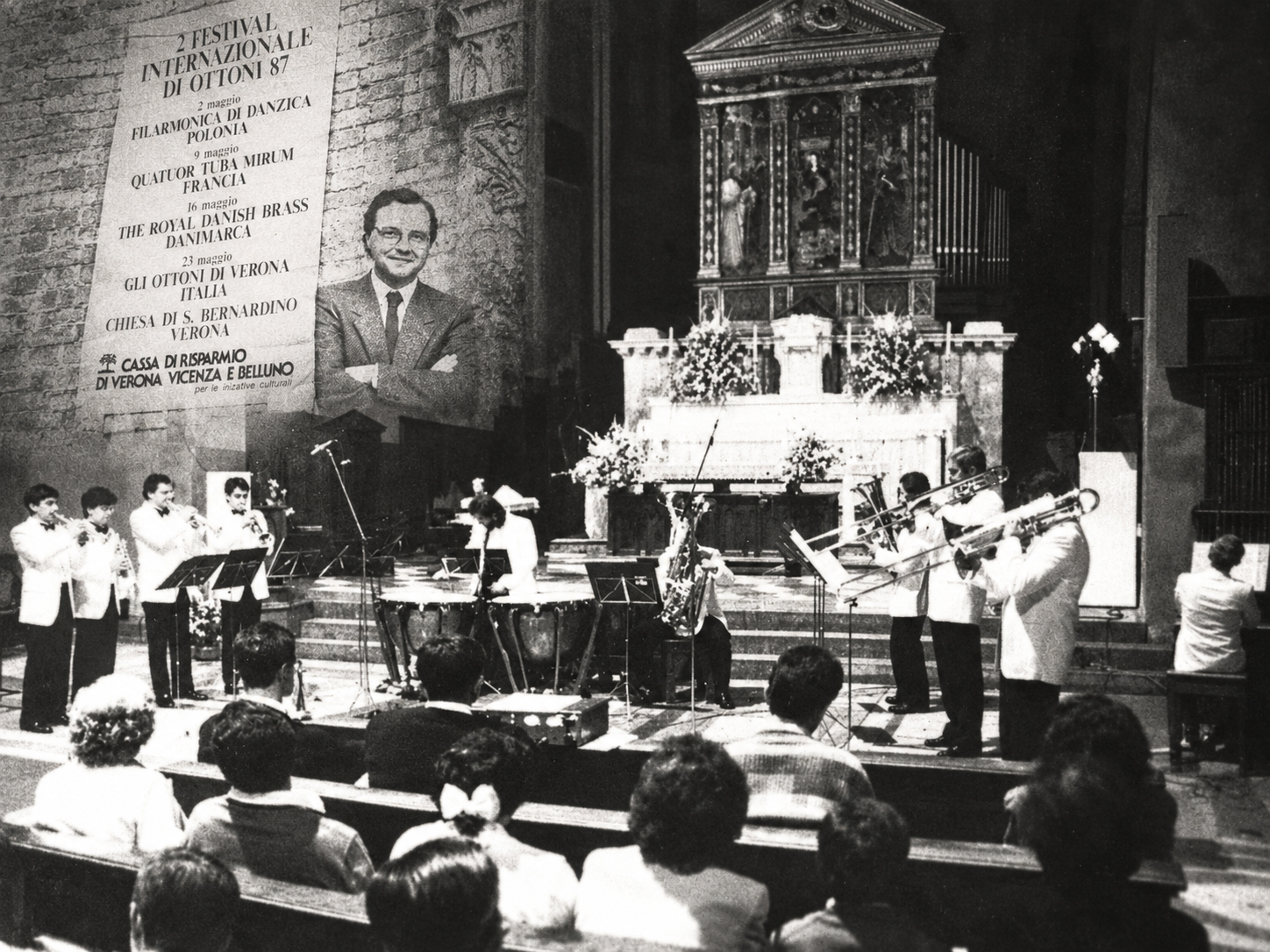
Giordano Fermi started the Verona Brass (Ottoni di Verona in Italian), an ensemble of varying instrumentation (from six to fifteen brass plus organ or percussion) in the mid seventies. Two international competitions, Ancona in 1978 and Stresa in 1980, awarded them 1st prizes, giving them a wonderful start. Since then the group has increased its concert activity, at first in its own area, Venezia and Lombardy, and then farther and farther afield. In 1986 they had a memorable tour in China.

Their repertoire is wide (if only because of their variable instrumentation) and diverse, using both modern and historical instruments.

The current membership is: Ivano Ascari, Ivan Bacchi, Franco Capilupi and Giordano Fermi (trumpets - Bb/C, Baroque, piccolo, flugel); Cristiano Boschesi, Bruno Brunelli, Thomas Reynolds and Alberto Serati (trombones, sackbuts, euphoniums); Oreste Gazzoldi (tuba); Damiano Rossi (organ) and Cesare Bisagni (percussion).

The festival

But Giordano Fermi did not stop there, for his organising talent led him to start the Verona International Brass Festival. A masterstroke! Once he had obtained the solid support of a local bank (the Cassa di Risparmio di Verona, Vicenza e Belluno), he turned aside from the beaten track. Whereas most festivals in this field are concentrated into a few days and offer an exhausting non-stop programme which often fives a superficial impression, the Verona festival (for brass!) has come up with a new and interesting formula: brass ensembles from many countries are invited (often chosen from BRASS BULLETIN presentations, according to Fermi) and their performances spread over a month (May) on the basis of one ensemble per weekend.

Each ensemble gives three concerts in different venues (Verona, Mantua, Schio or Bassano del Grappa) and takes part in an educational seminar at the Mantua Conservatoire, to which all Italian brass players, teachers and students are invited. As all the concerts are recorded, the organisers are able to produce a sampler record of each festival.

What is exceptional about the Verona Brass is that they attract not only brass freaks like ourselves but also a general audience, thus creating a real link between players and listeners and demonstrating to the latter the special resources of our family of instruments.

An example to follow

The success of the first two means it is already possible to announce that the 3rd International Brass Festival will take place in May 1989.

Giordano Fermi has managed to create an exceptional spirit of cultural enterprise which is part of the welcome upturn in Italian brass playing. We can take inspiration from his friendly and efficient formula, which stimulates artistic creation as well as exchange between colleagues and offers new professional outlets for musicians. (See also World News.)

Details and records of the festival and of the Verona Brass are obtainable from:

Gruppo Strumentale Ottoni di Verona, via Sant’Eurosia 8, I-37060 Trevenzuolo/Verona
☎ 045-735 02 13

¹ Giordano Fermi was born in Mantua, in Italy, in 1947. After obtaining his diploma as trumpeter and choral conductor/composer he played with the Verona Amphitheatre Orchestra, the Padua Chamber Orchestra and the «Solisti Veneti». He founded the Verona Brass and has written and transcribed many choral and instrumental works.

Brass Bulletin 59, III / 1987 pages 40–41

All content is protected by copyright © Brass Bulletin 1987–2026

Share this article

Facebook LinkedIn
Loading…

Questions & Answers

How the Digital Edition works

What does the Digital Edition include?

The Digital Edition brings together the articles already digitized as searchable online texts—not simply as scans or PDF files—along with their original illustrations, notes, authorship, issue information, and available translations. Related-article suggestions currently include only this digitized material.

Are the digital articles identical to the originals?

We preserve the original text, language, illustrations, captions, footnotes, and editorial context as faithfully as possible. The presentation is adapted for comfortable online reading, and obvious transcription or scanning errors may be corrected. The substance and character of the published article remain unchanged.

Which languages are available?

Brass Bulletin was published in English, French, and German throughout its history. Italian and Spanish translations were added from issue No. 60 onward.

On the Italian and Spanish sites, articles from issues 1–59 are therefore shown in English by default.

How often are new articles added?

New articles are added almost daily, with approximately one complete issue digitized each week. The pace may vary depending on the preparation, image work, and editorial checking required.

Why aren’t all articles available digitally?

The complete Brass Bulletin collection contains 1,246 articles published between 1971 and 2003. The full index is already available online, allowing readers to discover every article in the collection, including those whose complete text has not yet been digitized.

Digitization began in February 2026. Each article is carefully prepared for online reading, checked, and connected to its issue, authors, subjects, and illustrations. At the current pace of digitization, the complete collection is expected to be available online by February 2028.

Why do some references mention articles that are not available yet?

References in the original articles are preserved even when the material they point to has not yet been digitized. This keeps the historical and editorial record intact. As more issues are added to the Digital Edition, an increasing number of these references will lead to articles that can be read online.

Can I suggest an article or report a transcription error?

Yes. If there is an article you would particularly like to see digitized, or if you notice a possible transcription error or missing detail, please contact us. Reader feedback helps us improve the Digital Edition and prioritize useful connections within the archive.

How can I support Brass Bulletin?

Your support helps fund the preparation, verification, and online publication of the complete collection.

Subscribe to the Digital Edition

Prefer to support us without subscribing?

Make a donation

How is the digitization progressing?

We’re gradually making the Brass Bulletin available online, article by article. You can read newly digitized articles as soon as they’re ready, even before an entire issue is complete.

Visit our Digitization Roadmap to browse recent additions and see estimated availability for upcoming issues. These estimates follow our recent pace and may change.

Search Brass Bulletin.