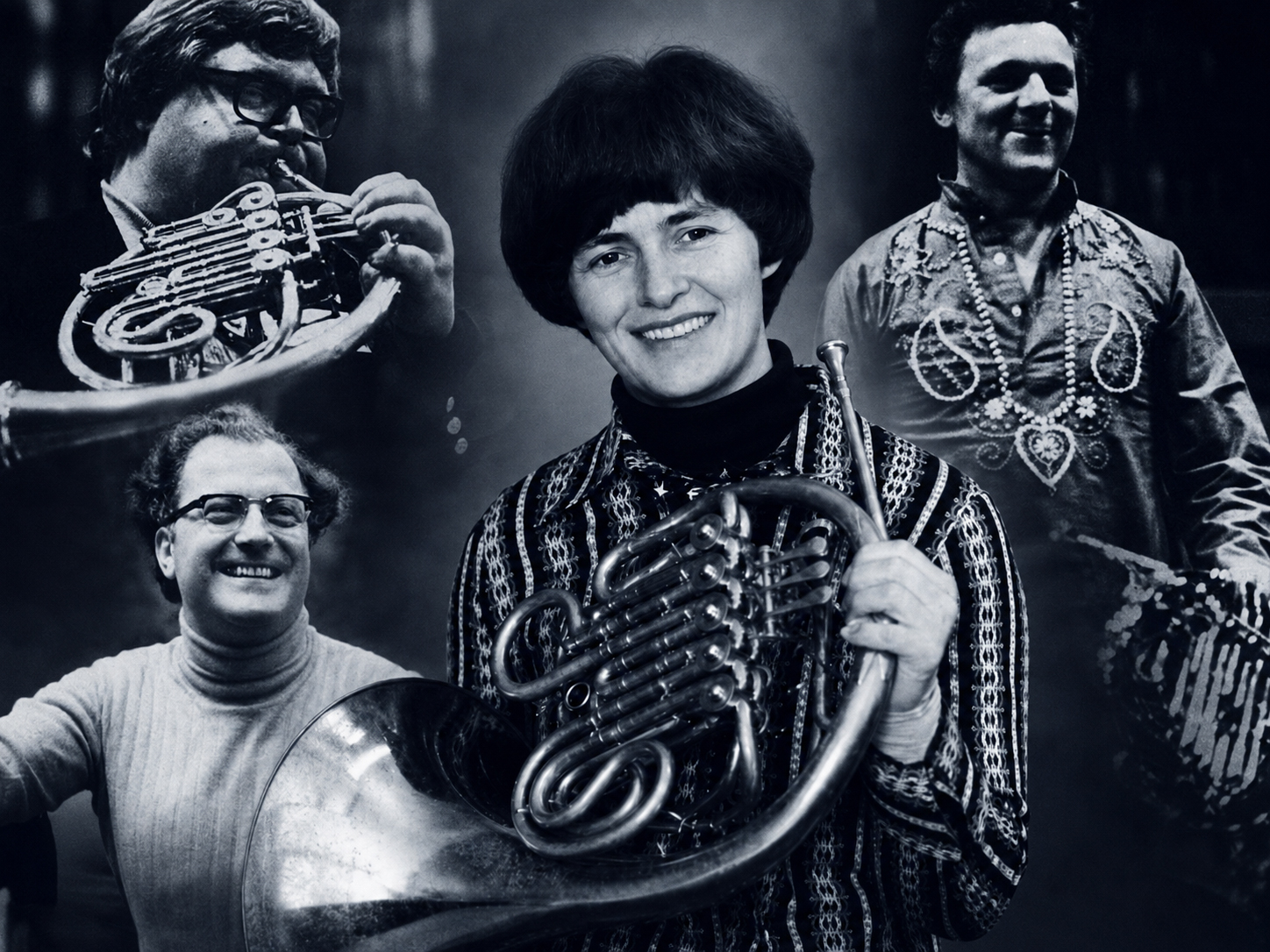
But even more interesting and rewarding than the above was the chance to meet so many new people, renew old friendships, and rub elbows with so many great contemporary horn players. The Biggies were always accessible, helpful, and friendly; and it was almost a relief to find that They too, are real people, with particular strengths and weaknesses and hopes and dreams not unlike your very own.
I remember Ib Lanzky-Otto detailing in a Master Class a particular problem of his with a certain technique. Followed, of course, by a flawless demonstration of that technique. Oh, well.
Without consuming the whole of this magazine, it is impossible to relate everything that happened, so I will have to be content with relating a few representative names and events.
Peter Damm and Herman Jeurissen gave lectures (both of which have appeared in The Horn Call) on the Mozart concerti. Damm postulated that Mozart had conceived of 7 horn concerti, based on the evidence of existing musical fragments.
Jeurissen went further and explained his reconstruction of the first movement of Mozart's Fifth Horn Concerto from a fragment. One could debate the details of the reconstruction, but this much is clear: the movement sounds very much indeed like Mozart, the music is beautiful, and Jeurissen's performance of it (with orchestra) was exquisite.
Does anyone have any more fragments to lend this young man?
One fairly heated panel discussion, one in which everyone was on the same side, was on the use of the discant horn (which I assume includes Bb-high/F double horns). Everyone agreed that the main danger of the discant horn is its use in anything but the highest register and in the appropriate style of music, and that one’s confidence can be threatened by its overuse. Also, almost everyone admitted having one.
Hermann Baumann, in a later lecture on the natural horn, probably spoke the most reasonable words on the subject. He said that all that is in the service of the music is legitimate. The music, not the equipment, is of number one importance. Further, it is not right to damn the discant horn or exclude it from competitions (e.g. trumpet players use small trumpets) in an arbitrary and prejudicial manner.
Even juries, he said, don't rate your equipment piece by piece. The final musical result is what counts, not how you get there.
At the close of this same panel discussion Michael Höltzel asked for a vote of support for a letter that he would send to music publishers to ask them to please leave the horn parts in the original key.
Kurt Janetzky reported that publishers usually answer that "the Americans are to blame. They won't buy parts in the original keys." This was news to the American participants, who were eager to ask the question of their orchestra librarians back home.
The soloists' performances: we were treated to a real Ohrenschmaus, a feast for the ears. Or: a musical smorgasbord, a wide variety of sounds, styles, interpretations, with something for everyone.
To name just a few: Frøydis Ree Wekre again demonstrated her perfect memory and control over difficult material, combined with a beautiful sound and singing phrases.
Except for a minor inconsistency in date of birth, I was sure that the Siegfried Call must have been expressly written for Gerd Seifert.
After Peter Damm finished the Quintet, K.V. 407, I abandoned the idea that I might ever hear any finer performance of Mozart.
I was impressed with Ferenc Tarjáni's ability to render a piece of otherwise not-very-pretty modern music as quite beautiful and enjoyable.
Douglas Hill looked at ease while displaying an astounding virtuosity in performing pieces of his own composition, which I find among the most interesting and enjoyable of the contemporary compositions for horn, partly because they have an emotional content and effect not found or felt in much of such music.
I want to get something off my chest — a few comments on the conditions under which the soloists often had to give recitals.
There was occasionally the annoyance of TV cameras, lights, and crews; or power mowers and tractors outside; but the worst distractions came (unbelievably) from the audience of participants.
Even after repeated requests from Dr. Berg (Director of the Bundesakademie) and Michael Höltzel, there were those who continued to take pictures during performances.
One example: a young man in the front row stood up right in front of a soloist in the last 10 seconds of the finale and got off the loud SLR clack and flash at the last note.
It was admittedly not as bad as at Montreux in 1976, where in addition to the cameras there was loud talking plus 200 cassette machines constantly being snapped on and off during performances.
To all the fools, barbarians, and other insensitives who preferred souvenirs to consideration for the soloists and the listeners — shame! Shame on you. Think about it. And wait until during the applause to shoot next time.
The high point of the week — literally — was our journey to the Burg Hohenzollern, a fortress-castle perched on a high conical hill, where we were treated to the same spectacular view and sunset enjoyed by the royal Hohenzollerns.
The music we heard was also worthy of a prince (and indeed, Prince Louis Ferdinand was in attendance) — with performances first in the courtyard from Höltzel's Detmold horn group and from Peter Damm on alphorn, and then in the ornate Grafensaal by five young players aged 17 to 23: Jakob Slagter, Matthias Berg, Kerstin Künkele, Radovan Vlatković, and Bruno Schneider.
They played splendidly, gloriously, with ease and confidence.
Closing the program, an ensemble of a dozen (or so) of the world's best hornists played Karl-Heinz Köper's Coup des Cors (Burleske für 12 Hörner), followed by Alan Civil's even more outrageous arrangement of Egmont Overture for A Lot of Horns.
It was virtuoso madness, thoroughly enjoyed by everyone.
Next was a stand-up buffet, with too few sandwiches and too much wine, enough said...
All in all, it was a most rewarding, if exhausting week.
No doubt many of the facts and dates learned from the lectures will soon fade from memory, but that kind of thing is never the point of such get-togethers anyway.
The most important thing gained from this or any workshop is the warm, lingering feeling from making or renewing many friendships with interesting people from everywhere, soloist and participant alike.
The short week of sounds, contacts, and good times provided a stimulation, a renewed enthusiasm for the instrument and its music, the resonance of which will still be felt long afterwards.
I envy those people who can attend a workshop every year.
There was something said about a symposium in Avignon next year, hosted by Daniel Bourgue:
Où est mon livre de grammaire française ?