Le traduzioni italiane originali di Brass Bulletin iniziano con il n. 60.

6 min di lettura

A modern corno da caccia

A modern corno da caccia

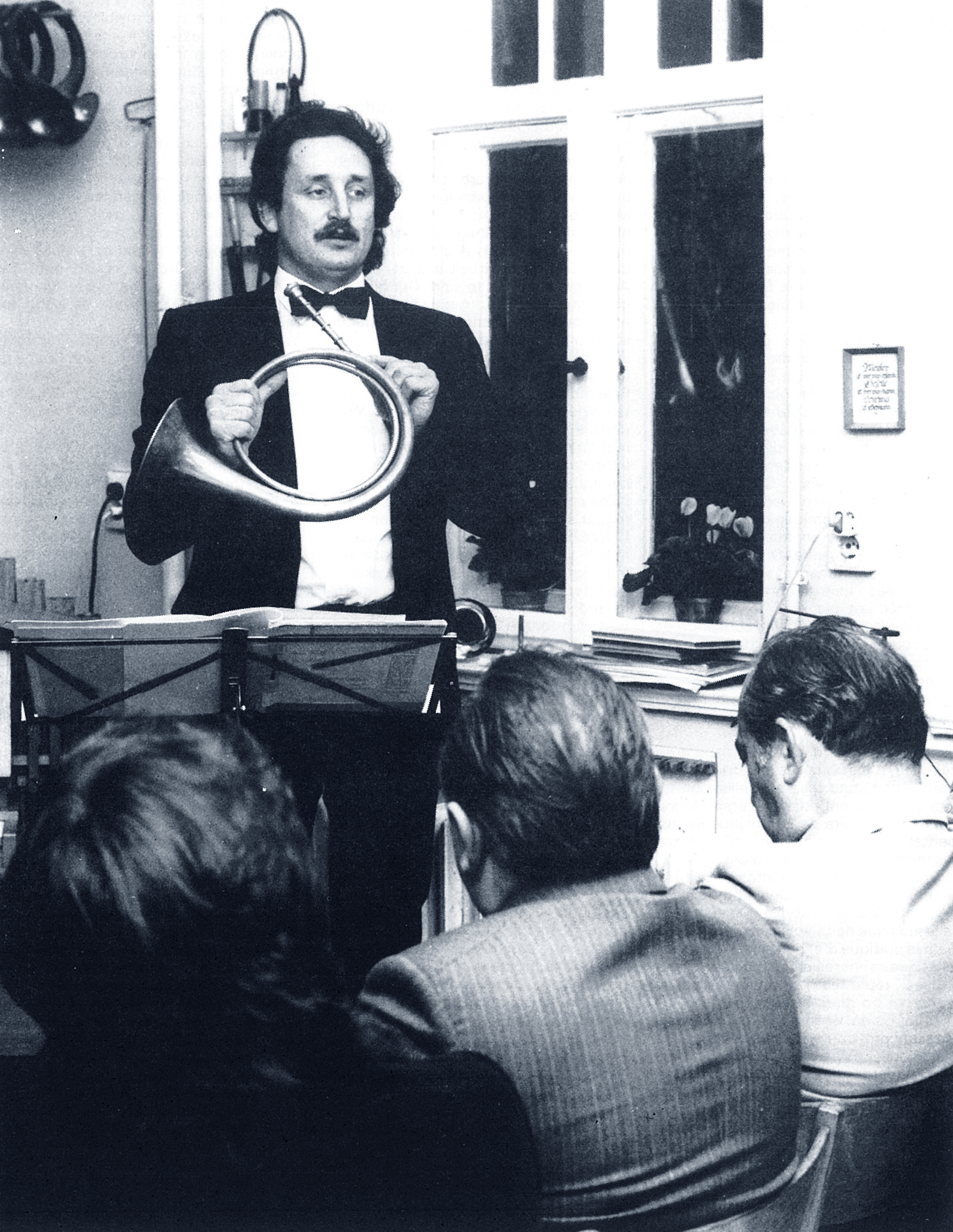
Ludwig Güttler, Professor of trumpet at the Dresden College of Music, demonstrating the corno da caccia.

The use of modern harpsichords for the performance of music from before 1760 is now widely accepted. The viola da gamba and oboe d’amore are also appearing, at least in musical centres. The oboe da caccia, however, because of the lack of usable instruments, often has to be replaced by the cor anglais which, though certainly related, was developed only in the 19th century, and then to produce darker tone colours. Even more problematical is the case of the instrument known in Italian as corno da caccia (literally “hunting horn”, appearing in French as trompe or cor de chasse and in German as Jagdhorn) which is called for not only in the instrumental and vocal music of the 18th century but also in solo concertos with instrumental accompaniment.

One of the most difficult examples in current performing practice is in Johann Sebastian Bach’s “B minor Mass”. The bass aria “Quoniam tu solus sanctus” in the Gloria calls for a corno da caccia in D using a range from D below the treble stave to high D (written C below to high C for D horn). The player had to change immediately from D horn to D trumpet for the attacca following chorus “Cum sancto spiritu”, where he is joined by two other D trumpets. Here the 1st trumpet rises several times to E above the stave while the 3rd has several times to play D below the stave.

Nowadays, without further ado, the horn part of the Quoniam is played on an orchestral horn an octave lower than written since it is not playable at its original pitch on this instrument, which was developed in the 19th century. No further thought is given to whether this is in keeping with the structure and character of the piece or whether Bach would have considered this register symbolic of the words tu solus altissimus Jesu Christe (Thou alone art the Highest, Jesus Christ), nor indeed to the thematic connection and tonal contrast with the ensuing chorus “Cum sancto spiritu” (With the Holly Ghost in the glory of God the Father, Amen). Clearly Bach wanted to characterise Jesus Christ as the Highest with the softer horn while using the more brilliant trumpets for the “splendour of God”. Even in the complete recording by the Vienna Concentus musicus conducted by Nicolaus Harnoncourt, which uses original 18th century instruments, the Quoniam horn part is played an octave lower than written.

Another present-day habit is to have high horn parts played by trumpets. This happens for example in the concerto in E♭ major for cor de chasse, rediscovered in Czechoslovakia and published in 1967, written by the Czech composer Jan Krtitel Jiri (or Johann Baptist Georg) Neruda (1706–1780), violinist and later concert master in the Dresden Court Orchestra from 1742 to 1772. It is scarcely playable on the orchestral horn yet enjoyable and challenging on the trumpet. The trumpet sound is different, however, not so soft as the 18th century horn sound even when the player manages to produce a light, soft sound.

The modern orchestral horn, on the other hand, has too much of a dark, baritone colour which does not suit the character of late 18th century music.

Dissatisfaction with this state of affairs prompted some enlightened instrument makers and players to look for new solutions. Among the makers who have done pioneer work here is Friedbert Syhre in the Bach city of Leipzig (GDR). First, in 1978, he developed a new F horn with the tonal character of the 18th-century corno da caccia but also the technical advantage of valves. On the basis of the experience amassed with this he then built a double horn in high B♭ and high F which was exhibited at the Leipzig Autumn Fair in 1980 and was awarded a gold medal. It was tested by the solo horns of the Gewandhaus and Dresden State orchestras, Waldemar Schieber and Peter Damm. The cantor of St. Thomas’s church, Professor Hans-Joachim Rotzsch, also declared himself in favour of this new instrument in the Bach style. Meantime it was also used by Peter Damm in his recording of the “Sonata no. 1” by Giovanni Buonaventura Viviani for the record “Music for Horn and Organ from Dresden Cathedral”, made by VEB Deutsche Schallplatten in East Berlin.

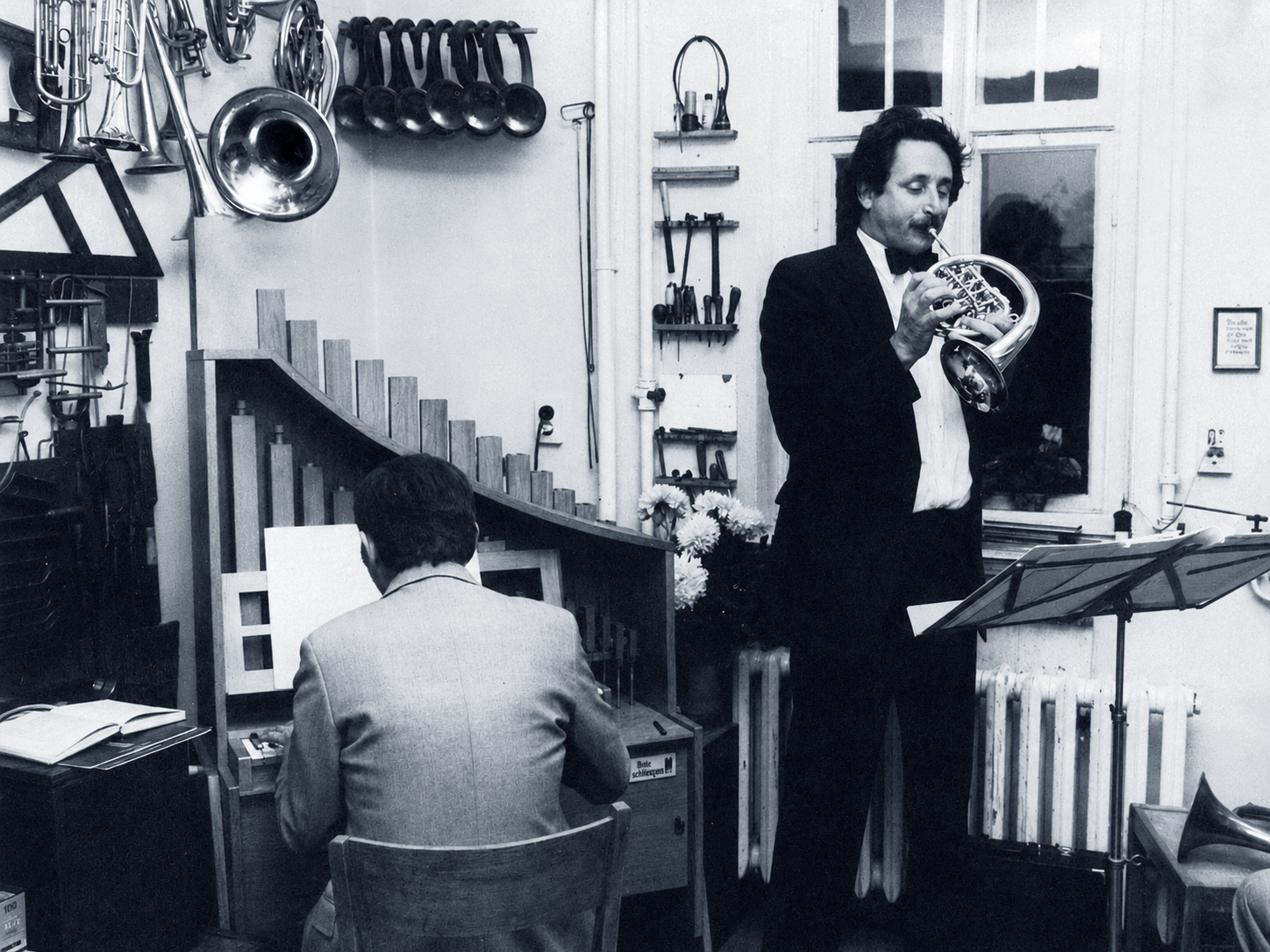
Ludwig Güttler during Friedbert Syhre’s 2nd Music Workshop.

Ludwig Güttler during Friedbert Syhre’s 2nd Music Workshop.

But parts for descant horn in D cannot be played even on this. At this point the impetus for developing yet another instrument came from the trumpet soloist Ludwig Güttler, professor of trumpet at the Dresden College of Music and associated primarily with the Dresden Philharmonic and the New Bach Collegium Musicum in Leipzig. He has made an intensive study of the 17th and 18th century repertoire for trumpet and horn as well as of performance practice and the instruments themselves. The fact that 18th-century brass players were usually as competent on the valveless corno da caccia at the written pitch as they were on the valveless trumpet played an important part in his considerations. Surviving works prove that, particularly in that part of the German-speaking world corresponding to the GDR today — in Dresden, Leipzig, Halle and Weissenfels — the art of trumpet playing and that of horn playing were equally developed. In addition to Bach other composers including Zachow, Keiser and Neruda wrote parts for trumpet and horn in the high register.

As far as the practice in Leipzig was concerned, Bach’s scores and his “Brief but essential outline of duly appointed church music” indicate that the trumpet and horn parts were performed by the same players; for the two instruments are never used simultaneously and the names of the two town musicians permanently employed to play them are given in the “Outline”: the famous Gottfried Reiche and Johann Cornelius Genther. The facts also indicate that these players used the same mouthpieces, cup mouthpieces, for both instruments.

For his experiments in sound and playing technique Ludwig Güttler first had a valveless natural horn built by the instrument maker Thein. On this he was able to play the high horn parts of Bach and his contemporaries with fine sound and surprising security. Going on from there he next asked the Leipzig master instrument maker Friedbert Syhre to build a new descant horn in D corresponding to the tonal character of the corno da caccia but benefiting from the much greater technical security of the valve horn, with right-hand valves as on the modern trumpet. For playing other parts Syhre also made Güttler a descant horn in B♭ with four right-hand valves.

Güttler explained and demonstrated the results of his investigations and experiments at Friedbert Syhre’s 2nd Music Workshop during the Leipzig Fair in the presence of instrumentalists, conductors, instrument makers and musicologists. The great tonal differences between the former corno da caccia and the modern orchestral horn immediately became clear, as did also the great tonal similarities between the reconstructed valveless horns and the new descant horn in D developed by Syhre.

These descant horns in D and in B♭ had already been used for disc recordings with VEB Deutsche Schallplatten of East Berlin in collaboration with Ariola Eurodisc. In the new recording of Bach’s “B minor Mass”, with the radio chorus and the New Bach Collegium Musicum of Leipzig, conducted by Peter Schreier, Ludwig Güttler plays the Quoniam horn part (bass: Theo Adam) for the first time at Bach’s original pitch and then the 1st trumpet part in “Cum sancto spiritu”. The features mentioned above become compellingly clear in this recording. In the recordings of the “Pentecost Cantata, no. 68”, Also Gott die Welt geliebt, and the “Reformation Cantata, no. 79”, Gott, der Herr, ist Sonn’ und Schild, with the choir of St. Thomas and the New Bach Collegium Musicum of Leipzig, conducted by Hans-Joachim Rotzsch, the 1st horn parts are played by Güttler on the new B♭ horn. The sound of these instruments suits the character and structure of the works, especially in “Cantata, no 68” where the horn joins the chorus sopranos, the 1st violins and the 1st oboe.

Friedbert Syhre’s instrument and Ludwig Güttler’s artistic playing prove that it is both possible and sensible to combine the sound of early instruments with the achievements in construction and performance technique made since the 19th century. Nor is there any problem in producing right-handed horns for trumpeters and left-handed ones for horn players. The question of whether these high horn parts should be played by trumpeters or horns players, in view of the long-standing “demarcation” between the two groups, will certainly be solved in practice and this will of course be due above all to the personal desire and ability of the players. If both 1st trumpets and 1st horns master the descant horn, that can only be good for music.

With their construction of the first right-handed descant horns in D and B♭ and of left-handed double horns in high B♭ and high F the Syhre workshop has made a pioneering contribution, the value of which it would be difficult to overestimate, to stylistically correct and therefore much livelier performance of music from before 1760 and in particular of the music of Bach. It is easy to foresee the artistic and of course economic significance this work has, and the requests which may be expected. The path chosen here — that of producing new instruments on the tonal model of historical ones, but incorporating recently developed improvements in construction and performance technique — seems to me the most sensible. Ensembles using historical instruments, such as the Vienna Concentus Musicus and the Capella Fidicinia at the Musical Instrument Museum of Karl Marx University in Leipzig, must remain exceptions since, for one thing, few historical instruments are available and, for another, such specialisation will only rarely be possible, given the comprehensive repertoire of instrumental music and the corresponding increase in musicians’ obligations.

And yet it is a deeply felt requirement of our cultural heritage to grasp the spirit and the stylistic and tonal essence of the music of early centuries. Study of the performance practice and the tonal characteristics of every age and their reproduction for today’s audiences make this music come much more alive than did the practice, still common in the first half of the 20th century, of adapting it to modern performing practices. Instrument makers have something important to say in all this. After this example set by Friedbert Syhre the next task will be to develop instruments corresponding to the former oboe da caccia and cornetto. This call is directed to woodwind makers, and woodwind players and instrument historians should work closely together with them.

Brass Bulletin 46, II / 1984 pagine 42–48

Tutti i contenuti sono protetti dal diritto d’autore © Brass Bulletin 1984–2026

Condividi questo articolo

Facebook LinkedIn
Loading…

Domande e risposte

Come funziona l’edizione digitale

Che cosa comprende l’edizione digitale?

L’edizione digitale riunisce gli articoli già digitalizzati sotto forma di testi leggibili e ricercabili online — non semplicemente come scansioni o file PDF — insieme alle illustrazioni originali, alle note, agli autori, alle informazioni sul numero della rivista e alle traduzioni disponibili. I suggerimenti di articoli correlati comprendono attualmente solo questo materiale digitalizzato.

Gli articoli digitali sono identici agli originali?

Conserviamo il più fedelmente possibile il testo originale, la lingua, le illustrazioni, le didascalie, le note e il contesto editoriale. La presentazione viene adattata per una lettura confortevole online e gli evidenti errori di trascrizione o scansione possono essere corretti. Il contenuto e il carattere dell’articolo pubblicato rimangono invariati.

Quali lingue sono disponibili?

Brass Bulletin è stato pubblicato in inglese, francese e tedesco nel corso di tutta la sua storia. Le traduzioni italiane e spagnole sono state aggiunte a partire dal numero 60. Sui siti italiano e spagnolo, gli articoli dei numeri da 1 a 59 vengono quindi mostrati in inglese per impostazione predefinita.

Con quale frequenza vengono aggiunti nuovi articoli?

Nuovi articoli vengono aggiunti quasi ogni giorno, con circa un numero completo digitalizzato ogni settimana. Il ritmo può variare in base al lavoro di preparazione, elaborazione delle immagini e verifica editoriale necessario.

Perché non tutti gli articoli sono disponibili in formato digitale?

La collezione completa di Brass Bulletin comprende 1.246 articoli pubblicati tra il 1971 e il 2003. L’indice completo è già disponibile online e consente di scoprire tutti gli articoli della collezione, compresi quelli il cui testo integrale non è ancora stato digitalizzato.

La digitalizzazione è iniziata nel febbraio 2026. Ogni articolo viene accuratamente preparato per la lettura online, verificato e collegato al relativo numero, agli autori, agli argomenti e alle illustrazioni. Al ritmo attuale di digitalizzazione, la collezione completa dovrebbe essere disponibile online entro febbraio 2028.

Perché alcuni riferimenti citano articoli che non sono ancora disponibili?

I riferimenti presenti negli articoli originali vengono conservati anche quando il materiale a cui rimandano non è ancora stato digitalizzato. In questo modo si preserva l’integrità storica ed editoriale della rivista. Man mano che nuovi numeri vengono aggiunti all’edizione digitale, un numero crescente di questi riferimenti condurrà ad articoli leggibili online.

Posso suggerire un articolo o segnalare un errore di trascrizione?

Sì. Se desiderate che un determinato articolo venga digitalizzato, oppure se notate un possibile errore di trascrizione o un’informazione mancante, contattateci. I riscontri dei lettori ci aiutano a migliorare l’edizione digitale e a stabilire priorità utili all’interno dell’archivio.

Come posso sostenere Brass Bulletin?

Il vostro sostegno contribuisce a finanziare la preparazione, la verifica e la pubblicazione online dell’intera collezione.

Abbonati all’Edizione digitale

Preferite sostenerci senza abbonarvi?

Fate una donazione

Cerca in Brass Bulletin.