Explore institutional access Explore institutional access

2 min. read

Editorial

Editorial

The second International Brass Congress (IBC2) took place recently. Readers will remember the first, which was held in Montreux, in Switzerland, in 1976 thanks to the Institute for Advanced Musical Studies (an ephemeral “US-international” institute which for several years benefited from the amazing generosity of an extremely wealthy Italian-American businessman).

That first meeting was an inspiration to the 500 brass players who took part. An outstanding bill of about 150’000 Swiss francs ($ 80’000) had to be paid by the Institute (its last act of generosity before disappearing from the scene). The founder, the tuba player Harvey Phillips, had envisaged a congress every four years but the economic problems of the last few years prevented him from doing so and it was certainly not easy to find a town and an institution which would agree to assume the inevitable deficit (IBC2 is said to have a budget of $ 200’000). Harvey Phillips, together with his colleagues from the various American guilds, eventually found the necessary support on his doorstep in Bloomington, at Indiana University, in one of the biggest schools of music in the world.

First problem

The location. Bloomington is a small university town and not very easy to get to, especially from overseas (Washington, New York, Boston or Chicago would have been easier) but it had to be done where possible.

Second problem

The date. The musical season and the academic year in American institutions are different from most of those in other countries, especially from those in Europe, where the music college exam period is at its height and the concert season has not finished. The dates 3rd-8th June were convenient from a US domestic point of view and so, understandably enough, they were chosen. The home market had to be considered first. The American brass guilds, although styled “international”, are in fact national, and characteristically American, in their structure, in keeping with the special criteria of that great country.

Third problem

The cost. The American guilds have organised several collections with a view to setting up scholarships to help students to participate. These scholarships will, naturally, go first to young American students. Meanwhile foreigners have to pay the whole cost of transport (which is considerable) as well as accomodation and congress fees (both of which are reasonable).

Not the same

When our American friends honoured us with their presence in Montreux, they were able to benefit from an American organisation on the spot, having travelled on advantageous charter flights. The official language — even in Montreux — was English.

The guilds are useful

Noting a number of problems in establishing internationalism does not mean that one is against this kind of association. It seems obvious that such organisations can help facilitate and develop an exchange of ideas and stimulate a widening of knowledge (although one has to beware of the singular lack of healthy argument which friendly instrumental associations engender — “Everybody’s great, everybody’s nice”).

It must also be recognised that the American guilds have not succeeded in taking a hold of brass players as they had hoped. Their “international” penetration has always been very modest and unrepresentative, despite all their efforts. This is one message which is very clear and which our transatlantic friends should read.

Refusal of hegemony

The world is rich and varied and must remain so. That there should be global influences is a good thing, but we must resist hegemony.

Welcome initiatives

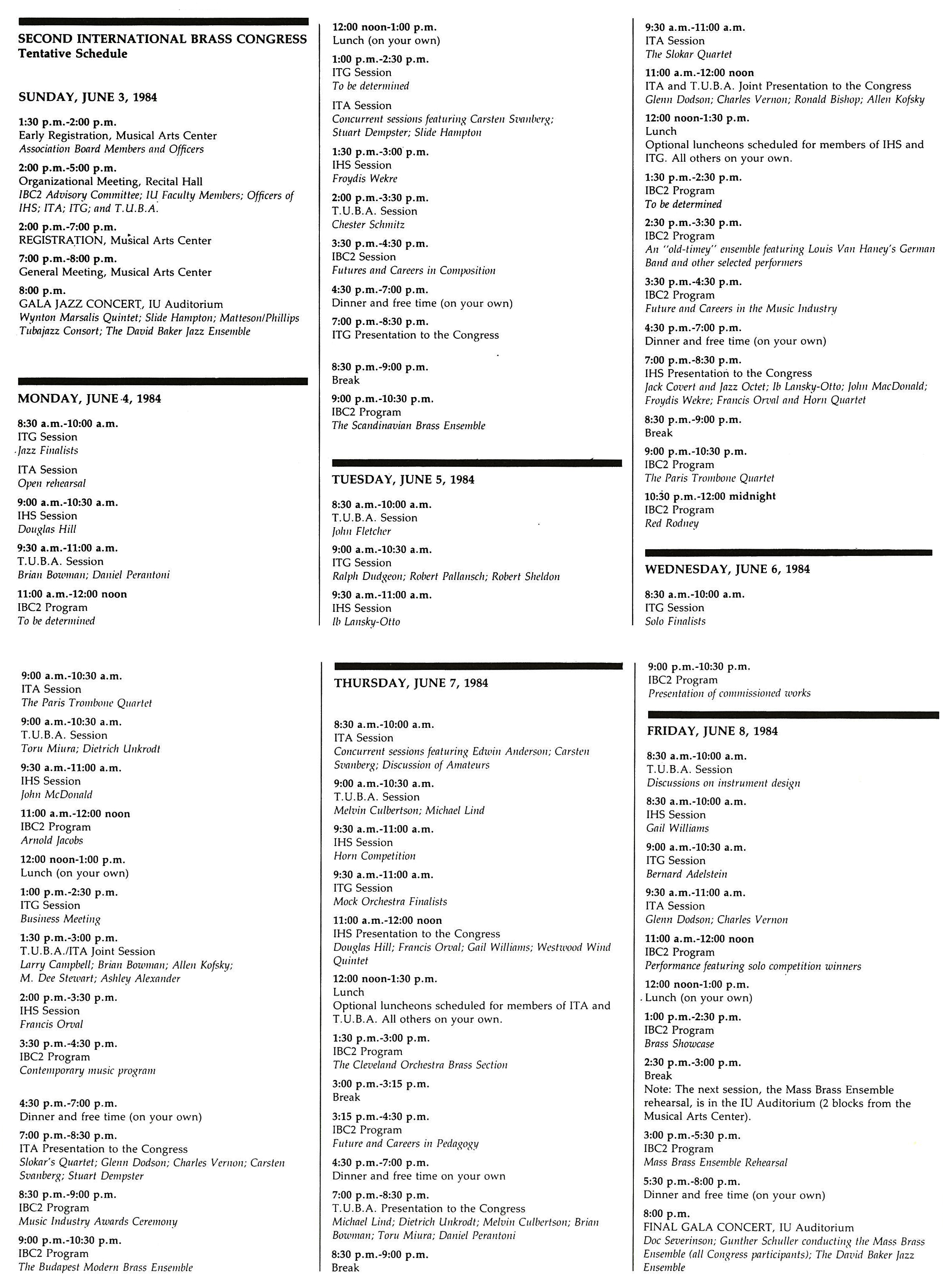
In the last few years we have noted the founding of national associations in many countries. These associations bear clear and legitimate names (French National Horn Association, French Trombone Guild, Japanese Trumpet Guild). BRASS BULLETIN views this movement sympathetically and supports it. It is a good thing that every country, indeed every region, should research and cultivate its identity and pass it on to its artists. On that basis nothing should stand in the way of international exchanges; quite the opposite, indeed. However — the IBC2 organisers have set up a marathon of fabulous events which makes it all the more unfortunate not to be able to attend (see below).
Brass Bulletin image

Brass Bulletin 46, II / 1984 pages 9–11

All content is protected by copyright © Brass Bulletin 1984–2026

Share this article

Facebook LinkedIn
Loading…

Questions & Answers

How the Digital Edition works

What does the Digital Edition include?

The Digital Edition brings together the articles already digitized as searchable online texts—not simply as scans or PDF files—along with their original illustrations, notes, authorship, issue information, and available translations. Related-article suggestions currently include only this digitized material.

Are the digital articles identical to the originals?

We preserve the original text, language, illustrations, captions, footnotes, and editorial context as faithfully as possible. The presentation is adapted for comfortable online reading, and obvious transcription or scanning errors may be corrected. The substance and character of the published article remain unchanged.

Which languages are available?

Brass Bulletin was published in English, French, and German throughout its history. Italian and Spanish translations were added from issue No. 60 onward.

On the Italian and Spanish sites, articles from issues 1–59 are therefore shown in English by default.

How often are new articles added?

New articles are added almost daily, with approximately one complete issue digitized each week. The pace may vary depending on the preparation, image work, and editorial checking required.

Why aren’t all articles available digitally?

The complete Brass Bulletin collection contains 1,246 articles published between 1971 and 2003. The full index is already available online, allowing readers to discover every article in the collection, including those whose complete text has not yet been digitized.

Digitization began in February 2026. Each article is carefully prepared for online reading, checked, and connected to its issue, authors, subjects, and illustrations. At the current pace of digitization, the complete collection is expected to be available online by February 2028.

Why do some references mention articles that are not available yet?

References in the original articles are preserved even when the material they point to has not yet been digitized. This keeps the historical and editorial record intact. As more issues are added to the Digital Edition, an increasing number of these references will lead to articles that can be read online.

Can I suggest an article or report a transcription error?

Yes. If there is an article you would particularly like to see digitized, or if you notice a possible transcription error or missing detail, please contact us. Reader feedback helps us improve the Digital Edition and prioritize useful connections within the archive.

How can I support Brass Bulletin?

Your support helps fund the preparation, verification, and online publication of the complete collection.

Subscribe to the Digital Edition

Prefer to support us without subscribing?

Make a donation

Search Brass Bulletin.