Explore institutional access Explore institutional access
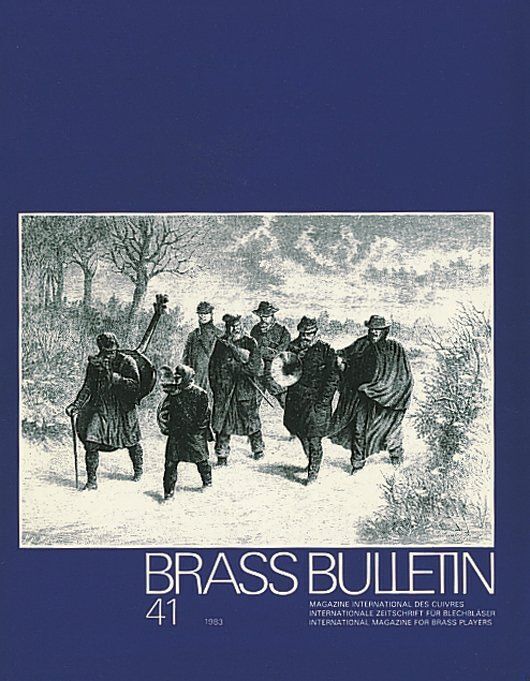
Brass Bulletin 41 - 1 / 1983
Issue
Brass Bulletin No. 41
Date
I / 1983
Pages
80
Contents
8 articles

Out of print

All issues

Brass Bulletin No. 41

I / 1983

Contents

8 articles

Editorial

Jean-Pierre Mathez

pp. 7–9 Professional life Teaching

When careers pause and certainty fades, real progress begins in private, where discipline, friendship and chamber music reshape what it means to be a musician.

The Wrong Brass?

Rudolf Lewy

pp. 10–15 Repertoire Equipment

Between blind fidelity and reckless modernisation, instrument substitutions force performers to decide when the score’s wording serves—or betrays—the music.

The attack

Louis Davidson

pp. 16–19 Trumpet Technique Teaching

Precision often begins with doing less, not more—a principle Louis Davidson places at the heart of trumpet playing with surprising practical consequences.

Jazz and the Horn

Part 2

Julius Watkins

Jeffrey Agrell

pp. 20–23 Horn Encounters Professional life

A pioneering career, landmark recordings and collaborations with jazz legends gave the French horn a place it had never occupied before.

Musical Piracy

Plagiarism, Photocopying

Jean-Pierre Mathez

pp. 25–27 Society Professional life

Long before digital piracy, publishers and performers were already confronting plagiarism, photocopying and blurred artistic ownership across the brass world.

Oscillatory Mechanism of the Glotis in Horn Playing

Philippe-Henri Dejonker, Francis Orval, R. Miller, R. Sneppe

pp. 28–35 Horn Technique Research

A horn note may begin before it is heard, as subtle vocal-fold oscillations appear to prepare the airflow that the lips will ultimately shape.

Science and Technology in Trombone Teaching

Sergej Gorovoj

pp. 37–38 Trombone Teaching Acoustics

What if tone production depended less on instinct than on understanding how the instrument, the lips and the air function as one interconnected system?

10 Outstanding Trumpet Players in the Los Angeles Area

Boyde Hood

pp. 43–53 Trumpet Encounters Professional life

Behind the polished sound of Los Angeles studio trumpet playing stood remarkably similar training, disciplined routines, and a craft shaped by constant stylistic demands.

Loading…

Questions & Answers

How the Digital Edition works

What does the Digital Edition include?

The Digital Edition brings together the articles already digitized as searchable online texts—not simply as scans or PDF files—along with their original illustrations, notes, authorship, issue information, and available translations. Related-article suggestions currently include only this digitized material.

Are the digital articles identical to the originals?

We preserve the original text, language, illustrations, captions, footnotes, and editorial context as faithfully as possible. The presentation is adapted for comfortable online reading, and obvious transcription or scanning errors may be corrected. The substance and character of the published article remain unchanged.

Which languages are available?

Brass Bulletin was published in English, French, and German throughout its history. Italian and Spanish translations were added from issue No. 60 onward.

On the Italian and Spanish sites, articles from issues 1–59 are therefore shown in English by default.

How often are new articles added?

New articles are added almost daily, with approximately one complete issue digitized each week. The pace may vary depending on the preparation, image work, and editorial checking required.

Why aren’t all articles available digitally?

The complete Brass Bulletin collection contains 1,246 articles published between 1971 and 2003. The full index is already available online, allowing readers to discover every article in the collection, including those whose complete text has not yet been digitized.

Digitization began in February 2026. Each article is carefully prepared for online reading, checked, and connected to its issue, authors, subjects, and illustrations. At the current pace of digitization, the complete collection is expected to be available online by February 2028.

Why do some references mention articles that are not available yet?

References in the original articles are preserved even when the material they point to has not yet been digitized. This keeps the historical and editorial record intact. As more issues are added to the Digital Edition, an increasing number of these references will lead to articles that can be read online.

Can I suggest an article or report a transcription error?

Yes. If there is an article you would particularly like to see digitized, or if you notice a possible transcription error or missing detail, please contact us. Reader feedback helps us improve the Digital Edition and prioritize useful connections within the archive.

How can I support Brass Bulletin?

Your support helps fund the preparation, verification, and online publication of the complete collection.

Subscribe to the Digital Edition

Prefer to support us without subscribing?

Make a donation

Search Brass Bulletin.