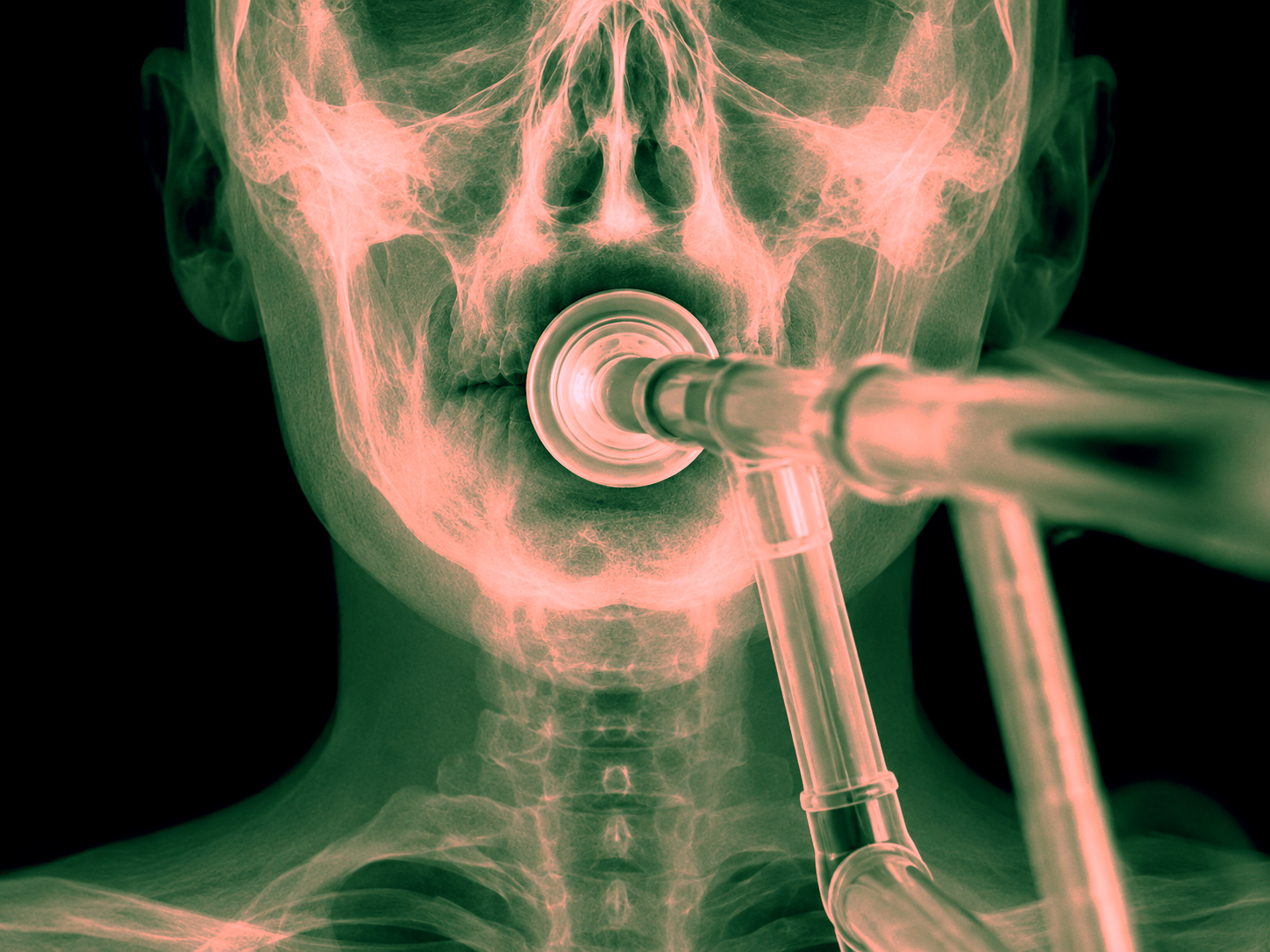
And yet a theoretical basis exists: B. P. Konstantinov's theory of the automatic oscillation of a wind-instrument reed, set out in his book Hydro-dynamic sound production and the propagation of sound in a restricted space. Briefly, this states that a wind instrument is an acoustic system with an inherent, structurally determined frequency of oscillation. In the case of the trombone this frequency with the slide in the 1st position is 58.270 Hz, i.e. pedal Bb. (Each slide position has a different inherent frequency and so produces a different pedal note; the remainder of the instrument's compass consists of overtones of these seven notes.) Excitation of the system depends on the generator being tuned to the same frequency as the rest of the system, as has been shown experimentally using a trombone blown by a mechanically produced airstream and a rubber valve (rubber “lips”) without a musician. This experiment showed that it was necessary to use a separate rubber valve for each note produced, indicating that the player must be able, in a sense, to “change his embouchure”, or to be more precise to change the oscillation frequency of his lips, for each note. (This matching of generator frequency to system frequency is only essential at the beginning of the note; once the note is sounding, the system takes over and itself determines the frequency of the generator.)
The ability to match the frequency of the lip oscillation to the frequency of the desired note presupposes an understanding of the functioning of the lip muscles, especially the ring-shaped orbicularis oris which surrounds the mouth and the opposed muscles radiating from it, for these govern the embouchure. A transparent mouthpiece, rather than a mouthpiece visualiser, is very helpful in monitoring the action of the lips in working conditions.
Two further points must be borne in mind if this acoustic system of player and instrument is to be made to function correctly: the first is an adequate energy supply, which here means correct breathing, which in turn means diaphragm breathing; the second is control over the speed of the airstream, which is achieved by raising and lowering the tongue in order respectively to reduce and increase the size of the mouth cavity through which the air flows (tongue high for high notes, low for low notes). Monitoring of the tongue position while playing requires X-ray photography.
If all these conditions have been met, the way is clear for good sound production. As a final check: if the player can produce light, clear sounds without using the tongue, this is an indication that all the conditions have indeed been met.