Ofrezca Brass Bulletin en su universidad, conservatorio o biblioteca Descubra el acceso institucional

3 min de lectura

Science and Technology in Trombone Teaching

Science and Technology in Trombone Teaching

Although we live in an age of great scientific and technological advances, very little of what has been written on the practice and teaching of instrumental performance has a sound scientific basis.

As brass players we all know the importance of good, clear sound production and we recognise the good fortune of those of our colleagues who have this gift naturally. For the rest of us the only way to make up for the lack of this natural gift is to understand the nature of sound production and the role of the musician and then consciously to adapt the various individual factors so as to improve the sound production.

In all the studies carried out on this subject to date a striking feature is the absence of a common theoretical basis or starting point; this lack greatly reduces the practical usefulness of such studies, whose aims (better playing and better teaching) are entirely practical.

And yet a theoretical basis exists: B. P. Konstantinov's theory of the automatic oscillation of a wind-instrument reed, set out in his book Hydro-dynamic sound production and the propagation of sound in a restricted space. Briefly, this states that a wind instrument is an acoustic system with an inherent, structurally determined frequency of oscillation. In the case of the trombone this frequency with the slide in the 1st position is 58.270 Hz, i.e. pedal Bb. (Each slide position has a different inherent frequency and so produces a different pedal note; the remainder of the instrument's compass consists of overtones of these seven notes.) Excitation of the system depends on the generator being tuned to the same frequency as the rest of the system, as has been shown experimentally using a trombone blown by a mechanically produced airstream and a rubber valve (rubber “lips”) without a musician. This experiment showed that it was necessary to use a separate rubber valve for each note produced, indicating that the player must be able, in a sense, to “change his embouchure”, or to be more precise to change the oscillation frequency of his lips, for each note. (This matching of generator frequency to system frequency is only essential at the beginning of the note; once the note is sounding, the system takes over and itself determines the frequency of the generator.)

The ability to match the frequency of the lip oscillation to the frequency of the desired note presupposes an understanding of the functioning of the lip muscles, especially the ring-shaped orbicularis oris which surrounds the mouth and the opposed muscles radiating from it, for these govern the embouchure. A transparent mouthpiece, rather than a mouthpiece visualiser, is very helpful in monitoring the action of the lips in working conditions.

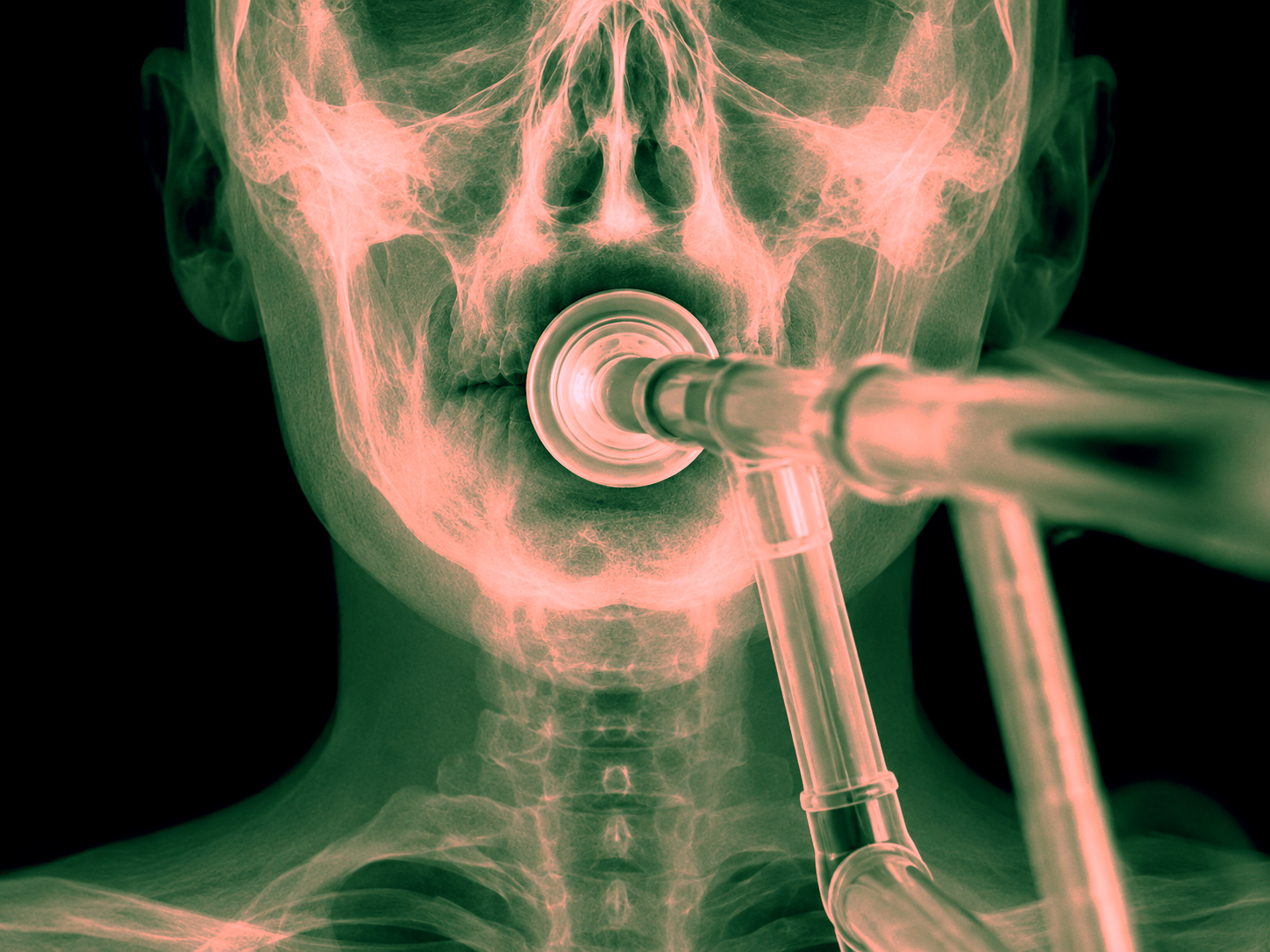
Two further points must be borne in mind if this acoustic system of player and instrument is to be made to function correctly: the first is an adequate energy supply, which here means correct breathing, which in turn means diaphragm breathing; the second is control over the speed of the airstream, which is achieved by raising and lowering the tongue in order respectively to reduce and increase the size of the mouth cavity through which the air flows (tongue high for high notes, low for low notes). Monitoring of the tongue position while playing requires X-ray photography.

If all these conditions have been met, the way is clear for good sound production. As a final check: if the player can produce light, clear sounds without using the tongue, this is an indication that all the conditions have indeed been met.

Brass Bulletin 41, I / 1983 páginas 37–38

Todo el contenido está protegido por derechos de autor © Brass Bulletin 1983–2026

Compartir este artículo

Facebook LinkedIn
Cargando…

Preguntas y respuestas

Cómo funciona la edición digital

¿Qué incluye la edición digital?

La edición digital reúne los artículos ya digitalizados como textos legibles y consultables en línea —no simplemente como escaneos o archivos PDF— junto con sus ilustraciones originales, notas, autoría, información del número y traducciones disponibles. Las sugerencias de artículos relacionados incluyen actualmente solo este material digitalizado.

¿Los artículos digitales son idénticos a los originales?

Conservamos con la mayor fidelidad posible el texto original, el idioma, las ilustraciones, los pies de imagen, las notas y el contexto editorial. La presentación se adapta para facilitar la lectura en línea y pueden corregirse errores evidentes de transcripción o escaneado. El contenido y el carácter del artículo publicado permanecen inalterados.

¿Qué idiomas están disponibles?

Brass Bulletin se publicó en inglés, francés y alemán a lo largo de toda su historia. Las traducciones al italiano y al español se añadieron a partir del número 60. Por este motivo, en los sitios italiano y español los artículos de los números 1 a 59 se muestran en inglés de forma predeterminada.

¿Con qué frecuencia se añaden nuevos artículos?

Se añaden nuevos artículos casi a diario, con aproximadamente un número completo digitalizado cada semana. El ritmo puede variar según el trabajo de preparación, tratamiento de imágenes y revisión editorial necesario.

¿Por qué no están disponibles todos los artículos en formato digital?

La colección completa de Brass Bulletin contiene 1.246 artículos publicados entre 1971 y 2003. El índice completo ya está disponible en línea y permite descubrir todos los artículos de la colección, incluidos aquellos cuyo texto íntegro todavía no ha sido digitalizado.

La digitalización comenzó en febrero de 2026. Cada artículo se prepara cuidadosamente para la lectura en línea, se revisa y se vincula con su número, sus autores, sus temas y sus ilustraciones. Al ritmo actual de digitalización, se prevé que la colección completa esté disponible en línea en febrero de 2028.

¿Por qué algunas referencias mencionan artículos que todavía no están disponibles?

Las referencias de los artículos originales se conservan aunque el material al que remiten aún no haya sido digitalizado. De este modo se mantiene intacto el contexto histórico y editorial. A medida que se incorporen más números a la edición digital, un número creciente de estas referencias conducirá a artículos que podrán leerse en línea.

¿Puedo sugerir un artículo o informar de un error de transcripción?

Sí. Si hay algún artículo que le gustaría especialmente ver digitalizado, o si detecta un posible error de transcripción o algún dato que falta, póngase en contacto con nosotros. Los comentarios de los lectores nos ayudan a mejorar la edición digital y a establecer prioridades útiles dentro del archivo.

¿Cómo puedo apoyar a Brass Bulletin?

Su apoyo ayuda a financiar la preparación, verificación y publicación en línea de la colección completa.

Suscríbase a la Edición Digital

¿Prefiere apoyarnos sin suscribirse?

Haga una donación

¿Cómo avanza la digitalización?

Estamos poniendo Brass Bulletin a disposición de los lectores en línea, artículo por artículo. Pueden leer los artículos recién digitalizados en cuanto estén listos, incluso antes de que se complete un número entero.

Consulten nuestro calendario de digitalización para descubrir las últimas novedades y las fechas estimadas de disponibilidad de los próximos números. Estas estimaciones se basan en nuestro ritmo reciente y pueden cambiar.

Busca en Brass Bulletin.