6 min. read
The history of the big York-Hirsbrunner Tuba
The instrument maker's point of view
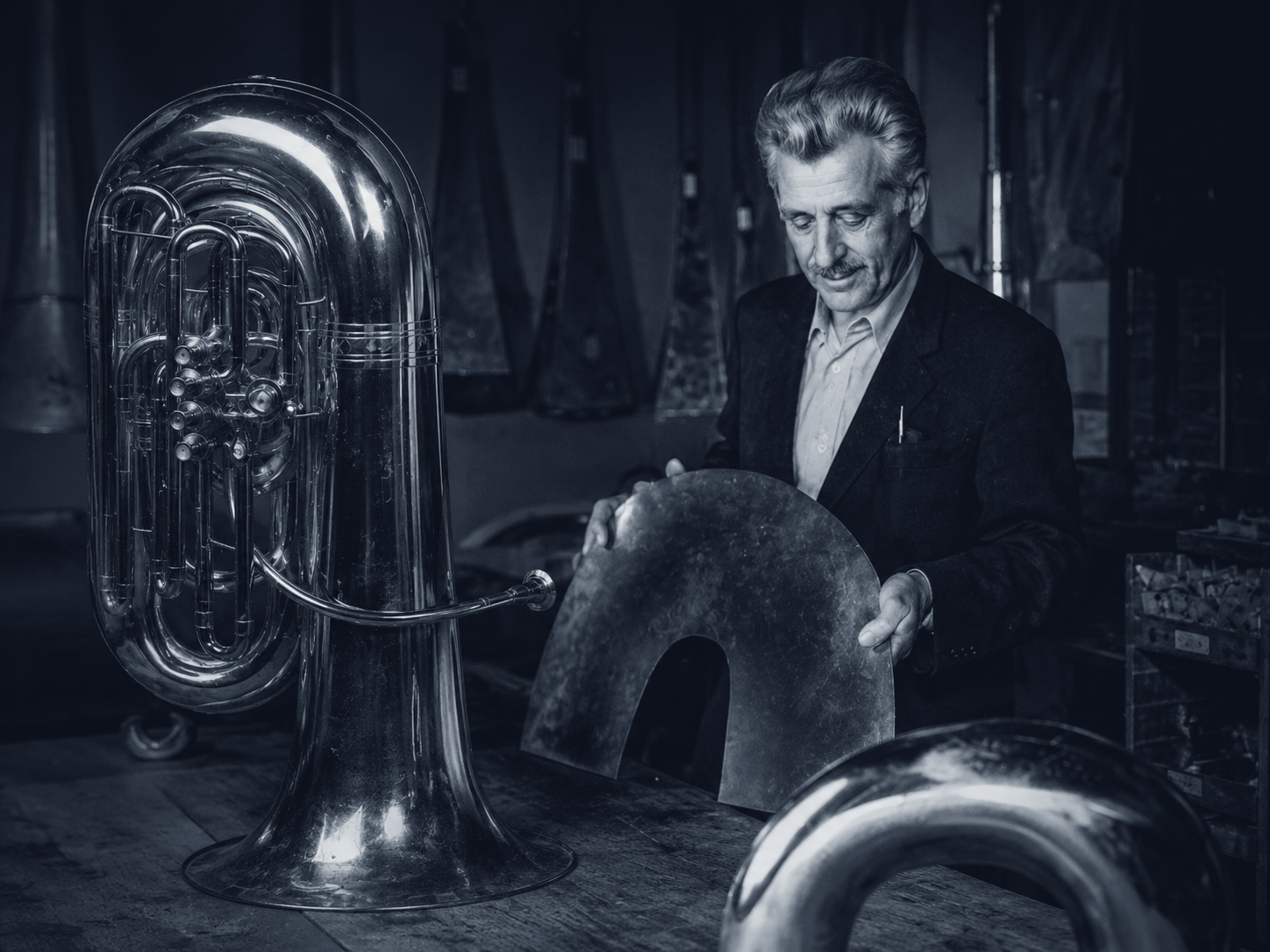
It is fully ten years since we began collaborating with our representatives in the United States. Our associates there felt that practically no new development had taken place in the tuba field for several decades. Indeed since the Second World War several well known American tuba manufacturers had gone out of business although they made very good instruments.
Ten years ago, therefore, began close collaboration with American professional tuba players in order to develop new instruments which would meet the requirements of modern professionals. We invested a lot of time and money in these experiments and it was four years before we could put on the market models which really met today's needs and wishes.
For seven years I have attended tuba symposiums, talking to dozens of tuba players about their ideas and concepts. In the USA, particularly, one particular model came up again and again in conversation, one which is unfortunately no longer produced today. I don't know how often I heard people say,
“Your tubas are great, but that big York of Arnold Jacobs' in Chicago, that's unbeatable”.
Only two are supposed ever to have been built. So I told these players all they had to do was let me have one of these instruments and I would show them we can still build tubas like it today. But the answer was always,
“Well, lots of firms have tried but nothing much has ever come of it”.
In the summer of 1979 I had the pleasure of having Mr. Arnold Jacobs visit me in Sumiswald during a Chicago Orchestra tour of Switzerland. He was impressed by our factory and I think that this was the deciding factor in making him feel confident enough to place one of his instruments at our disposal for the purposes of making a copy. I well understand the fear that every musician has when his instrument has to be repaired for he feels that it just won't sound the same afterwards. When I think what terrible repair jobs I have seen, carried out by so-called repairers in the States, I can fully understand this fear. Only an instrument maker who has thoroughly mastered his craft is in a position to carry out this kind of work and really give the musician back his instrument.
I therefore had the job of giving Mr. Jacobs back a completely overhauled tuba, technically and musically as new, while at the same time we could use this opportunity to take the instrument's measurements, make a record of its exact construction and produce a single copy.
I must explain at this point that hydraulic and mechanical production of tubing sections like this was completely unknown 55 years ago. All parts were cut to size from flat, and quite thin, metal sheet and formed into tubes. For bending, these tubes were filled with lead and experienced craftsmen bent them into the desired shape laboriously by hand. So, if we wanted an exact copy of this instrument, one that would have the same qualities of sound and response, we were going to have to make it by the same method. For me the task had become a matter of prestige and I brought all the knowledge and ability of myself and my best workers to bear on the job of proving that we were still instrument makers.
Brass Bulletin 40, IV / 1982 pages 34–39
All content is protected by copyright © Brass Bulletin 1982–2026