In dealing with the following material I shall write in the first person. Although I shall try to be objective, the ideas are very much my own, and it would be pretentious to give any other impression.
The first octave
The first octave is what I call the octave from the first partial (open pedal) to the second partial (low C). (All references will be to the CC tuba only for reasons of simplification but can be applicable to tubas of any key.) It is absolutely necessary to me that any tuba I play has the capacity to play chromatically in tune from low C down to pedal C and to do so without compromising tone quality for intonation or vice versa. This has been done in several different ways. Besson developed many years ago a system of compensating pistons which adds, with any valve combination including the fourth valve, a correctional amount of tubing. This allows a tubist to play chromatically down to the pedal with only four valves and also to be able to use normal fingering progressions. For some still unanswered reason the 1-4 combination on every Besson instrument I've ever played — B♭ tenor, F, E♭ and CC — was flat, and it was necessary to shorten the compensating tubing on the first valve. Otherwise this system works. It would be inappropriate, however, to discuss here the pros and cons of Besson tubas. I will only say further that the added length of valve stroke needed in order for the compensating system to function is noticeably encumbering.
No other four-valve system can give full chromatic range and acceptable intonation from low C down to the pedal. By making token changes in valve tube length, tuba makers have tried to make an acceptable four-valve system, but they have only succeeded in moving the problems around. In order to play a normal four-valve system without making unacceptable compromises, one would have to change slide length from note to note as much as one foot (30 cm), a hardly acceptable characteristic for fluent music making. Not to mention that low D♭ or C♯ is not possible.
I agree with most tuba makers with whom I've spoken, that many problems are avoided by building a tuba with as few valves as possible. Obviously four are not enough (unless there is some system of compensation). Six valves, as far as I and most tubists and makers are concerned, are too many. I believe that the five-valved tuba is the answer. Most tuba makers who are seriously competing in the market make a five-valved tuba. All of them have the capacity to play in tune chromatically down to the open pedal.
The function of the fifth valve varies among players and makers. I have tried most of these systems and find that they all function to some degree. The first thing we realize in a five-valved tuba is that it will not play perfectly in tune without some slide manipulation. Keeping this in mind there are two important things to consider; economy of motion and musical fluency. I hereby propose a system which I have used for the past ten years and which I believe minimizes slide manipulation and minimizes musical distraction.
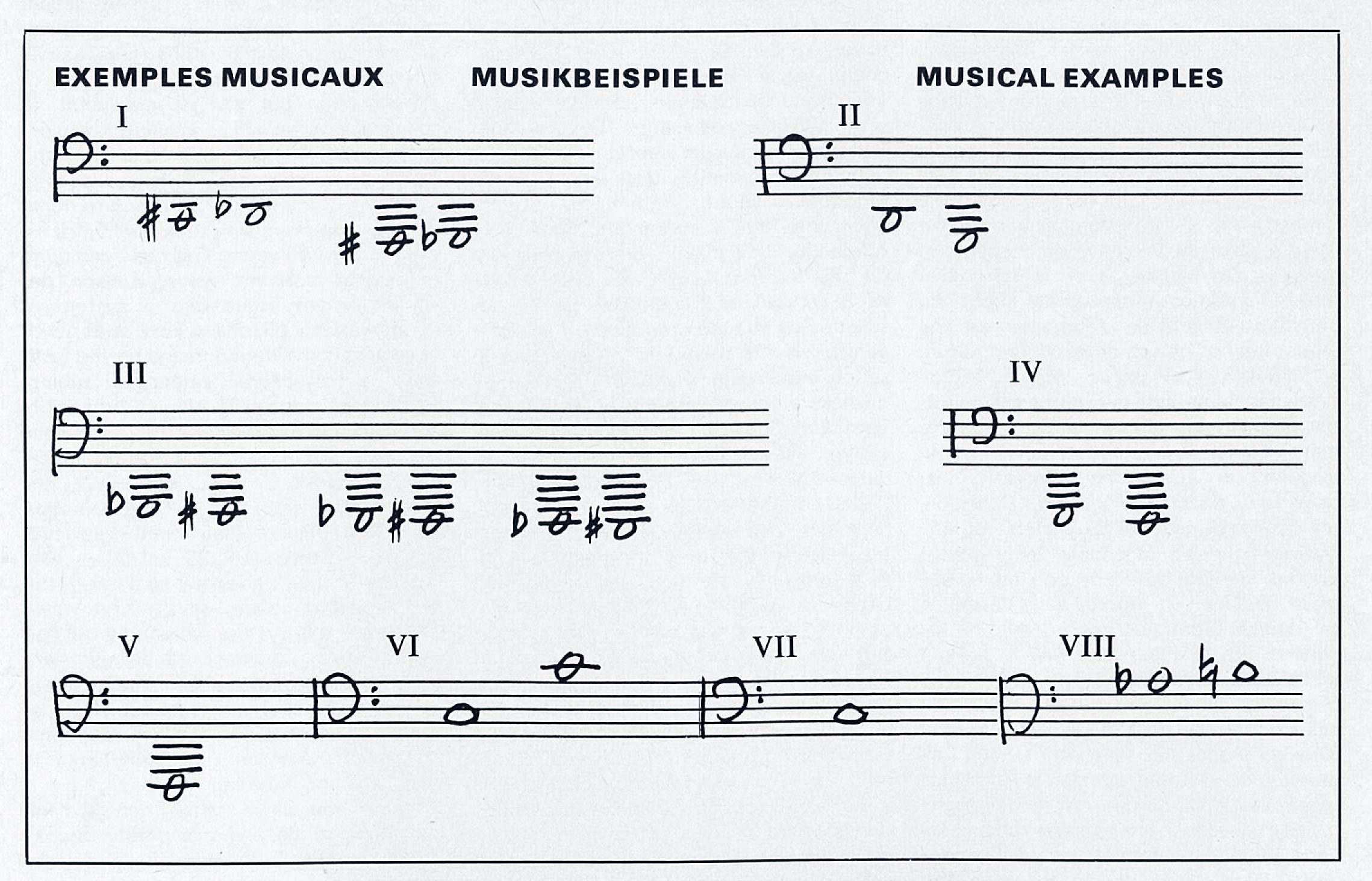
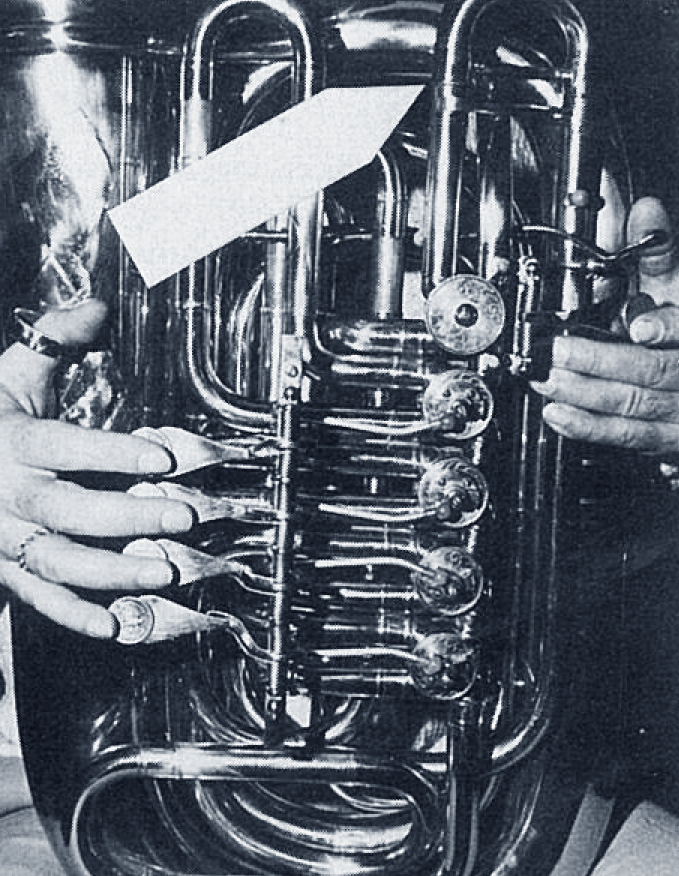
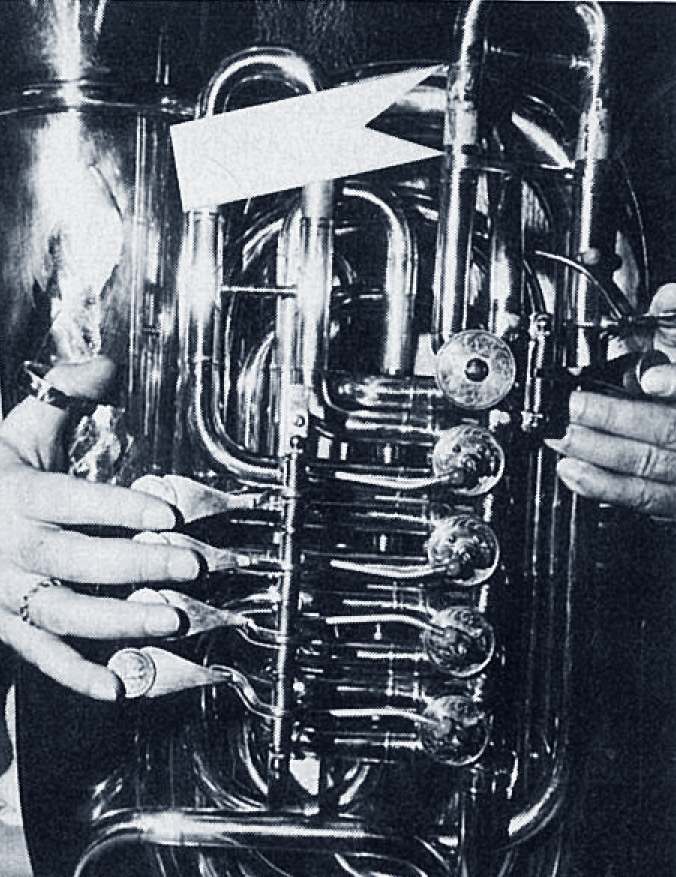
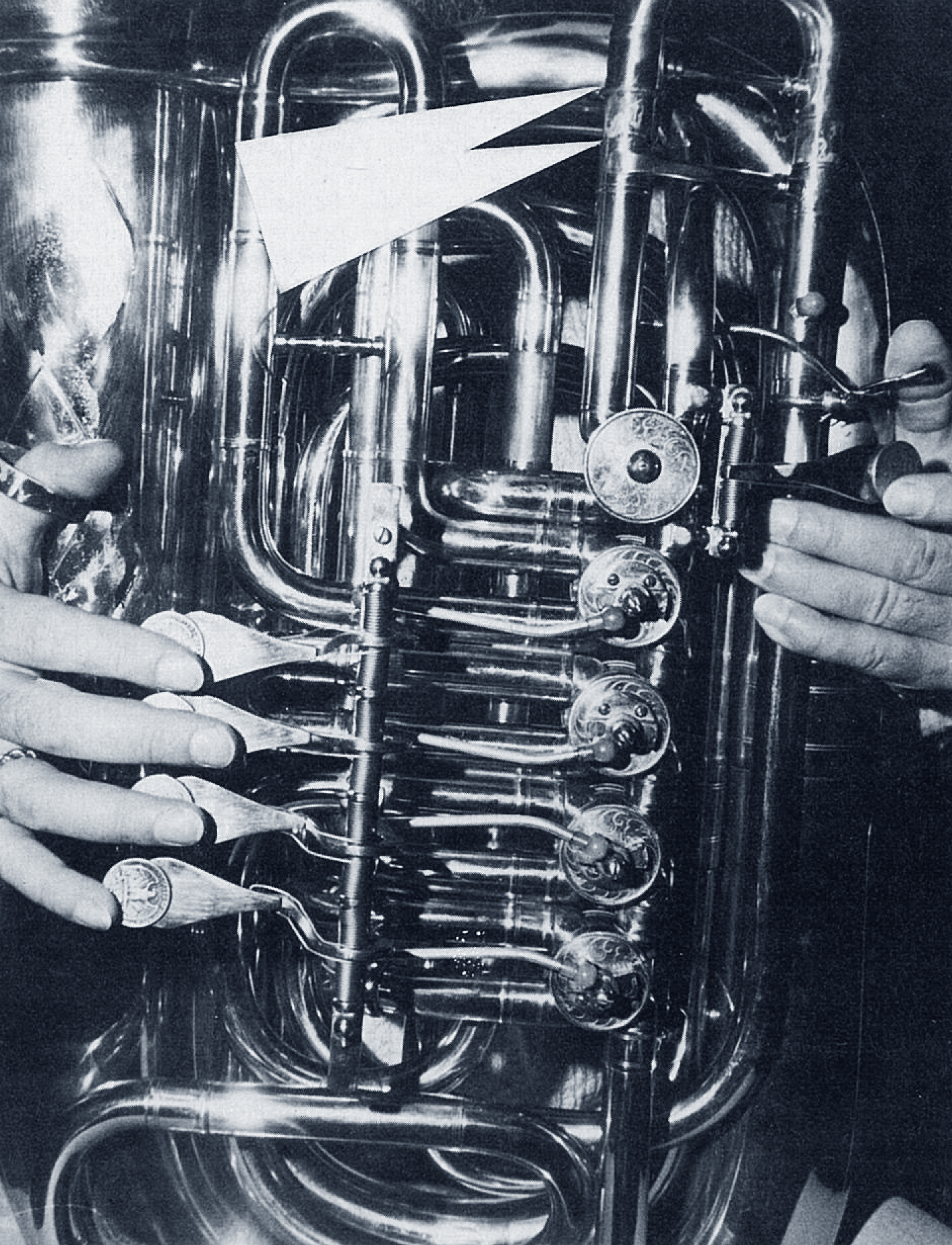
The function of the fifth valve is purely for low-register intonation compensation. The valve is tuned, with the slide in, 33 cents sharp to an A♭ or G♯ (referring again to C tubas), that is, 1/6 of a tone sharper than the 2-3 combination. By the use of a thumb lever the slide can be lengthened approximately 2½ inches (6.35 cm) with very little effort or motion. Using the "in" position (see photo number one), one can play C♯/D♭ and F♯/G♭ (mus. ex. I) using the combination 1-2-5, thus leaving the fourth valve free to tune to an uncompromised D and G (mus. ex. II). Using the "in" position, one can play the following: G♭/F♯, E♭/D♯ and D♭/C♯ (mus. ex. III). Using the "out" position (see photo number two), one can play E and D (mus. ex. IV). This leaves only F (mus. ex. V) (see photo number three), which is played with the slide extended approximately ¾ inch (2 cm). Some type of rubber ring should be on the slide to avoid a metal-against-metal clank when the slide closes, and a post of some sort is necessary to stop the slide from going out too far.
I will discuss the pros and cons of the fifth valve being operated with the index finger of the left hand or with the thumb of the right hand, in the next section on mechanical prerequisites. This fifth-valve system is efficient, highly functional, and rather simple when put into practice, and I recommend it to any player or maker who wishes to minimize the problems of low-register intonation compensation.
Mechanical prerequisites
The first impression when trying a new instrument is how it feels. In its playing position, is the horn stable and is the player comfortable? Is the placement of the slides arranged in a reasonable way? I once played a very fine Czechoslovakian tuba that was impossible to hold in a comfortable playing position without the tuning slide being pushed in by my right thigh. There is a good argument against horizontal tuning slides involving the theory that the fewer turns the vibrating column makes, the better. There are definitely fewer turns in a vertical tuning slide, but a design that makes it impossible to play without one's thigh pushing the tuning slide to a completely closed position is, of course, ridiculous. I think it's important to mention this only to point out what can happen if even the basics are overlooked. Instrument security and stability are essentials in the design of a good tuba.
When the instrument is in playing position, is it balanced, and is the right hand unencumbered and free for valve manipulation? I find that even the best-designed tubas are more secure and the right hand is freer when the left arm is placed across the front of the instrument and the left hand is placed somewhere in the area where the leadpipe crosses the bell. This is especially necessary for me in rapid technical passages because the right hand is then free of all responsibility other than valve manipulation. This, of course, opens a problem of how to operate the fifth valve and its slide compensation.
Many, if not most, tubas are now built with the fifth valve to be operated by the right thumb. This is perfectly acceptable up to a certain speed, when the thumb is simply too slow; at this point the left index finger is far more efficient. The solution is simple; have a fifth valve that can be operated by both the right thumb and the left index finger. This has already been done by Mirafone with a simple design, and with materials light enough so that the difference in "feel" between this double linkage and a single linkage is almost imperceptible.
The fifth-valve slide manipulation need not be changed, whichever hand we choose to operate the fifth valve. In using the right thumb one could manipulate the fifth-valve slide by hand, but the system described above is far more efficient, the stroke needed by the thumb to move the slide its 2½ inches is less than one inch, and the tuba's stability is much less affected by the thumb-lever system. The register in which we would use the fifth-valve compensator (the first octave) generally is not technical enough in nature to necessitate placing the left hand around the front of the instrument.
One cannot deal with the mechanics of tuba playing without at least touching upon a discussion of rotary vs. piston valves. Most of the rotary valves on tubas today are good. After long experimentation, Hirsbrunner has developed a lightweight valve by filling a hollow valve with a plastic material, thus making the valve only 40% the weight of a normal valve the same size. However, in playing these tubas I unfortunately do not feel the difference. Perhaps it is in the linkage or spring tension where there is still a problem. In any case, lighter valves are a must, and Hirsbrunner has set an example that all makers of rotary-valve tubas should follow.
Personally, I prefer piston valves. I've never seen rotors that can compare with pistons in the way that they articulate or the speed at which they can move. Conn, on its newest C tuba, which I tried at The International Brass Congress in Montreux, has built the best piston valves that I have ever encountered on a tuba. They were light, fast, and silent. I would be quite happy if I could have such valves on all my tubas. I don't suggest that this fact influence established makers of rotary-valve tubas (such as Mirafone and Alexander), but I hope they will continue perfecting their rotors, which are so much a part of their German tradition.
I think it's important to mention two reasons why I don't like top-action piston tubas. I've never played a top-action tuba that was easy to hold, and most of the playing situations I encounter are organized to some degree by the direction of my bell. Even when tenor tuba is used, and its bell is slanting in the opposite direction to the lower tuba, this still makes something of a problem. Yamaha, who makes one of the finest tenor tubas (baritones) I've seen, would have an even better instrument if it were front-action rather than top-action. The arm and hand are also in a better position on front-action instruments.
Acoustical prerequisites
Acoustical problems in a tuba are, by far, the most difficult to deal with. The problems are easy enough to point out, but solutions are often seemingly impossible to find. These problems can be put into three categories: intonation, dissipation of the vibrating column, and distortion of the vibrating column. Another extremely important consideration in tuba acoustics is, of course, timbre.
Intonation difficulties are the most obvious of these problems, and I must say that the past decade has seen enormous improvements. Hirsbrunner deserves congratulations for designing the most perfectly in-tune tuba I’ve ever played. All my life I've been told certain partials are going to be out of tune and that nothing could be done to correct them. The fact that other brass instruments had corrected these problems, or that some tubas were remarkably better than others, did not seem to reinforce my argument. The chronic use of alternate fingerings and mid-register slide manipulation is no longer acceptable. Alternate fingerings change timbre and therefore ruin tonal consistency. They also have a very encumbering effect on technical fluency. Mid-passage slide manipulations can only get in the way of fluent music making. The use of alternate fingerings or mid-register mid-passage slide manipulations may be appropriate on rare occasions but should be absolutely unacceptable as a frequently-practiced remedy for a tuba that is badly out of tune.
We all know that the fifth partial is somewhat flat. This is natural and to be expected. Some tubas have fifth partials that are far flatter than natural, but the makers attempt to explain this fact as being natural. This flatness on good trumpets and horns is very slight and easily controlled. Hirsbrunner's tuba certainly is acceptable, as are a few other instruments. A German maker who has three models of CC tubas, one with the fifth partial acceptably in tune and the other two with it unacceptably flat, maintains this flatness to be natural and has never attempted to answer for the fact that their different models have a terrible discrepancy.
There are many different types of tubas with different types of intonation problems, but I think it's important to point out one more specific problem that seems universal. The open C's (mus. ex. VI) on every F tuba I've ever played have been sharp. This has been explained as an F-tuba characteristic and that nothing could be done. It is an F-tuba characteristic, but the thought that nothing can be done is simply not true. Most C's on these F tubas, especially in the lower octave, (mus. ex. VII) are problematic in timbre as well as pitch.
This brings us to the problem of tonal dissipation. That is: a weakening of the vibrating column as it travels through the instrument. When we find a note that is obviously dull or woofy compared to the rest of the notes, this is caused by what I call tonal dissipation. These notes are impossible to center and of course are therefore untuneable. When examining these notes with the use of an oscilloscope or a harmonic analyzer, I've found that most of the overtones all but disappear and that the fundamental is extremely unstable. The only remedy for this is an alternate fingering which changes the note to another partial. For example, if we play this open C with the fourth valve we change the note from a third partial (open) to a fourth partial (fourth valve). For this reason the tonal dissipation is obviously caused by the placement of the nodes and antinodes in the vibrating column, because in changing the nodal pattern by a change of partial, the problem disappears. This problem of tonal dissipation occurs all too frequently, and an alternate fingering is not the way it should be corrected. I will discuss a possible approach to the problem later.
Tonal distortion is another acoustical malady that we find far too often. This results in notes that seem to have a rattle which in no way can be controlled. It especially can be noticed on attacks or on staccato notes that chronically have a burr. (For the sake of translation one might describe a "burr" as an rrrrr sort of rumble on the start of a note.) I must say here that sometimes this is the fault of the player, especially among students. However, when the problem appears on a single note, and the other notes above and below are good, it's probably the fault of the instrument. Sometimes when these same notes are played at very high dynamic levels, the distortion becomes so bad that the tone turns into a rumble of indistinguishable pitch.
On my own equipment this situation is most obvious on high A♭ and B♭, (mus. ex. VIII) notes which in no way can I play at the same dynamic level as the neighboring notes. Although this same problem was encountered by colleagues of mine using the same kind of equipment. I experimented using an amplified tuba, in order to be sure that it was the fault of the instrument rather than of its players. While playing the same notes at a very low dynamic level where the rumble was almost unperceptible, and by simply increasing the amplification to a very high level, I heard the same distortion, thus proving to myself that the problem was inherent in the sound structure of these notes rather than being a problem of embouchure.
I sincerely wish at this point I could say exactly what must be done to correct all these acoustical problems. Unfortunately I can’t, and I don't know of anyone else who can. All I can offer is a possible approach to the problems. Trial and error, which is the method used by most brass instrument makers, is virtually no longer possible because of time and economical efficiency. We must find a method of procedure that will enable us to locate specifically where these problems occur in the vibrating column and what is causing them. There is no question but that we have the technology to do this.
In regards to the intonation problems, tonal dissipation and tonal distortion, we must through our technology put both our eyes and ears inside the instrument and analyze exactly what is happening to the vibrating column as it travels its journey from the mouthpiece to the bell. We must find exactly where and why a fifth partial comes out a quarter-tone flatter than it should. We must find out which nodal point is weakened when we find tonal dissipation, what causes tonal distortion, and where it is occurring. I'm sure we all have theories as to what causes these problems and also how they might be corrected, but the fact is that we no longer have time for theories. We have the capacity now to locate, isolate, and correct these acoustical disorders conclusively, and I would urge all makers who identify with any of these problems discussed above to begin work repairing them.
Perhaps the most difficulty in standardizing a tuba comes in regard to timbre. This is, other than our individual musical styles, the most personal aspect of our playing. Fortunately, I consider timbre far less of a problem than the other acoustical aspects discussed above. There are very few tubas that, if played well, have a bad tone. The major consideration is, in what musical situations are we generally going to use this tuba? Personally, I have not found a tuba which I find appropriate for both the breadth of sound or mass and power I need to put a bottom on a large symphony orchestra as well as the maneuverability and elasticity needed for solo and chamber-music playing. I would like to find such a tuba, but I don’t expect to. This only brings to light the fact that in regard to tuba timbre we must be willing to compromise somewhat.
Arnold Jacobs, whom I consider one of the great brass teachers of the world, once told me that we all have two tubas, the tuba in our mind's ear and the tuba we hear with our real ears. This is a beautiful concept as long as the tuba we have in our mind's ear stays realistic, and the tuba we hear with our real ears is willing, ever so slightly, to compromise. One must be careful to avoid creating in our imagination a dream tuba that will perform every musical thought without any difficulty... or at least to keep such thoughts clearly in the category of fantasy. (There is material enough in the subject of concept and execution to fill a book and a very interesting book at that, but further discussion would be inappropriate in this article in which I'm trying to deal with the more practical aspects of tuba construction.)
Very basically, what I would like in a tuba's tone quality is a good fundamental and a relatively even harmonic curve which maintains its proportions through the complete range and through a reasonable dynamic spectrum. Many instruments have tendencies to lose most of the higher overtones in softer dynamics and in some cases do not produce reasonably proportional harmonic curves until they reach forte. Also important, of course, is that the instrument maintain as much fundamental as possible in the louder dynamics, to avoid becoming too bright in quality. The high register should not become dull nor should the low register become bright. This perhaps may sound like a little too much to hope for, but there are, in fact, tubas that have exceptionally beautiful sounds even at the extreme fortes and pianos and in both the high and low registers. Cerveny is a good example of such an instrument.
Tone quality starts even before we get to the instrument, in the oral cavity and dental arch and lips. Beyond the point of the lips we can control tone with the mouthpiece, leadpipe, bore size, taper, and bell. Each of these components that make up an embouchure are, of course, not changeable; we can do much with mouthpieces, but from that point change becomes more difficult. Reasonable perimeters for all these components are well established, and I would advise both players and makers to avoid extremes.
One of the greatest questions I still have in my own mind is: what is the best type of bell? I am presently involved in an experiment with bells, and when it is complete I would like to publish my findings in Brass Bulletin. From limited experimentation I can only say that the bell can make the difference between a good tone and a beautiful tone. The size of the throat and the bell diameter alone can determine a large part of the harmonic curve. Consideration must be given to brass thickness, brass alloy, and type of rim; not to mention some of the subtler aspects such as silver plate, gold plate, lacquer, or bare brass. The most important factor, however, still remains: is the bell compatible with the other components of the instrument? I think, because of time and money, many makers stop when they find a bell that makes a satisfactory sound. With further perseverance this "satisfactory" tuba might very well become spectacular.
There is a new and unfortunate trend developing among many of the longer and more established brass instrument makers of the United States and Europe. Many instruments are simply not coming out of the factories as good as they have been a few years ago. This new laxness in quality control is a deplorable turn of events and should be looked into very seriously by the makers. Timesaving shortcuts in the building of musical instruments should not be tolerated by discriminating players. If such practices continue, it's only a matter of time before these first-line instruments lose their status and become second rate compared to some of the newer makers, who of course, are being very careful with their new product.
Some of the bad workmanship to be aware of includes leaks, badly fit valves, badly aligned valves, badly fit joints, bad soldering jobs, and even something so obvious as a buzzing bell. Many players here in the Los Angeles area are taking a look at a new horn through an X-ray machine before purchasing it: this is perhaps an extreme measure, but not unwise considering what some of the makers are putting on the market as a finished product these days.
On the other hand many makers are making substantial strides toward improving the standard of tubas: Hirsbrunner, who has built a tuba that is in tune and has designed lightweight rotary valves that will eventually replace the heavier solid brass rotors which most tubas now have; Mirafone, which offers an instrument with a solid, centered, and negotiable first octave, a generally facile and flexible instrument throughout the entire register; Cervény, with its beautiful tone; Conn, who has built valves which are fast and silent and need a minimum of effort from the player to operate; and Yamaha — simply by virtue of the other superb brass instruments it has recently made, one would hope for a superb tuba from them. These makers are exemplary, and hopefully any success they now enjoy will not deter them from producing a more improved product. I'm sure I've not mentioned all the makers who could be classified as leaders, and for any name I've overlooked, I apologize.
If this article could be instrumental in the establishing of some criteria which most tubists could stand behind, I would be very happy. Tuba makers will, of course, be more willing to work towards realizing a tuba of excellence if the players can agree on what they want. The sooner we can achieve this, the sooner we can forget about it and approach the realm of making beautiful music, which is a far nobler goal.