14 min. read
Part 1
Arnold Jacobs
Interview
By Roger Bobo
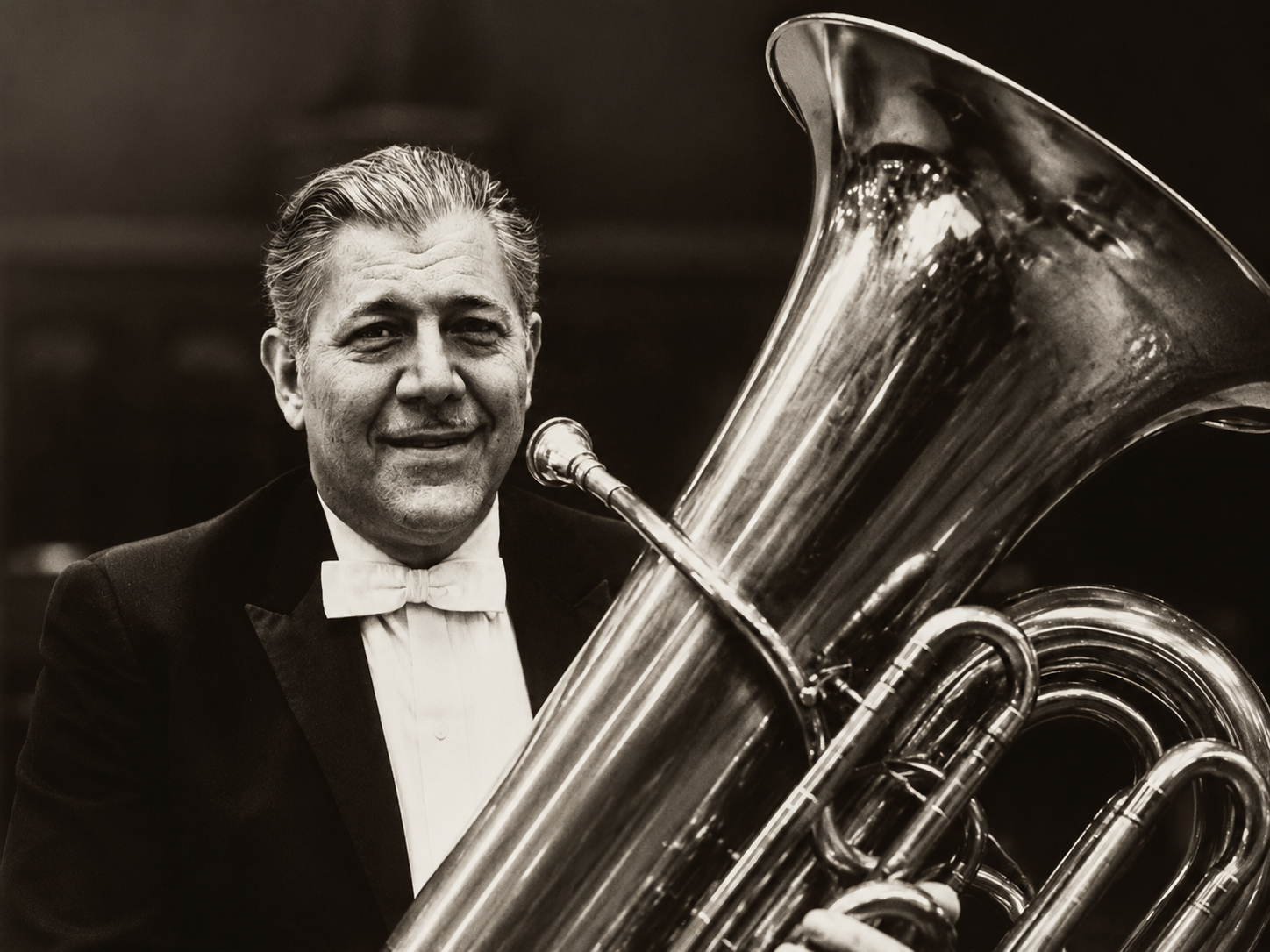
Arnold Jacobs
That Arnold Jacobs was one of the world's first great tubists would be an understatement to many people. His playing in the Chicago Symphony has served as the definitive model of symphonic tuba playing for conductors, colleagues and students for over a quarter century. As a teacher he is known for his great knowledge of human physiology regarding wind instrument and vocal performance and his students of all the wind instruments and of voice can be found all over the world. (RB)
Roger Bobo: Let me ask you this: if you could give a short message to the brass community, what would you choose to say?
Arnold Jacobs: I would choose to put a heavy dominance on the sounds that are so interesting to brass players, and with the definite recognition of the tendency to become so involved in the brass instrument that you forget about the music that you play on the brass instrument. While the instrument is important, it is still an extension of the person, essentially; and it shouldn't become so all-consuming that all you think about is mouthpieces and horns. The music that you make with the instrument has to be really dominant.
Roger Bobo: In teaching, how do you differentiate one from the other?
Arnold Jacobs: You have to talk to the student and get an insight into his motivations. If you have a student who tends to think very mechanically, and he becomes very involved in playing an instrument like the tuba, very frequently his thoughts will be on his instrument: on the fingering patterns, the parts of his tissues, embouchure, respiratory system, tongue — and very frequently the music is a minor part. You’d give it a rating of maybe 15% of his intellectual capacity and attitudes, and 85% would be on the technique.
I always like to reverse it, so that 85% has to be based on the phenomenon of sound that is inspirational thinking, on intuitive aspects of the brain, and 15% is awareness of structures and functions of all types including the instrument. Usually if you find a person who likes to sing music vocally, you find that he is very easy to maneuver into this type of approach to his instrument. For any brass instrument, that is an extremely healthy approach.
If you find a student who is much more interested in the chemistry of the person who plays, the engineering principles, and so forth, it is a little dangerous unless he also has the inspiration to make great music.
Brass Bulletin 33, I / 1981 pages 43–50
All content is protected by copyright © Brass Bulletin 1981–2026