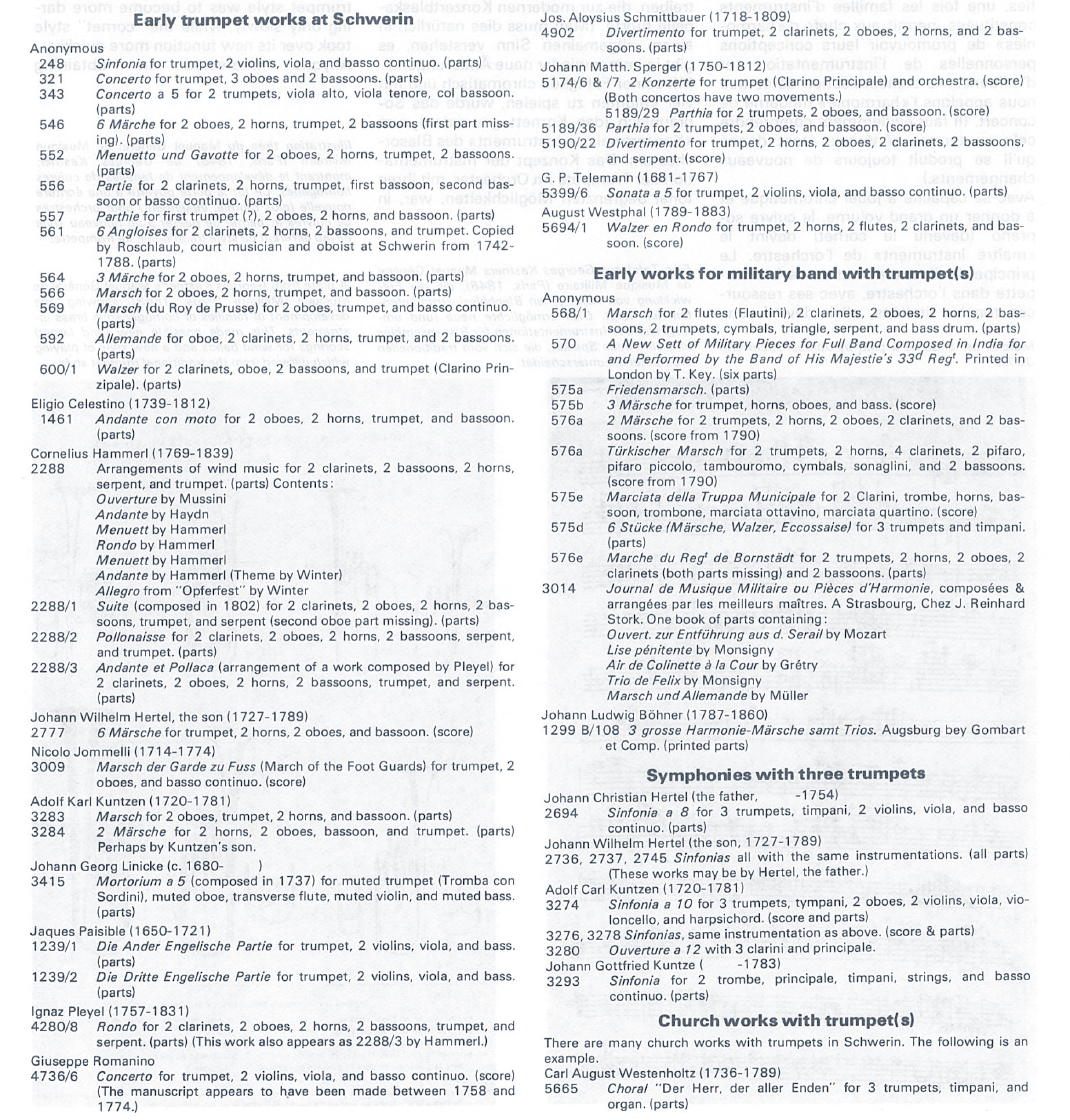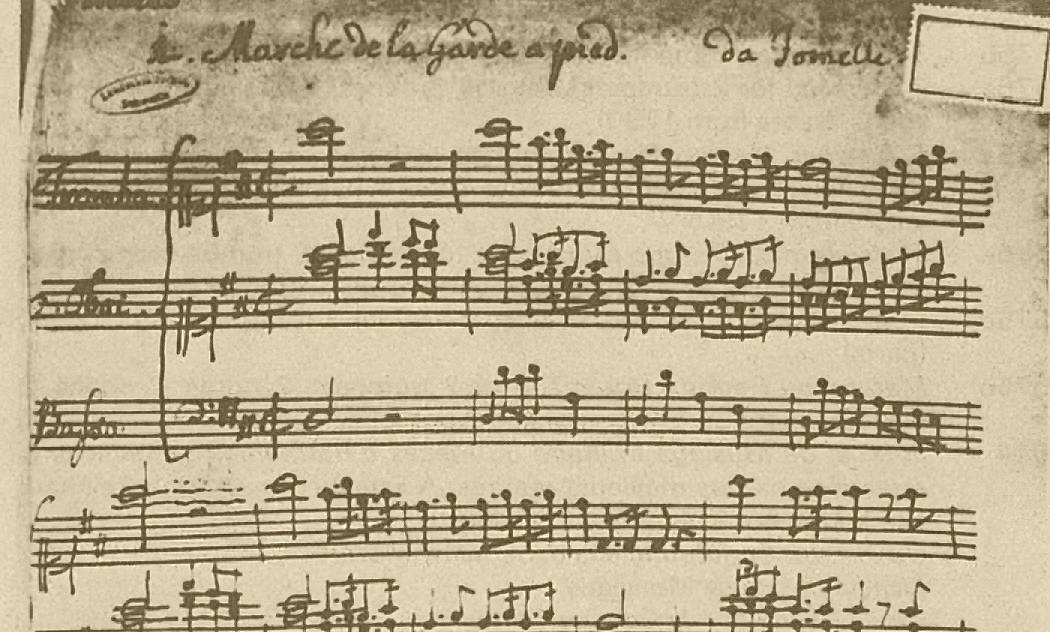
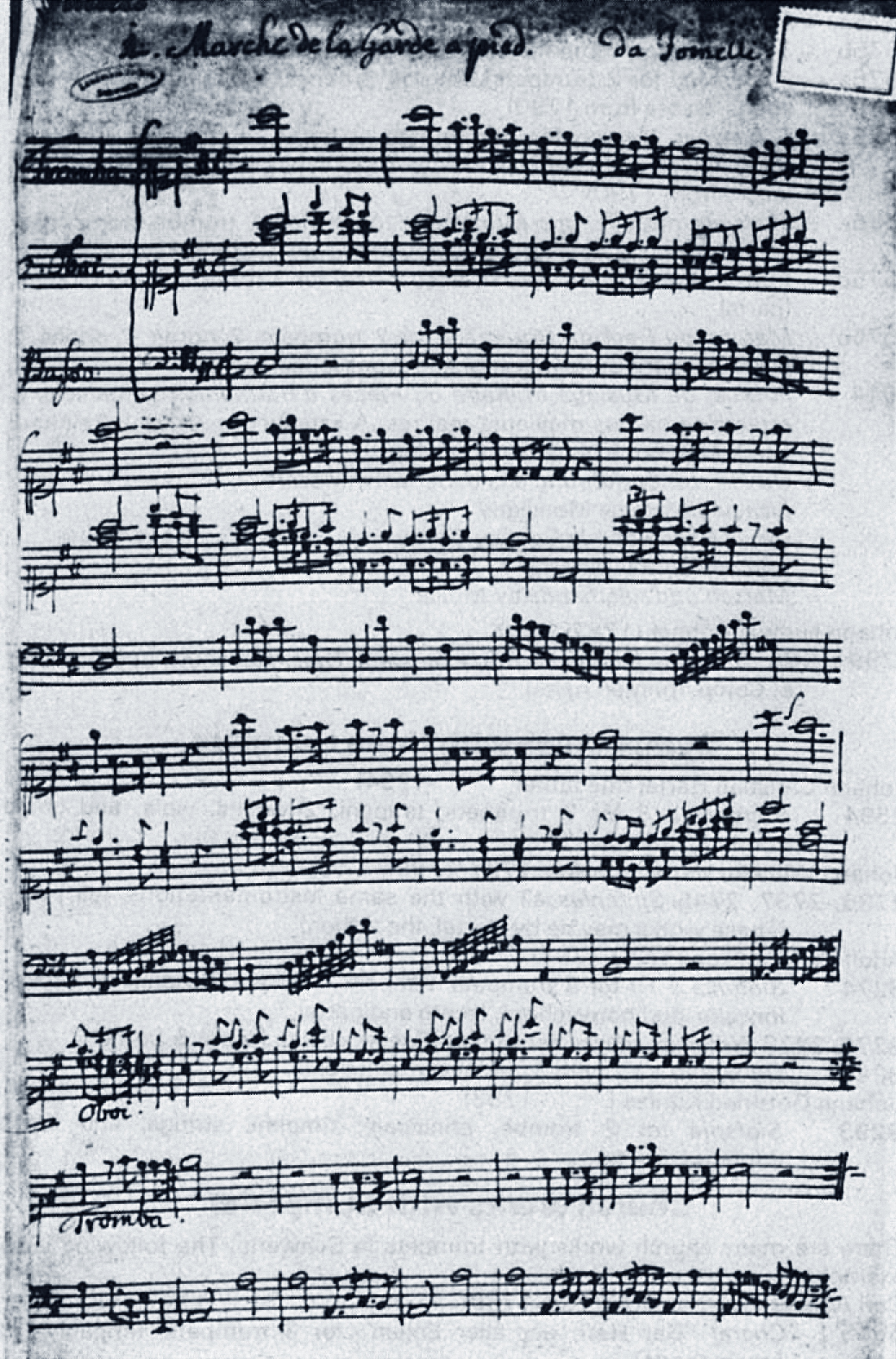
Marche de la Garde à pied by Jomelli (Schwerin 3009)
Modern scholars have concentrated their study on solo and orchestral works with trumpets, and for this reason, the list which follows may be something of a surprise. It is apparent that trumpets and horns were frequently used with other woodwind instruments. Wind bands did exist before, in England and France. It seems that the English wind players who were part of the King’s Musick (including 16 trumpets, kettledrums, shawms, cornetts and sackbuts) did not perform as a single unit. It also appears that Louis XIV supported perhaps the first organized “wind band” in the last few decades of the seventeenth century. Denner “invented” what we know today as the modern clarinet in 1690 and this led the way for the numerous instrumental combinations found in the present list of early wind band manuscripts.
In 1763 Frederick the Great fixed the Prussian army band at 2 oboes, 2 clarinets, 2 horns, and 2 bassoons. David Whitwell has already called attention to the Haydn and Mozart works written for ensembles of mixed winds. (See: A New History of Wind Music, published by The Instrumentalist, 1972.) What eventually was to happen in the early nineteenth century and which would culminate in the standardization of our own contemporary band instrumentation may be seen in three basic elements. It is true that each was happening at the same time and over a period of years. First, the high brass were made chromatic—finally and successfully—by use of the piston and rotary valves. Second, the “industrial revolution” came to music instrument manufacturing with many new models designed and complete families of homogeneous instruments developed. Third, the doubling of parts once the wind instrument families had been developed allowed band leaders to promote their personal concepts of instrumentation and influence the standardizing of what we call the modern concert band. (Certainly one must perceive this in general terms, as there is continuous change still going on.)
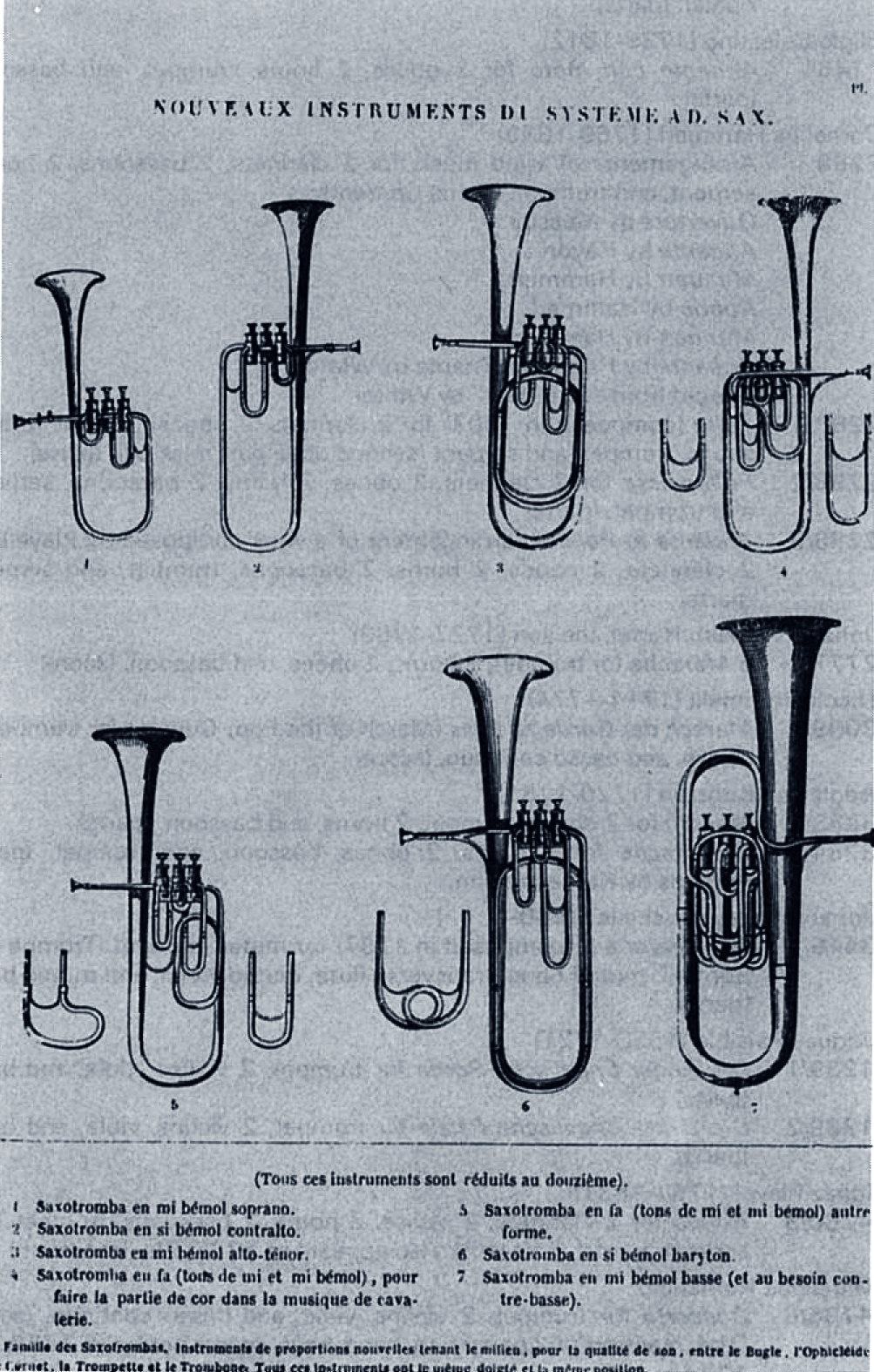
A plate from Georges Kastner’s Manuel Général de Musique Militaire (Paris, 1848) showing the development of families of homogeneous brass instruments. This made possible new (and larger) scorings for wind bands and a new style of playing which differed from the traditional trumpet style.
With its ability to play chromatically and with great volume, the soprano brass (ultimately the cornet) became the “concertmaster” instrument of the band. The concept of orchestral trumpet scoring, with its limited tonal resources, was to continue in the tradition firmly established by Haydn and Mozart. This trumpet style was to become more daring only slowly, while the “cornet” style took over its new function more quickly.
Anyone interested in obtaining microfilms of works listed should write to: Mecklenburgische Landesbibliothek, Musikabteilung, Am Dom 2, DDR-27 Schwerin. In the following lists, the library call number is given first, followed by the original title, and then, the instrumentation (which has been given in English).