The original of the second movement (Contredanse) is in E major. In several of his compositions Rameau calls for the E pitch in addition to the then usual D pitch.

In the third movement ob. I, tpt I, vln. I and harpsichord first play a motif in unison. Not until bar 3 do the orchestral parts divide:
Divertissement gai
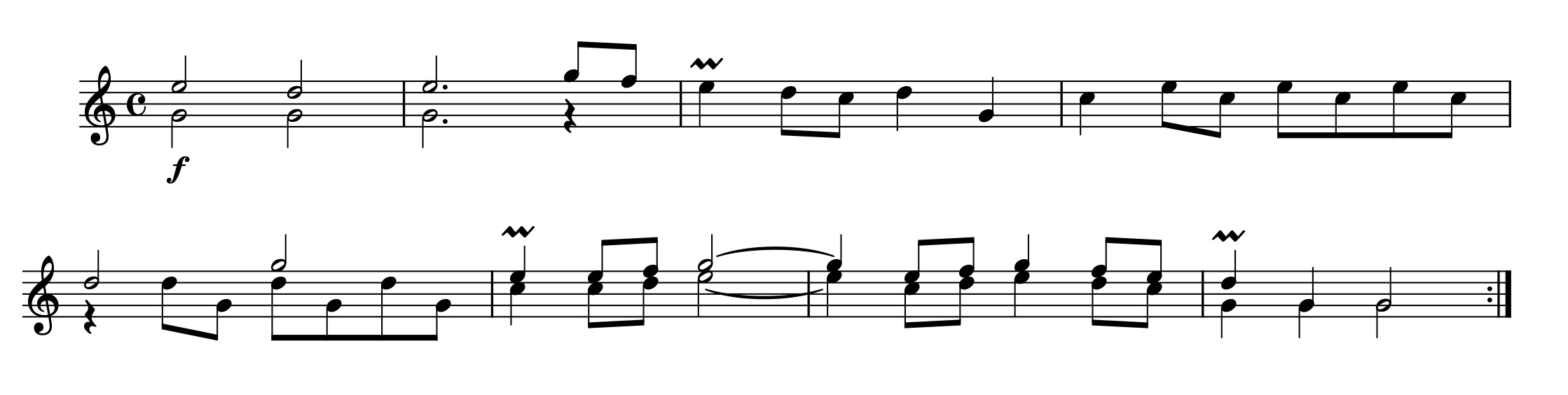
The fourth movement is a short Passepied in which the following trumpet melody (both trumpets playing the same part) forms the framework for a central section without trumpets:

No. 9, an Air vif (Danse des Lacédémoniens) from the opera Les Fêtes d'Hébé, contains very tricky trumpet passages. The movement begins with a sounding top D (!) and contains wide-interval leaps requiring great accuracy:

The following passage is a puzzle:

Sections a) and c) are intended for a D trumpet. Section c) cannot be played on the same trumpet, however, since the notes B, G# and E (sounding) do not lie within its natural harmonic sequence and can scarcely be produced even by forcing. Rameau otherwise writes only natural harmonics.
The following solutions are possible:
- Copyist's error: the trumpet rests, and the oboe plays this passage alone.
- Sections a) and c) are played on a D trumpet, and section b) on an E trumpet, which has these notes. It may be adduced in support of this theory that, as I have already mentioned, Rameau used the E pitch as well as the D.
I have in my collection a copy from the Paris Conservatoire library of the collection Pièces de trompettes de M. de la Lande, Rebelle et Philidor (Res 921) made by André Danican Philidor which contains on pages 60/61 a piece with the title Pièce à double trompette et de différent ton et le gros basson de Philidor (for 2 "double trumpets" and bassoon), in which a C trumpet and a low G trumpet take the melody alternately (for further details see Brass Quarterly, vol. VI, no. 1: "New Light on Some Unusual Seventeenth Century French Trumpet Parts" by Mary Rasmussen).
Clearly the idea of combining trumpets of different pitches, which was taken up in the second half of the 18th century by Starzer, W. A. Mozart and Dessary amongst others, was also around in France in the first half of the century. The sounding C# in section c) may be a slip of the pen.
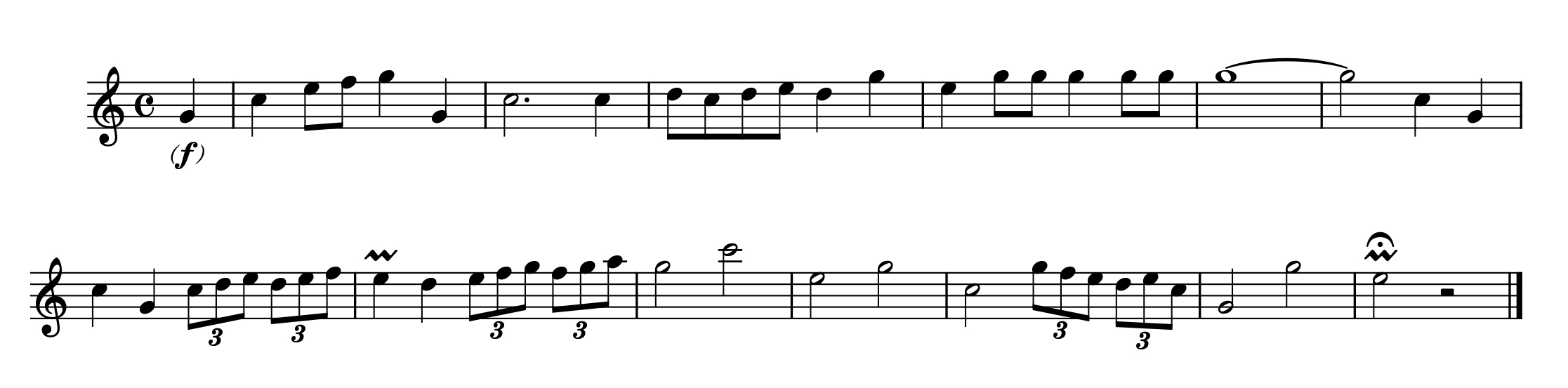
The same movement also includes the following passage:

The initial top E is, as far as I know, the highest trumpet note to be found in the French Baroque.
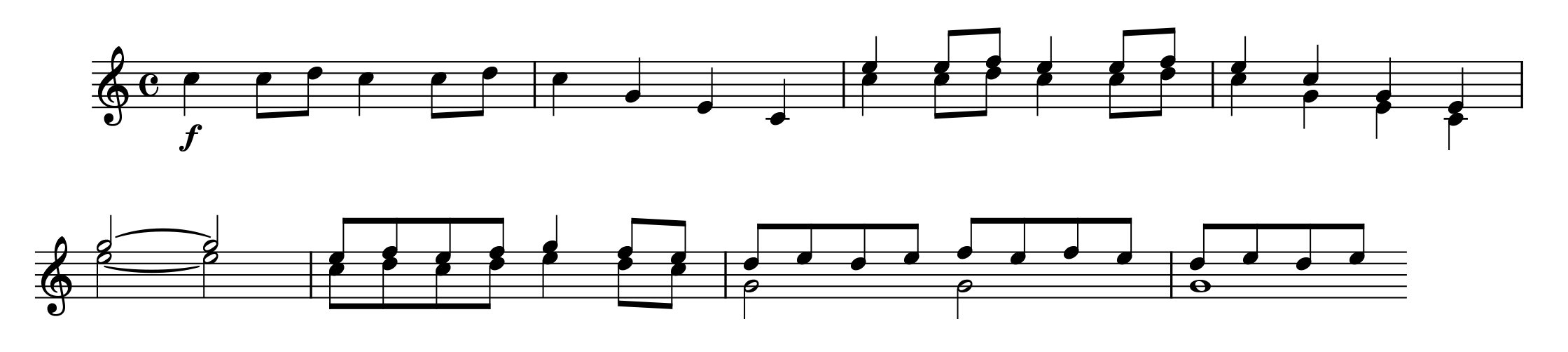
The remaining movements contain many fine trumpet tunes. A few excerpts:
No. 10 Entrée gai
The second motif is taken up again in the 11th movement (both movements come from the same opera) and modified:
No. 11 Gavotte en rondeau
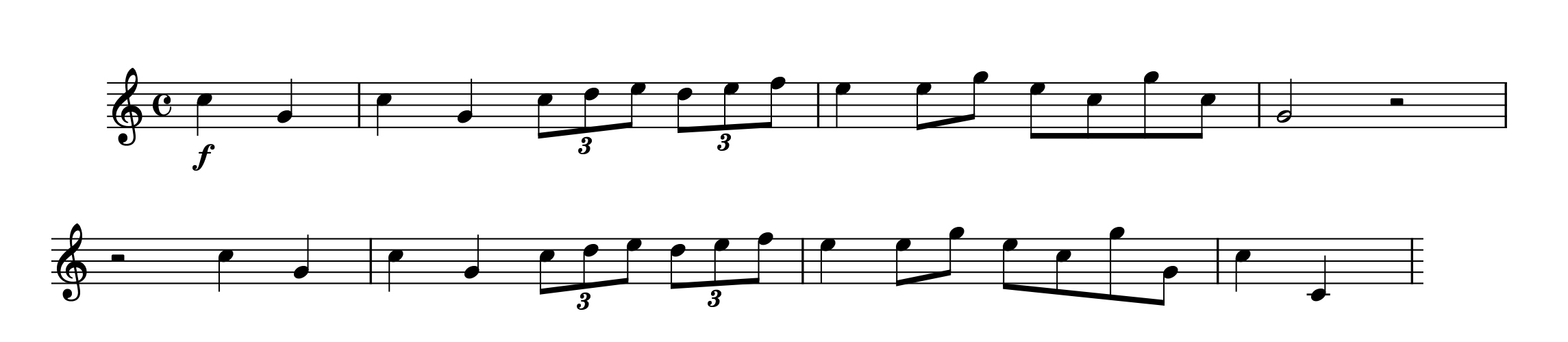
Menuet I (no. 12) contains only simple passages

No. 14, a brilliant Air de triomphe, forms the conclusion:
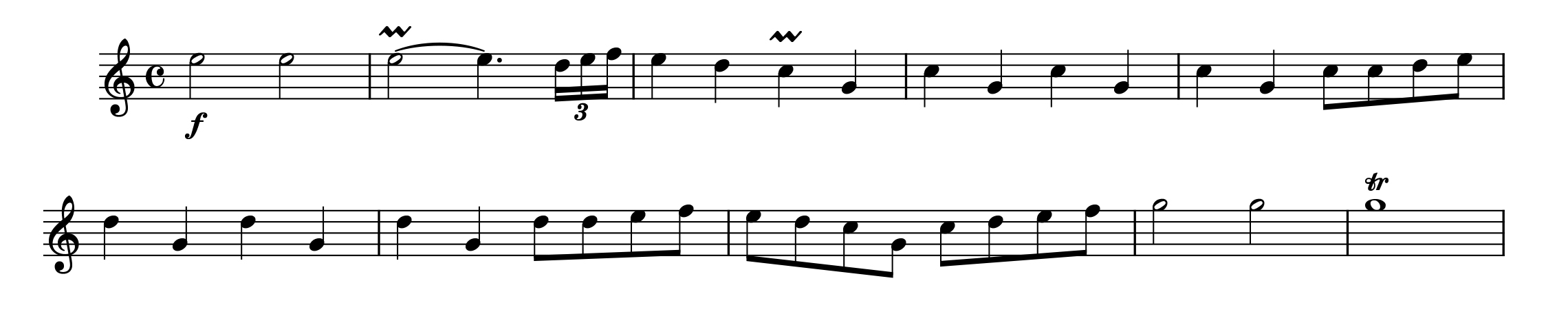
All these pieces — distinguished by their dance-like grace and liveliness from the solemn, stately and often rather ponderous trumpet pieces of Lully, and so representing the mentality of this gallant age of the French Rococo, as do the paintings of Boucher, Watteau and Fragonard — show that Rameau must have had excellent trumpeters at his disposal.
In the appendix I have listed Rameau's other instrumental pieces containing trumpets. Since the list contains few slow movements, I have also included instrumental movements with horns; these could serve as slow movements if necessary. I hope I may hereby have done some small service to our horn players, even if these horn movements scarcely provide material enough for a horn suite.
The operas of Lully and Rameau are seldom performed nowadays. One reason for this may be that few people nowadays have an educational grounding in ancient mythology, which provides most of the material for the action of the operas. It would be a pity, on the other hand, if the fine instrumental movements from these operas were also to pass unnoticed.
We should realise that the procedure of arranging suites and divertimentos from instrumental pieces of diverse origins was quite normal in the French Baroque — as we know from the examples of Philidor and Francoeur. There should therefore no longer be any reservations about this, not even from the musicological point of view, if there is a chance of bringing valuable music back to life.
Appendix
Suite No. 1 in D Major for 2 Trumpets, 2 Oboes, 2 Bassoons, Timpani, Strings and Basso Continuo
- Air de Triomphe (Le Temple de la Gloire)
- Contredanse (Les Fêtes de l’Hymen)
- Divertissement gai (La Princesse de Navarre)
- Passepied vif (La Princesse de Navarre)
- Air de Triomphe (Naïs)
- Entr’acte gai (Naïs)
- Passepied I (Les Fêtes de l’Hymen)
- Passepied II (Les Fêtes de l’Hymen)
- Air vif (Les Fêtes d’Hébé)
- Entrée gai (Les Fêtes de Polymnie)
- Gavotte (Les Fêtes de Polymnie)
- Menuet I (Les Fêtes d’Hébé)
- Menuet II (Les Fêtes d’Hébé)
- Air de Triomphe (Les Fêtes de l’Hymen)
Other Instrumental Movements with Trumpets
- Ritournelle gaie (Les Indes Galantes)
- Menuet (Les Indes Galantes)
- Prélude (Les Indes Galantes)
- Chaconne (Les Indes Galantes)
- Menuet (Les Indes Galantes)
- Air II (Castor et Pollux)
- Combat vif (Castor et Pollux)
- Entr’acte (Castor et Pollux)
- Air très vif (Les Fêtes d’Hébé)
- Prélude (Les Fêtes d’Hébé)
- Prélude gai (Les Fêtes d’Hébé)
- Air vif (Les Fêtes d’Hébé)
- Menuet vif (Les Fêtes d’Hébé)
- Annonce (Les Fêtes de Ramire)
- Entrée de Triomphe (Les Fêtes de Ramire)
- Chaconne (Les Fêtes de Ramire)
- Ouverture (Les Fêtes de Polymnie)
- Chaconne (Les Fêtes de Polymnie)
- Air (Le Temple de la Gloire)
- Annonce (Les Sybarites)
- Ouverture (Naïs)
- Entrée (Naïs)
For Trumpets and Horns
- Ouverture (Le Temple de la Gloire)
Instrumental Movements with Horns
- Air vif (Les Indes Galantes)
- Loure gaie (Les Fêtes d’Hébé)
- Musette (Les Fêtes d’Hébé)
- Gavotte (Les Fêtes d’Hébé)
- Ouverture (La Princesse de Navarre)
- Gracieux (La Princesse de Navarre)
- Contredanse (Zephyre)
- Air de Chasseurs I (Les Fêtes de Polymnie)
- Air de Chasseurs II (Les Fêtes de Polymnie)
- Chaconne (Le Temple de la Gloire)
- Air (Le Temple de la Gloire)
- Ouverture (Les Surprises de l’Amour)
- Rondeau (Les Surprises de l’Amour)
- Gai (Les Surprises de l’Amour)