12 min. read
On the early history of valves and valve instruments in Germany (1814-1833)
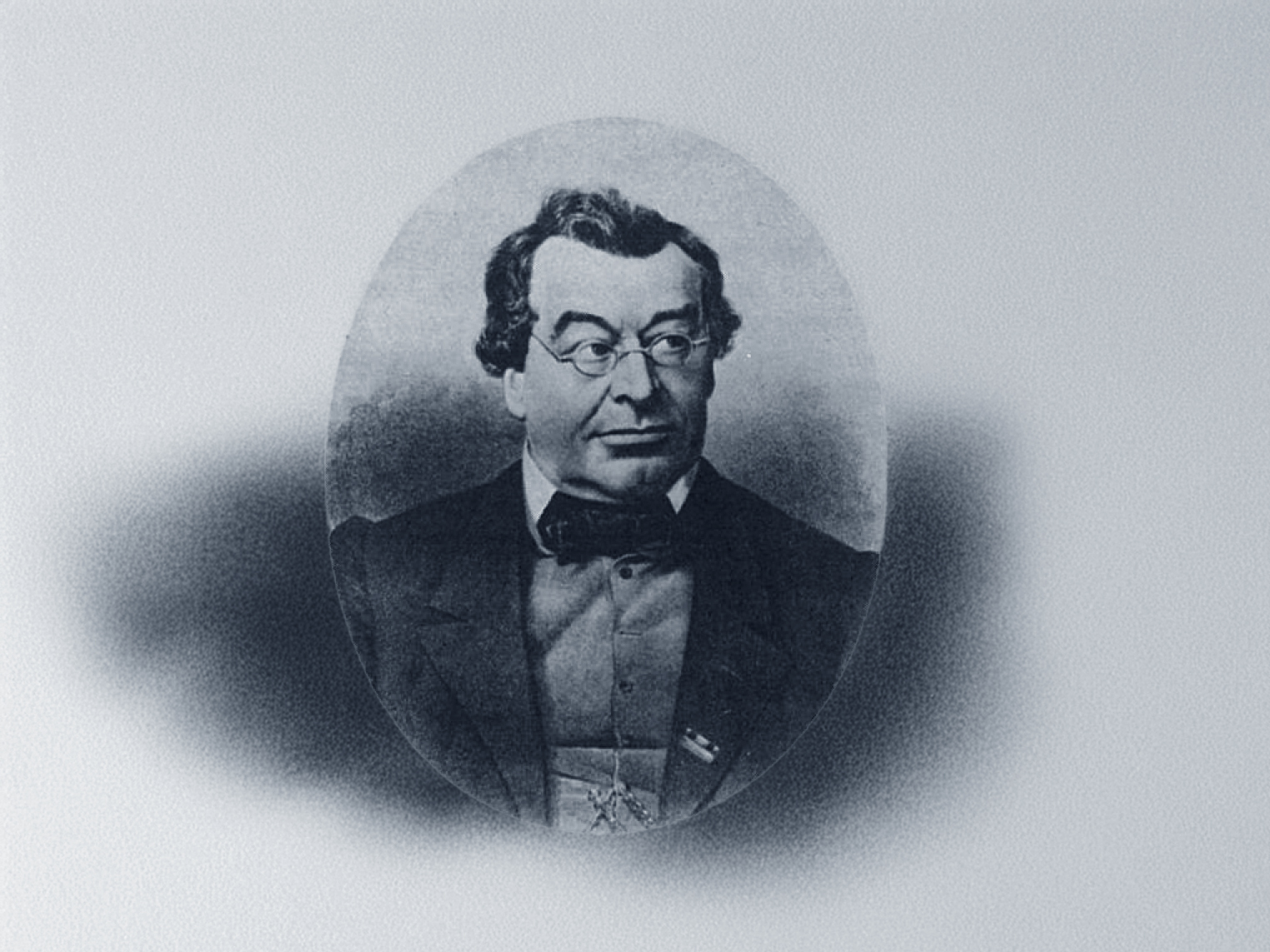
Wilhelm Wieprecht (1802-1872)
The rotary valve
In a letter of the 12th April 1818 dealing with the acceptance of the invention as a patent, the ministry of trade calls upon Blühmel and Stoelzel to have the original type of valve, the rotary valve included in the patent, which had hitherto been only hinted at:
Because the mechanism for shutting the valve loop is different from the earlier one, which you Herr Blühmel have explained by means of a diagram, and you Herr Stölzel by the prototype horn, both of you however having the intention of returning to the first method, according to reports, only retaining the box and the sliding valves for the horn, I hereby request you to submit a drawing and description of this mechanism which the instruments sent to Waldenburg demonstrate, so that the patent may also cover this type of shutting device.
But neither Blühmel nor Stoelzel complied with this request. Both of them only applied for a new patent for the rotary valves in 1828, after Stoelzel's application for extension had been turned down. Behind this ten year wait lies the economical thought: if the rotary valve had been included in the patent of 1818, they would have forgone any resulting economical use of the invention right from the start. But in this way they had the hope of receiving a new patent. During the oral negotiations with the Technical Delegation Blühmel or Stoelzel — or both of them — remarked, that they would use the rotary valve for the trumpet and trombone and the sliding valve on the other hand for the horn.
In 1828 Stoelzel — similar to 1818 — is sooner on the way through the administration than Blühmel and addresses the following letter on the 27th March 1828 to the State minister von Schuckmann:
The drawings included herewith are according to some mechanisms which were already made by me in 1814 by means of which I intended the perfection of metal wind instruments and which already at that time had reached a stage of development which allowed all the missing notes on these instruments to be played with ease and security, only I had no further use for these same valves, because the sliding valves which I submitted in 1818 and 1827 to a royal ministry require a much shorter depression and are therefore much quicker and easier to move which in turn enables every passage to be played.
I am however now in a position to submit this subsequently, whereby I would like to mention that all of these devices can only be considered as one invention only as all of them are reckoned in conjunction with the attached tubes and all have one aim. If however my intention should prove incorrect so I would beg of a high ministry to grant me a patent on it.
Strangely Stoelzel almost provokes the minister's refusal.
In the continuation, the development of the rotary valve is examined through the patent applications of 1828, shedding light on the technical differences between Blühmel and Stölzel and the emergence of early valve systems.
Brass Bulletin 25, I / 1979 pages 41–50
All content is protected by copyright © Brass Bulletin 1979–2026