2. The rotary valve system:
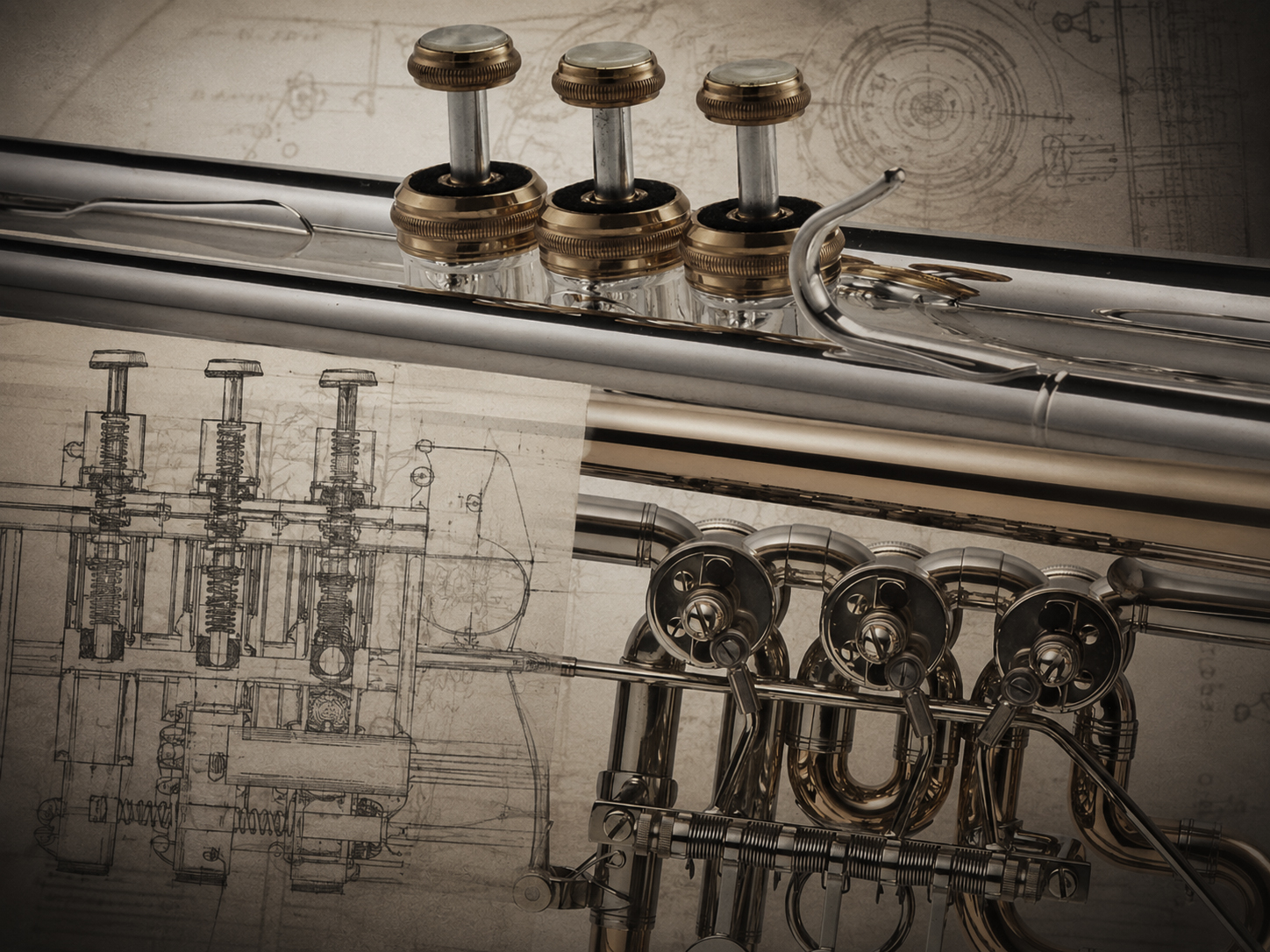
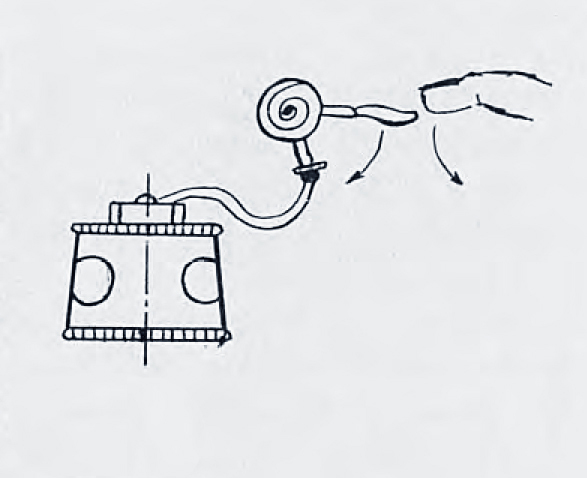
The cylinder has the form of a truncated cone and is traversed by two tubes. By pressing a lever, the cone is rotated a quarter turn around its axis. When the lever is released, the cone returns automatically to its original position by means of a spiral spring enclosed in a small cylinder.
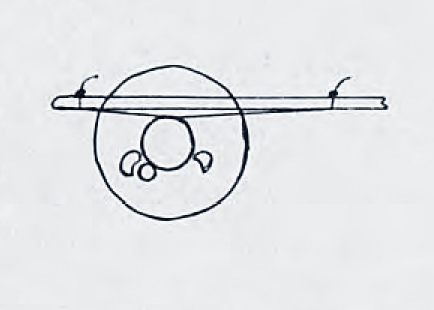
In some instruments, a system of four small axes and a transmission bar is required to transfer the motion of the vertical lever to the horizontal main axis. In others (see Fig. B), a simple string mechanism suffices. In both cases, the finger action is indirect.
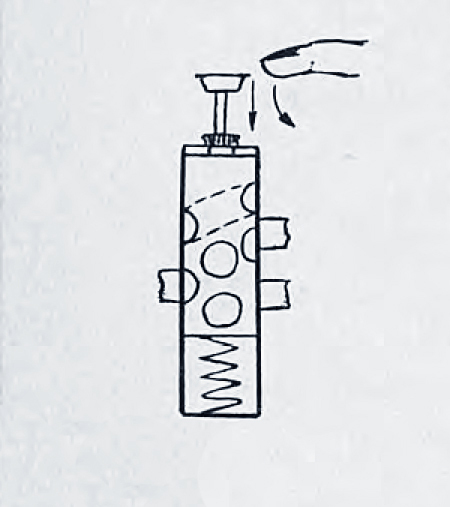
A disadvantage of the piston system is the relatively long travel of the piston. In trumpets it varies between 0.48 and 0.64 inches; in tubas it can reach as much as 1.04 inches.
An advantage of the rotary valve system is that the player can shorten or lengthen the lever travel by adjusting the finger’s position relative to the axis. The disadvantage, however, is that more force is required for shorter travel. On the other hand, the motion ranges of finger and lever are inversely related.
Wear of the piston and its casing is inevitable. After some years of use, both (and the small cotter pin, if present) will be worn. This process can be delayed by coating the piston with a thick layer of chromium — provided that the surface is perfectly smooth and free of even the smallest imperfections.
With the rotary valve system, only the end of the cone is subject to wear, which may cause some play. This can be compensated by adjusting the cone position. However, this more complex system has another serious drawback: when a valve is used, several parts are involved (the cylinder and its four axes), which inevitably produces noise — not only mechanical noise but also sympathetic vibration.
String transmission is simple and silent, but it shares the same disadvantage as shoelaces: the string will inevitably break at the most inconvenient moment.
In the case of mechanical problems, the piston system is clearly preferable. Usually, issues can be resolved simply by disassembling, cleaning, and lubricating. Achieving the same result with a rotary valve system requires a screwdriver, a pin remover, a small hammer — and a good deal of patience and calm.
Personally, I prefer the piston system for its simplicity and quiet operation, despite its inevitable wear. It would be interesting, however, to hear the experiences and opinions of other brass players — especially tubists, who more than anyone must deal with the issues of piston travel and mechanical noise in their instruments.