21 min. read
On the early history of valves and valve instruments in Germany (1814-1833)
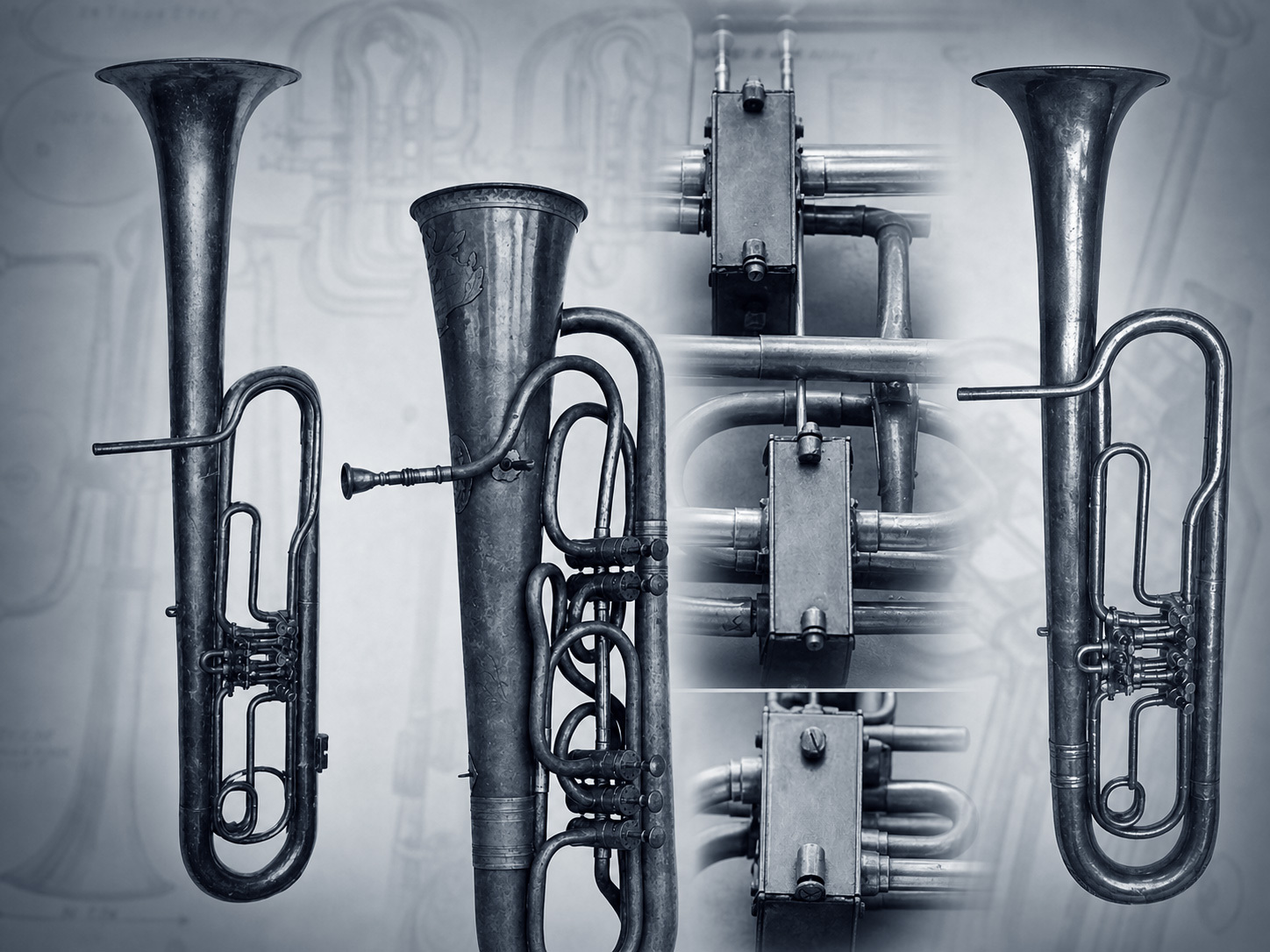
Alto horn, tenor horn, valve bass horn*
In Europe, the first half of the 19th c. was marked by wars of independence, accompanied by an exuberance of feeling which, in music, was reflected in the emergence of Romanticism. Its influence on brass music was the tendency towards dark, mellow tones as a sustaining bass in ensemble and orchestral playing. This led to the creation of large bore invention-trumpets and keyed bugles.
Stoelzel's letter of 6 December 1814, addressed to King Frederick William III, is full of this sense of renewal that is expected to create a new kind of music "that will surprise the world." He talked about the application of valves to the Waldhorn, trumpet and bugle. It was his wish to be directed to "introduce this new kind of music into the regiments."
Stoelzel understood in the course of the next few years that the renewal was much more than just the application of valves to those few instruments. It was clear to him that future brass bands should be unified in tone. As we learn from Wieprecht, the newly invented instruments like the keyed bugles, the English bass horns, the ophicleides etc. were introduced singly into the bands with no consideration of sound proportions⁶.
Stoelzel created a four-voice family of large-bore trumpets shortly after 1818, probably meant for cavalry bands. In 1820 at the latest the "trumpet bass" was created and on 20 January 1821 Stoelzel's colleague in the court band, trombonist Friedrich August Belcke, gave a first performance on the "tenor trumpet bass" in Berlin (AMZ 1821, col. 122).
At a later performance in Leipzig, 1824, the instrument was already called by its permanent name "tenor horn" (AMZ 1824, col. 490). The "trumpet bass" was in G, later mostly in F or Eb; the tenor horn was — and still generally is — in Bb.**
In his application for reinstatement of the patent (1827) Stoelzel claims to be the inventor of the alto, tenor and bass trumpets, later called alto horns etc. After declaring that, owing to his valves, the horns, trumpets and trombones were now greatly perfected and without defects, he continues:
The following section details Stoelzel’s valve designs, instrument proportions, and collaborations with makers, showing how bore, valve placement, and form shaped the emerging horn family.
Brass Bulletin 26, II / 1979 pages 69–82
All content is protected by copyright © Brass Bulletin 1979–2026