The earliest period 1814–1818
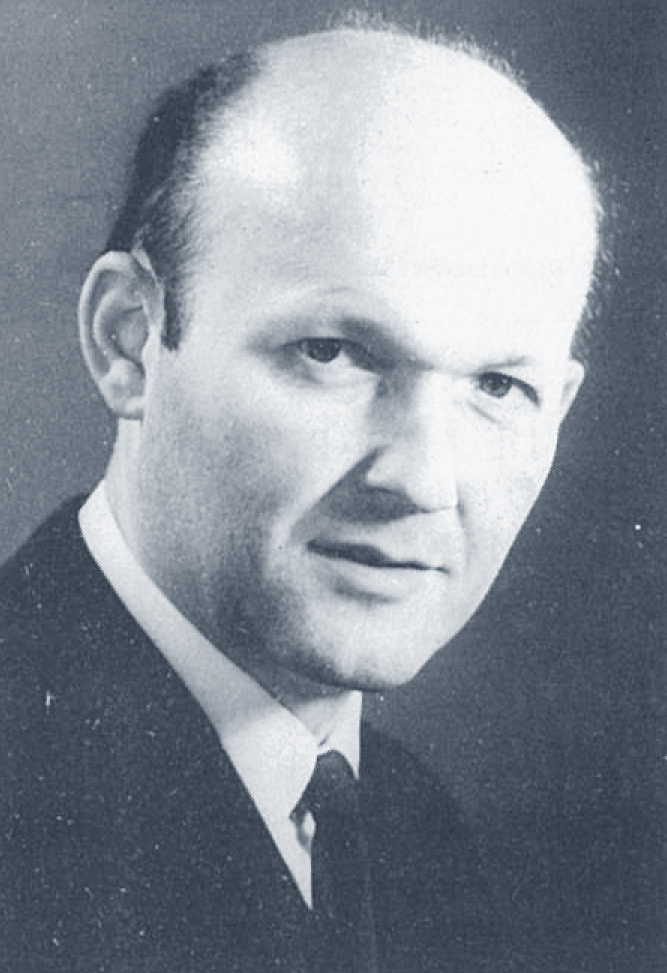
The story of invention, according to the earliest documents begins with a letter which Heinrich Stölzel "Princely chamber musician of Anhalt in Pless" in Silesia sent on the 6th December 1814 to King Frederick William III of Prussia:
Most illustrious, most mighty King Most gracious Lord and Majesty!
The horn, to which I have chiefly dedicated myself, is most defective as regards the inequality of its notes and the impossibility of producing them with the same purity and strength. This fact often made me very impatient and led me to make experiments which might alleviate the problem, which at the beginning were all failures, but which finally led me to an invention, which rewarded me for all my trouble and satisfied my demands on the instrument. My horn can play all the notes from the lowest to the highest with the same purity and strength without having to stop the hand into the bell. The mechanism of my invention is most simple, can be employed easily and quickly and everyone who plays the instrument can make himself thoroughly familiar with its application in a few days. This device renders the many crooks superfluous and makes it possible for the artist to play all the notes without losing any of the instrument's tone. This mechanism can also be applied to the far more imperfect trumpet and even to the bugles. Because the trumpet, whose whole compass hitherto consisted of 13 notes and through my invention has received 24 additional notes, which sound just as beautiful and pure as those 13 and for which now composers may write in a not so limited fashion, but in any major or minor key they wish, I believe that I do not exaggerate in promising your Majesty that by means of these instruments music may be made which will astound the world. I submit myself to every examination and am of the assumption that your Majesty may assist me further in this matter which is so important for the world of music and I am in the happy anticipation and yearn for nothing more than to be able to lay my instruments at your Majesty's feet which would then give me the hope of your Majesty entrusting me with the introduction of this new music to the regiments and of rewarding me according to the value of my invention.
I remain your most humble servant,
Pless, on the 6th Dec. 1814
H. Stölzel
After this letter Stölzel's valve horn was already available in 1814. For Stölzel it was also a matter of the economical use of his invention which had already been expected at the introduction of the valve instruments from the perspective of 1814.
The reply from the king or the chancellery is not preserved. The king had ordered that the invention be judged and examined and it was approved (see below). The applications for privileges and patents which since 1796 were directed more and more frequently to the king, led, on the 14th October 1815 in the "Publicandum", to the regulation of the law of patents in Prussia. Connected with this regulation was the fact that on the 29th December 1815 Stölzel made an application for a patent to the Prussian finance minister, referring to his earlier application and to the "Publicandum":
However I take the liberty of turning directly to your Excellency in this matter, because my invention, as your Excellency may deign to descry from the transcripts herewith included, has already been examined on the most high command of His Majesty and has been approved, I have, namely, invented a device for the horn, which enables the player, in all simplicity, to produce all notes from the lowest to the highest with the same strength, fullness and purity, the majority of which were hitherto only obtainable by stopping the hand into the bell and then were only dull and unclear. My horn is not a keyed instrument, and therefore has not lost any of its beautiful tone and keeps its pleasing form. I therefore most humbly request your Excellency to bestow me with a patent for 15 years for my invention for all the Prussian states, which, as I hope, should cause no objection, as I will have the instruments made by makers in the land and will not undertake this myself and cause therefore no detriment to them...
Stölzel still speaks of the great effort and considerable expense involved, for as a musician he is dependent on foreign help from the technical side.
The revised copies, which Stölzel included with his application, are three assessments of his invention, which he had already sent on to the king after his application of 1814. The oboe player and brigadier of the footguards in Berlin, Alvensleben, writes to Stölzel in Pless on the 21st December 1814, that the king had commanded him to give his opinion of the horn, and asks Stölzel to send him an instrument for examination. After a letter of the 19th January 1815 which was not received, Stölzel made another suggestion and did not dispatch the instrument. After this, Alvensleben requests Stölzel on the 13th February 1815:
to kindly send the instruments to the royal major general and commander of Breslau, von Kehsel, and because it would be of importance to His Majesty the King, I would ask you to see to this matter with utmost haste.
Because the evaluation as well as other documents are missing, it is not known whether Stölzel sent the instrument to Kehsel.
The second assessment, issued on the 24th March 1815 by G. B. Bierey, musical director of the town theatre in Breslau:
The invention for perfecting the horn, submitted to me by Mr. Stölzel from Pless, does not only correspond in all aspects to the claims he has made, but herewith do I bear witness, that according to my judgement and the truth, that the use of the same gives the horn a standard of perfection hitherto unattained and as a result provides results unknown so far.
Bierey publishes a modified and extended report on the 27th March 1815 in the Silesian provincial paper and also in the General Music newspaper, Leipzig 1815.
The third evaluation was commanded by the king from colonel "Lieutenant and director in the war ministry", von Thiele. Thiele wrote to the king from Vienna on the 19th April 1815:
Your Majesty the King has applauded the report made by experts on the invention by Mr. Stölzel for perfecting the horn and the trumpet, that this invention is expedient and promises usefulness and even if the present circumstances do not allow putting the suggestions into practice, may His Majesty be pleased to inform Mr. Stölzel of the satisfaction with his efforts and the interest shown.
Of all the assessors Bierey was the only one who had seen the completed instrument.
Therefore on the 1st February 1816, the "6th bureau" of the finance ministry informs Stölzel, that a patent
can only then be conferred, when you have submitted an exact description of your invention, and make it clear by precise drawings, or by means of models or an example of a horn fitted with the device itself...
Stölzel however did not comply with this request, and about 2 years later, on the 19th February 1818 he communicates the following explanation for his silence to the finance minister and renews his application:
Illness and other circumstances have hitherto prevented me from continuing with it; however I have been in Berlin for the last 6 weeks or so, and have had the honour of presenting my invention to the general manager of the Royal theatre, the honourable count von Brühl who has approved it, and now take the liberty of submitting most humbly to Your Excellency my horn fitted with this mechanism. Hereby I would like to repeat my most humble request: to confer on me most graciously a patent on it for 6 consecutive years. Finally I would most humbly care to remark that this invention is not only applicable to the horn but also to all other brass instruments.
According to a report on the 17th March 1818 (see below) Stölzel had sold his first horn to the prince von Pless, apparently in 1815. Afterwards he had a new, improved horn built. This was ready at the latest in the autumn of 1817 (Allg. Mus. Zeitung 1817, Sp. 814), and he demonstrated it chiefly in 1818, in various German towns as Berlin and Leipzig. In this manner he also presents the valve horn to the Grand Duke of Sachsen-Weimar, Carl August and offered it for sale⁵. The reason for Stölzel settling in Berlin from the end of 1817 was that he could direct the patenting and introduction of his invention more easily, and have direct contact with the instrument makers.
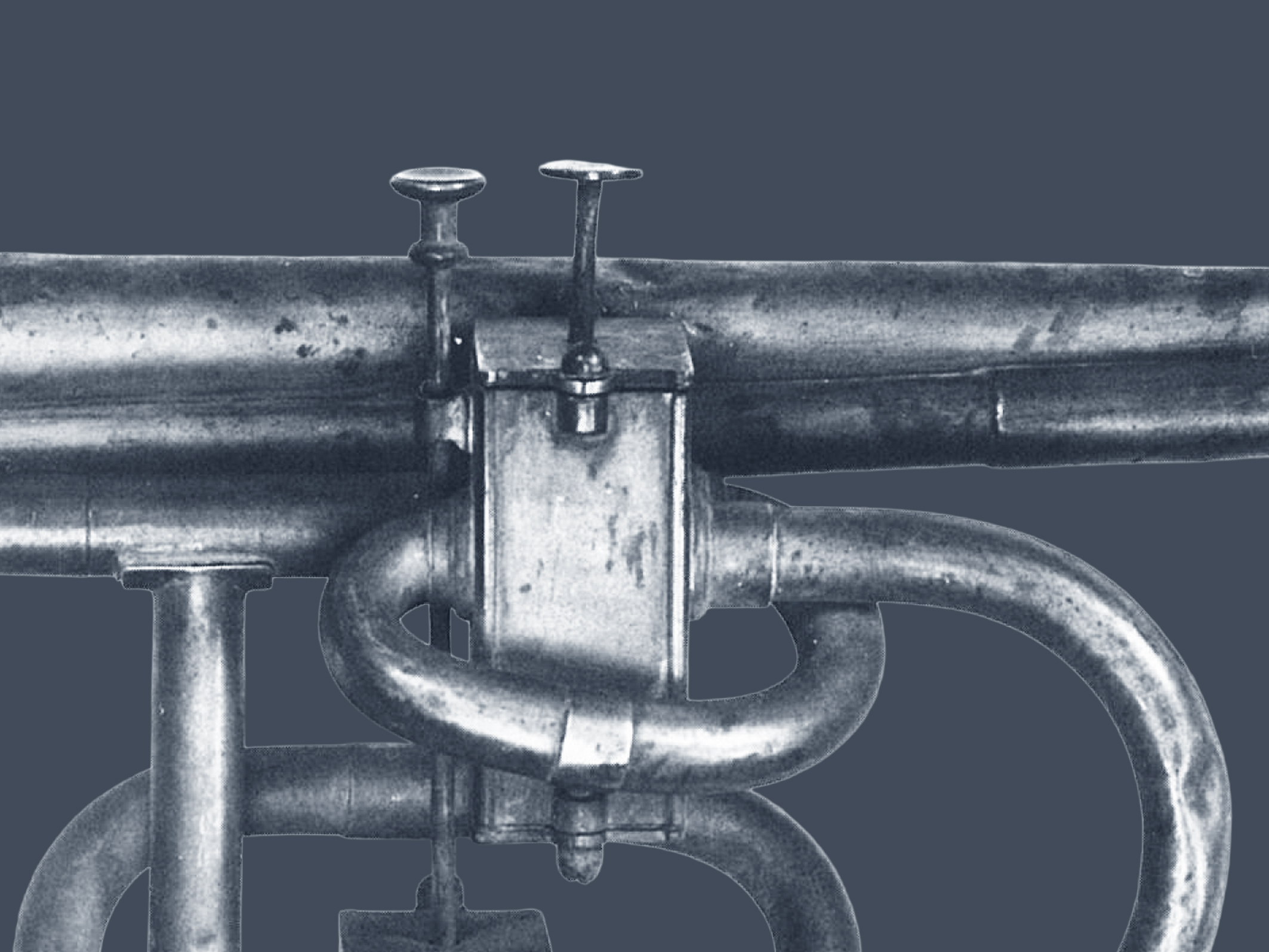
The manager of the Royal theatre count Brühl, found it desirable to make Stölzel's invention generally available (letter to the king from the 2nd April 1818) and allotted a vacant position in the royal band to him, probably as early as April 1818. Without drawings or precise descriptions existing, it can be taken as a certain fact, by inference, that the valves for which Stölzel applied for a patent were the widespread Stopferventile (Schubventile, push-valves) (drawing 1; III. 1). Stölzel's invention would doubtlessly have been recognised as a patent, if the royal captain Gerhard had not contested the primacy of Stölzel's invention 3 weeks before his renewed application.
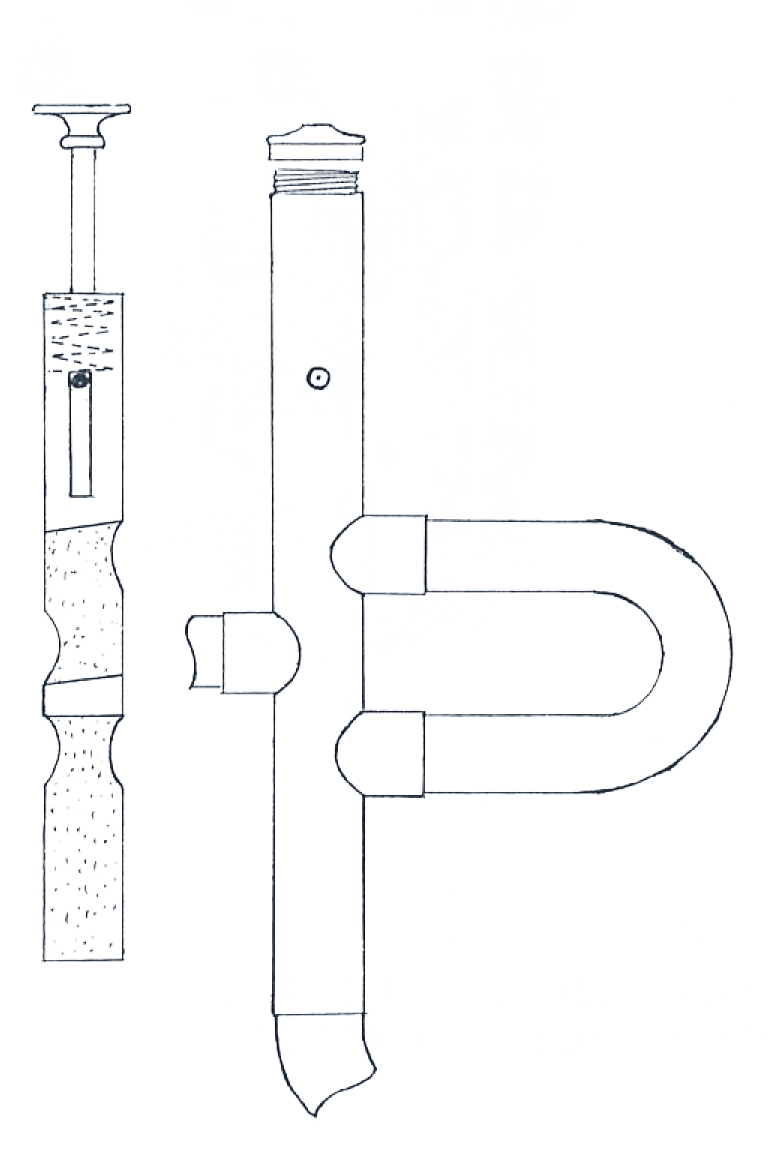
Drawing 1
Stölzel’s sliding valve (Stopfer or Schubventil), patent 1818. In grey: sections conducting air.
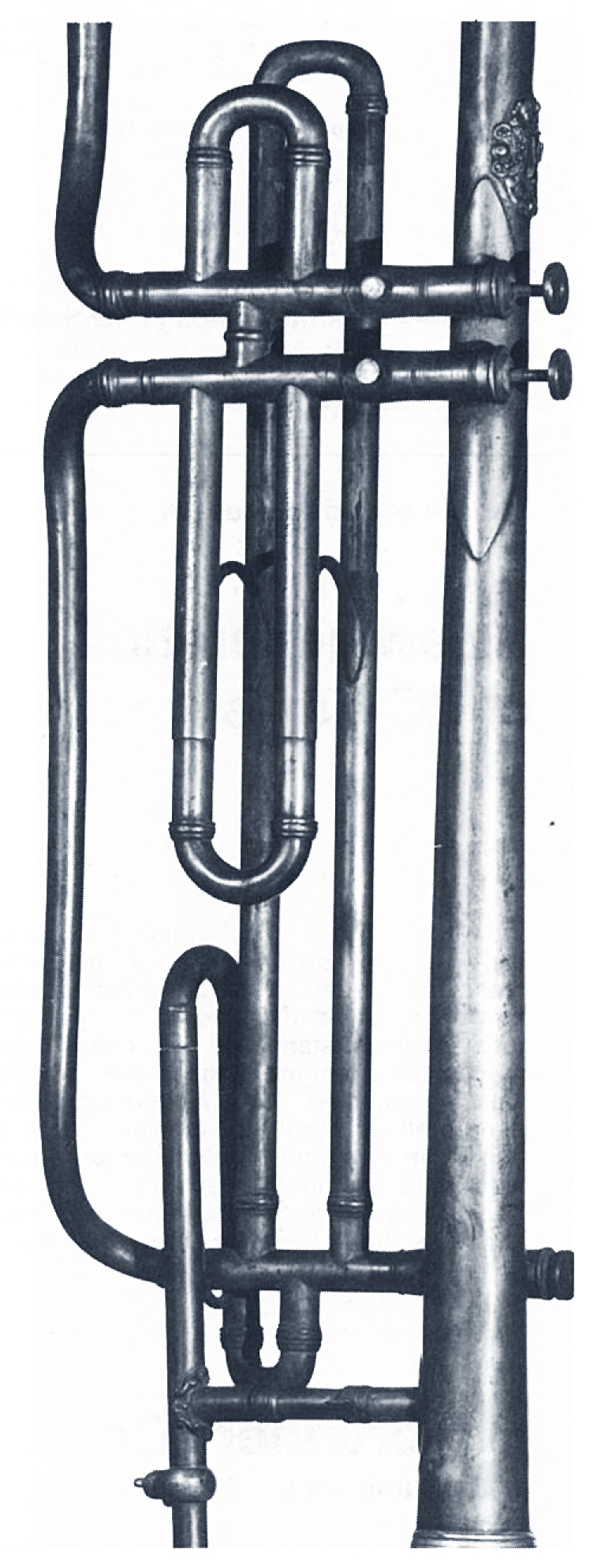
1. Clavicor by Guichard, Paris, after 1840; detail of 2 stopping valves by Stölzel (according to 1818 patent). At the thicker places, screws for holding the springs. (Kat. Nr. MIR 64, Germanisches Nationalmuseum Nürnberg, coll. Dr. Dr. h. c. Ulrich Rück)
After Friedrich Blühmel had heard of Stölzel's intention, he made a request from Waldenburg to his duty station to present his claim to priority to the appropriate official department and make it credible. Consequently captain Gerhart writes to the ministry of trade on the 19th January 1818:
According to report, a musician called Stetzel from Silesia is staying here as a private person or has been engaged as horn player in the fusilier corps, who claims to be the first inventor of an excellent improvement to the so-called keyed horns (horn and trumpet) and as such is applying for a patent. According to documents and particularly to an early report of the Silesian Oberbergamt, it appears that without doubt Mr. Blühmel of Waldenburg is the real first inventor of this improvement and has also sent horns here already, with this invention...
Now that it is most desirable, that this aforementioned Blühmel should not lose all the fruits of his 3 years work which has entailed some expense; consequently the Bergamt in Waldenburg has today been directed to collect together all the evidence which proves the same to be the first inventor and to submit this proof as quickly as possible.
Gerhard requests the ministry to wait with the granting of the patent until the question of the primacy of the invention has been settled. Likewise with the request for the precise examination of priority, count Brühl turned to state minister von Bülow on the 21st February 1818 and in doing so he expresses his personal opinion on Stölzel's invention:
The invention of this machine at all, is one of the most important which has been made, perhaps for centuries, to improve a musical instrument: and I feel myself duty bound to remark that the mechanism developed by Stölzel is without doubt superior to that of Blühmel.
Friedrich Blühmel had sent in his application for a patent on the 18th February 1818, one day therefore before Stölzel's repeated application. Blühmel had come from Waldenburg to Berlin and sent off his application from the "office of the mine 'im neuen Münz' building no. 9 on the Werder market". He writes that in 1808 he changed over to the horn and trumpet from the violin on which he could make no progress due to the hard work in the mine. The imperfections of these instruments stimulated him to remedy these faults. He enlarges on this:
The numerous uses of the mechanical forces, which I had an opportunity of seeing during my presence in Upper Silesia, particularly the various air pipes used in the blast apparatus of the high and low furnaces which always led me back to the basic idea of executing an improvement on these instruments, I believe I could use to reach my goal and therefore sought the company of the keepers of the machines and other experts in order to comprehend the dosing and opening of the wind pipes, whilst I started out with the idea of which way the air must pass through the tubes of the instrument, to lengthen or shorten according to certain dimensions, in order to make up the missing notes of the compass [...]
Collecting all the keys together soon made it clear, that the addition of a semitone and a whole tone loop, which could be opened and closed whilst remaining in close contact with the instrument and which lowered the note played by a semitone, whole tone or 1½ tones could be effected.
In Waldenburg I experimented with my idea and learned to solder in order to reduce costs; through lack of tools I was soon forced to have recourse to the artisans themselves, who unfortunately through their lack of knowledge of this object caused me expense through their work involved but yet did not bring me nearer to my goal. The possibility of carrying this work out was there but the clumsy execution of the mechanism caused the playing of scales to be very slow and difficult, so that I was still not in a position to produce my instrument for the general public. In addition my first experiments had to be carried out on a trumpet made in the old long form, since no other instrument was available at the time, and I had much trouble not to put the mechanism on the outside of the instrument and thereby disfiguring its shape. In 1816 I finally got results, whereby all the whole tones and semitones could be played on the trumpet by means of 2 valves and now there was nothing left for me to do but to simplify the mechanism even more and to confine it within a narrow space. This had not been successful with the early artisans who I had employed for my work and I turned therefore to the locksmith Master Richter. During this time several instruments of the latest type with sliding valves were sold to the industry in the district round Waldenburg and these valves gave me the explanation of how to construct the closing and opening of the whole tone and semitone loops on my contrivance, and so to make the whole as simple and as perfect as possible, which both my instruments trumpet and horn have at this time and which are described in more detail in the drawing and explanation which I have included.The drawing comprises simply the invention of the improvement, which to all intents and purposes remains the same in all the instruments mentioned above, the semitone and whole tone slides only varying in length according to the instrument in question.
Through lack of time it is not possible to submit a trumpet and trombone made in the new way at the same time, which however will occur within the next few days, as these instruments are both being worked on right here and now the old trumpet will suffice to prove the legitimacy of my claim. I shall not fail to give the new trumpet and trombone into the care of the high ministry as soon as they are completed and as long as a correct drawing will have been made in their place.
As proof that I am the real inventor of this improvement, I include 9 certificates with my most humble application and with the deepest respect.
Finally Blühmel makes a request for a ten-year patent for Prussia for the sole manufacture of valve trumpet, valve horn and valve trombone. Apparently Blühmel had experimented with rotary valves up to 1816, which is also touched upon in the letter of the Bergamt from the 3rd March 1818 (see below). Only after the appearance in Waldenburg of the instruments fitted with sliding valves did he start work in 1817/1818 on the construction of box valves (III. 2).
In February 1818 he had the trumpet with two and the trombone with three box valves under construction with the brass instrument maker J. C. Gabler (s. b.). Blühmel's stay in Berlin was analogous with that of Stölzel's: the supervision of Gabler's work and the quick and direct contact to do with his application for a patent. Included with Blühmel's application were drawings (not preserved) and a caption. The main drawing was the valve section of a horn with a semitone and whole tone valve.
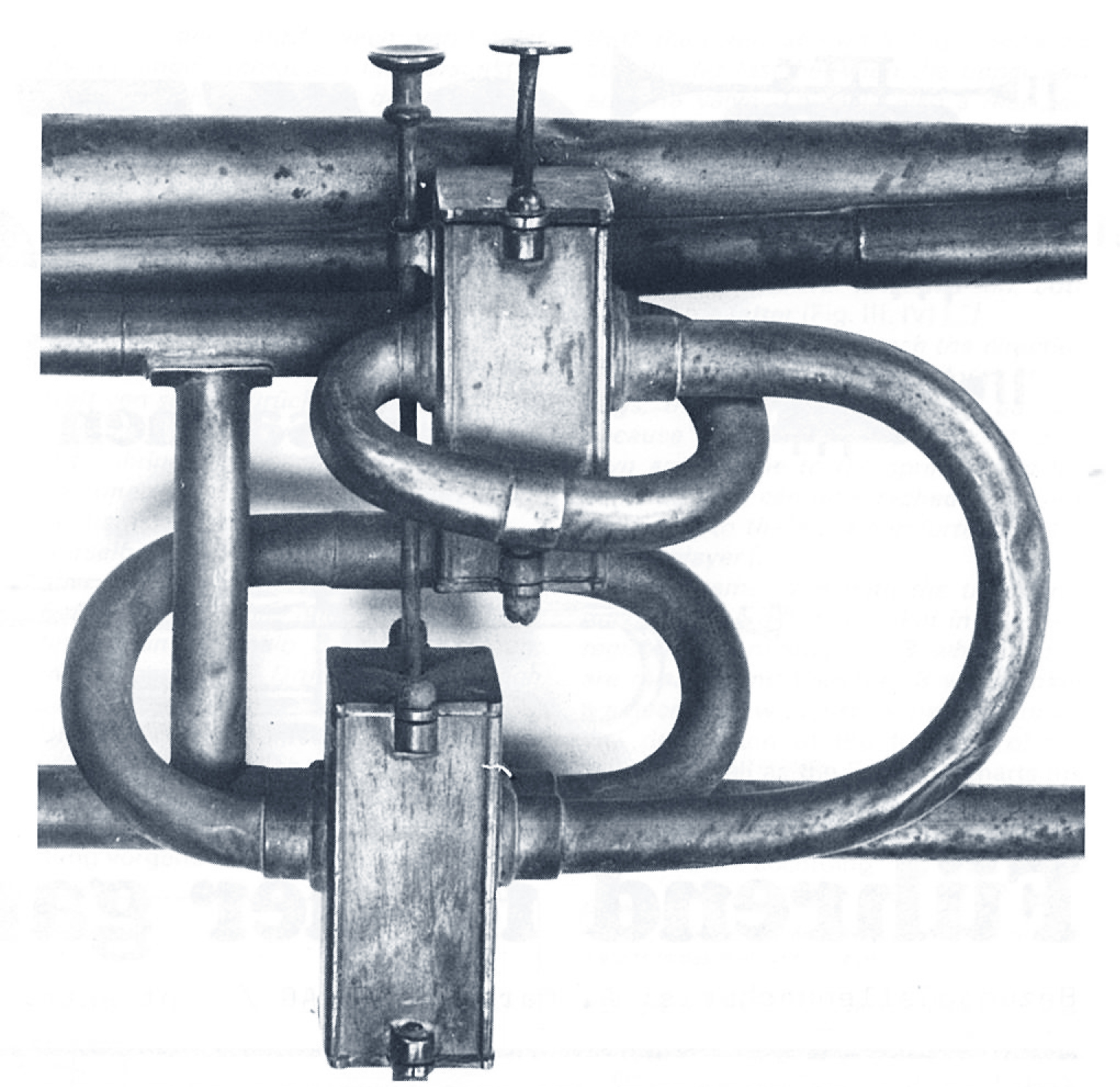
3. Trumpet, W. Schuster, Karlsruhe between 1823 and 1830. Detail of both box valves, based on Blühmel’s design. (Kat. Nr. MIR 130, Germanisches Nationalmuseum Nürnberg, coll. Dr. Dr. h. c. Ulrich Rück)
Blühmel describes it thus:
The whole consists of 3 crooks and 2 valve boxes. The first loop a. replaces the former invention piece and is brought into contact with the tubes aa by means of the sliding valve when this remains in the same position as in Fig. IV and VI, by means of a short diagonal tube in the sliding valve as in Fig. IV. The long tube b. which comes out of the 2nd valve box and returns to it is the whole tone loop which is closed air-tight by the forward part of the sliding valve at point x as in Fig. VII. The short tube c. which can be seen on the first valve box is the semitone loop and is closed as in the case of the whole tone loop at point x and as a result both loops, b and c can be cut off from the so-called invention loop.
The valve boxes 1 and 2 are identical, in their exterior form as well as in their inner construction. They consist of the box where the tubes are situated and the sliding valve. This is a hollow brass box with three openings two of which are constructed perpendicularly (Fig. III) and one diagonally. This valve is pressed against the rear part by means of a spiral spring which is made of hammered brass because it only slightly oxidises (Fig. IV).
Both the round screws in Fig. II hold the cotton ring fast between the upper part and the valve. There is also a rear part which is held together with the upper part by means of two long screws with countersunk square heads (Fig. II) and nuts (Fig. I and V), and in order that the movement of the valve is not hindered, a semicircular groove is made on both sides of the latter (Fig. III, IV) [...]
It is not necessary to attach the direction of the valve pistons in the form of the rings, they can just as well be buttons because the valves jump back of their own accord due to the springs, and the valve buttons can be attached anywhere according to the most comfortable place for the player [...]
It is the same case with the trombone, only with the difference that in the bass register 6 semitones or 3 whole tones are missing and therefore 3 valve boxes are necessary with just as many pistons...
The description of the function of the valves as well as the fingering charts are here left out of Blühmel's description. Drawing no. 2 is a reconstruction of a box valve according to Blühmel's description. It is important to mention that the change is completely made of brass and the small tubes were made separately and were afterwards soldered in. According to Blühmel's description of the top and bottom of the valve case the valves were at first perhaps built into the trumpet lengthways.
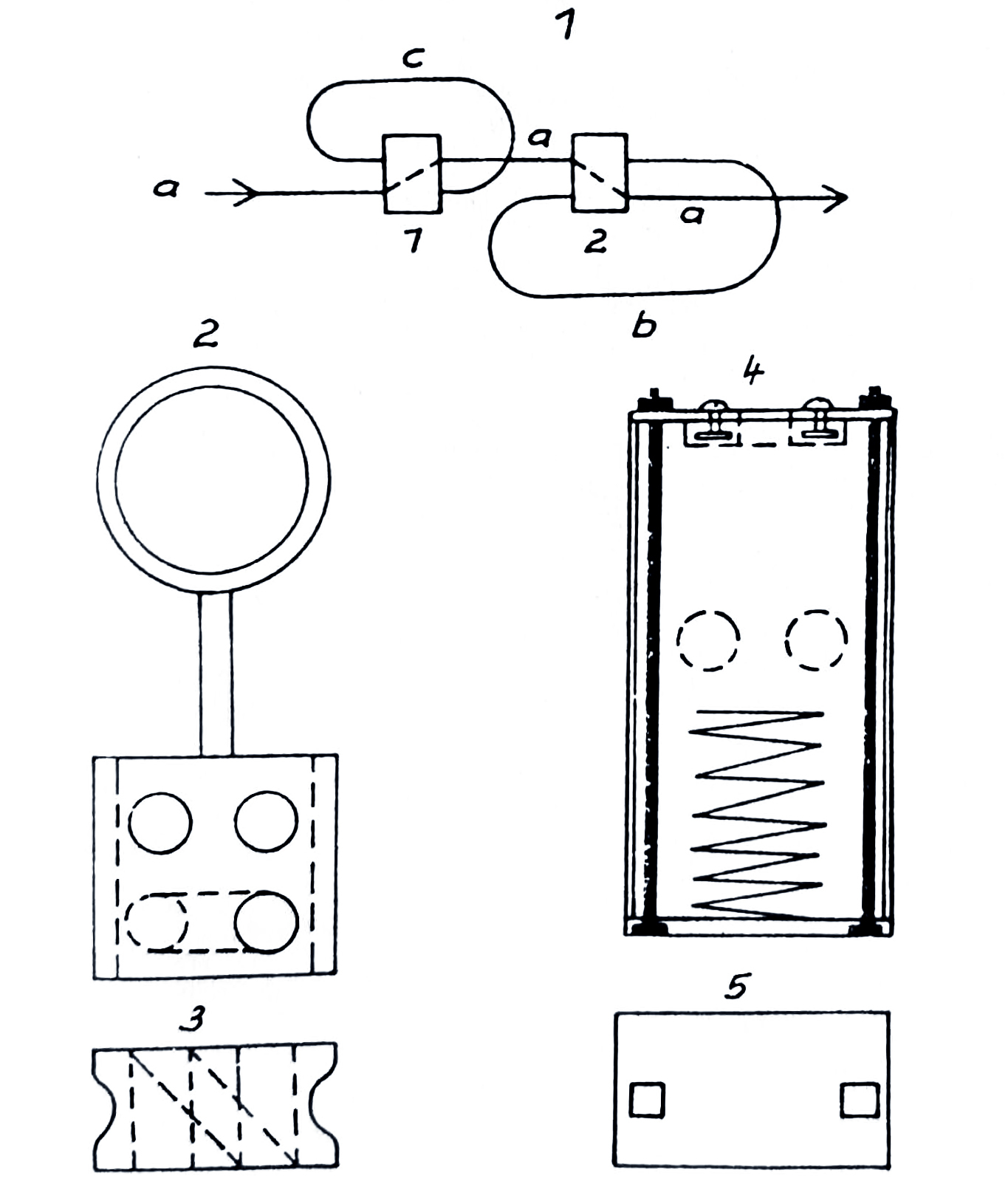
Drawing 2
Blühmel's box valve (Patent 1818), reconstruction according to the patent description.
- Course of air direction in the valves as seen from above (front view). The inscription corresponds to that in Blühmel's description.
- Change as seen from the front, corresponds to Fig. IV in Blühmel's report.
- Change seen from below.
- Valve case (front view) with screws, going through felt ring, spring and indicated tube entries and exits.
- Valve case from below, with the heads of the case screws.
Meanwhile the documents requested by the Oberbergamt regarding Blühmel arrived from Waldenburg and on the 3rd March 1818 captain Gerhard dispatched them to the ministry of trade with the following remarks:
The invention of the sliding tubes, which I have the honour of dispatching myself along with other pieces of experimental work which Mr. Blühmel did in earlier years, are indeed from 1811/12, which Bauer’s certificate indicates (4); but this device also has been modified without the assurance of Bauer, which can be seen from Posher's certificate Nr. 5. I heard Mr. Blühmel himself play on this old device in September last year. When hearing the witnesses, the town and country courts seem to have taken less account of the approval the invention has met with in not deeming it necessary to attest Piehl's certificate Nr. 9, but rather they limited themselves to establishing the fact that Blühmel really did invent this device without having any connection with Stölzel. Mr. Blühmel has, by the way, the intention, in case a patent is granted to him, to use the old device, and to dispose of the boxes and this particularly in the case of instruments which require more than 2 boxes, but until this matter is decided on, it should be kept secret. The documents referring to Blühmel are most obediently enclosed.
Why Blühmel presented his petition to the Bergamt remains a mystery. Either he wanted financial support for his experiments or had his application for a patent negotiated through this office. For according to the Publicandum of 1815 the patents were supposed to be submitted to the appropriate provincial government. Stölzel had turned directly to the finance minister, thereby taking a short cut through the prescribed administrative path.
This letter of captain Gerhard is noteworthy because of his mention of the years 1811/12, the rotary valves which are hinted at indirectly and because of the independence of Blühmel's and Stölzel's invention.
In the face of priority demands made by third parties of intermediary persons the ministry of trade turned to royal town court in Waldenburg on 8th March 1818 to discover more about Blühmel and to the royal provincial government in Breslau to obtain further information from the town's musical director Bierey. The same day Breslau's factory commissioner was instructed to find out from Stölzel whether the valve mechanism was originally the same already as on the prototype horn of the 15th February 1816.
He was in addition to present this horn to the chamber musician Schneider and ask whether it corresponded to the original invention. The questions on the original form of Stölzel's valves had the intention of revealing whether there had been a possible common starting point. Schneider wrote, that Stölzel had already constructed a perfect chromatic horn in July 1814 and since then had not undertaken any essential changes,
only to give the horn the necessary orchestral pitch he had put an additional bend on to the crook which is clearly apparent when comparing the prototype horn with the drawing enclosed and this extra bend had not yet been attached to that device which was mentioned in music director Bierey's of Breslau certificate on the 24th March 1815.
On the 17th March 1818 Stölzel reports the following: that he had firstly in July 1814 constructed a fully chromatic horn. The horn which was the basis of Bierey's judgement of the 24th March 1815 was essentially the same as the prototype horn of 1816, only it did not yet possess the bend which Schneider mentioned. The first horn belonged to the prince von Pless and he had his own one built and marked with the date of the 15th February 1816. There are 3 further assessments which date from the 4th and 6th February 1818 (the third is without date) which were requested by Stölzel himself and indeed still before his last application for a patent. All three people from Breslau (bandmaster Schnabel, J. G. Keller, Hoffmann) bear witness to the fact that Stölzel had demonstrated such a horn to them in the summer of 1814. The information requested by the ministry of trade is not preserved.
Meanwhile Stölzel and Blühmel have come to an understanding and on the 6th April they apply for a common patent under the style of "Stölzel's and Blühmel's invention". Stölzel promises to pay "a sum of 400 thalers in full settlement of all claims to Blühmel for the sole use of the patent, and in fact 200 thalers in cash on the day the patent is issued and 200 thalers after one year from that date". On the other hand Blühmel commits himself "not to make any further use of his invention, or to make any other claims". Blühmel thereby leaves the use of any possible patent to Stölzel for the sum of 400 Reichsthaler.
After the king had left the acknowledgement of priority to state minister von Bülow, there finally resulted the grant of a patent for Blühmel and Stölzel together on 12th April 1818, and indeed for 10 years for Prussia. The patent was granted
for that particular device for the perfection of brass wind instruments, namely the horn, trumpet and trombone...
The technical delegation, whose assessments of musical instruments were made by engineers, at that time Wedding and Schaffrinsky, looked upon these new aspects of instrumental construction technology from the point of view of the engineer and the Publicandum of 1815. Technical valves were at that time no longer anything new. It only culminated in a patent in 1818 because of the special application of the valve principle to wind instruments. Different types of valve were not considered worthy of a patent, because they all functioned according to the same aerodynamic principle. Therefore after 1818 no other applications for patents for valves were given approval in Prussia. The musical side of the various types of valves was always disregarded. The arguments as to the question of priority in 1818 hardly touched on the specific characteristics of both types of valves. Only in 1828 Stölzel in a letter to the state minister von Schuckmann (see section "rotary valve") makes the claim of having invented all three types of valve in 1814.
Wieprecht's assertion that Blühmel and Stölzel were "for a long time in close contact with each other in Silesia" (see Kalkbrenner p. 91), is credible. This statement is actually a corroboration of Stölzel's claim of having invented all three types of valves.
The problem of priority cannot be solved according to the present state of sources. Wieprecht too, could not discover from personal conversations with Blühmel and Stölzel, which of them was the first to come across the idea of the valve. And Wieprecht was apparently most interested in clearing up this question. It is relatively certain that Stölzel produced a valve instrument which was ready for demonstration more quickly, apparently already in July 1814, and Blühmel not till 1816. The difference in time however was rather more a result of the technical skill of execution, than the idea itself. Blühmel and Stölzel both deserve to be acknowledged as the inventors of the valve principle in brass instruments. If in secondary literature Stölzel is occasionally mentioned as being the real inventor of the valves, then at the bottom of this there is the contract between Blühmel and Stölzel, mentioned previously and the sum paid in settlement to Blühmel. As Stölzel only had instruments built with his valves, invented new instruments and brought a new valve into use not later than 1827, Blühmel's name receded into the background. In addition Blühmel did not have the contact with the instrument makers in Berlin, living as he did in Waldenburg.
(to be continued)