Explore institutional access Explore institutional access
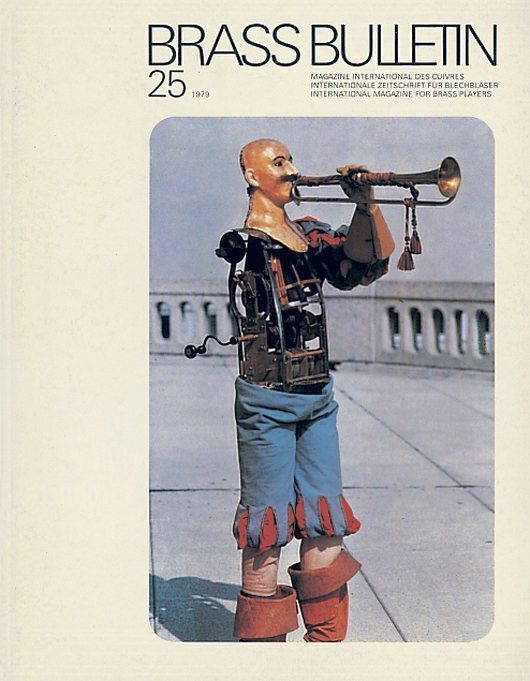
Brass Bulletin 25 - 1 / 1979
Issue
Brass Bulletin No. 25
Date
I / 1979
Pages
96
Contents
7 articles

Out of print

All issues

Brass Bulletin No. 25

I / 1979

Contents

7 articles

Editorial

Jean-Pierre Mathez

pp. 3 Society

A warning from the machine: Jean-Pierre Mathez reflects on Kaufmann’s robot—questioning whether technology is shaping music… or slowly replacing the human artist.

Maurice André

Part 2

Biography

Jean-Pierre Mathez

pp. 27–39 Trumpet Encounters

From circus gigs to Bach with Karajan: Maurice André reveals how relentless work, discipline, and daily technical refinement shaped one of the greatest trumpet careers.

On the early history of valves and valve instruments in Germany (1814-1833)

Part 2

Herbert Heyde

pp. 41–50 History Equipment

From invention to rivalry: the early history of rotary and piston valves reveals a battle of ideas, patents, and craftsmanship that transformed brass instruments forever.

The classical solo concerto for trombone and its interpreters in the 19th century

Werner Beyer

pp. 51–55 Trombone History Repertoire

From Queisser to Ferdinand David: the rise—and disappearance—of the classical trombone concerto in the 19th century reveals a forgotten golden age of virtuosity.

A guide to commercial tuba playing in the Los Angeles area

Tommy Johnson

pp. 56–58 Tuba Professional life Technique

Hollywood reality check: Tommy Johnson reveals what it really takes to become a commercial tuba player in Los Angeles—skill, versatility… and patience.

Dreams and wishes

Things I would like to see happen concerning the horn and horn playing

Jeffrey Agrell

pp. 59–62 Horn Equipment Repertoire

A set of proposals for the future of the horn: Jeffrey Agrell addresses editions, pedagogy, instruments, and repertoire—from Mozart to contemporary practice.

What is a Brass Band?

Barrie Perrins

pp. 63–70 History Society

Barrie Perrins traces the 19th-century origins, instrumentation and social role of the brass band—from industrial roots to international musical life.

Loading…

Questions & Answers

How the Digital Edition works

What does the Digital Edition include?

The Digital Edition brings together the articles already digitized as searchable online texts—not simply as scans or PDF files—along with their original illustrations, notes, authorship, issue information, and available translations. Related-article suggestions currently include only this digitized material.

Are the digital articles identical to the originals?

We preserve the original text, language, illustrations, captions, footnotes, and editorial context as faithfully as possible. The presentation is adapted for comfortable online reading, and obvious transcription or scanning errors may be corrected. The substance and character of the published article remain unchanged.

Which languages are available?

Brass Bulletin was published in English, French, and German throughout its history. Italian and Spanish translations were added from issue No. 60 onward.

On the Italian and Spanish sites, articles from issues 1–59 are therefore shown in English by default.

How often are new articles added?

New articles are added almost daily, with approximately one complete issue digitized each week. The pace may vary depending on the preparation, image work, and editorial checking required.

Why aren’t all articles available digitally?

The complete Brass Bulletin collection contains 1,246 articles published between 1971 and 2003. The full index is already available online, allowing readers to discover every article in the collection, including those whose complete text has not yet been digitized.

Digitization began in February 2026. Each article is carefully prepared for online reading, checked, and connected to its issue, authors, subjects, and illustrations. At the current pace of digitization, the complete collection is expected to be available online by February 2028.

Why do some references mention articles that are not available yet?

References in the original articles are preserved even when the material they point to has not yet been digitized. This keeps the historical and editorial record intact. As more issues are added to the Digital Edition, an increasing number of these references will lead to articles that can be read online.

Can I suggest an article or report a transcription error?

Yes. If there is an article you would particularly like to see digitized, or if you notice a possible transcription error or missing detail, please contact us. Reader feedback helps us improve the Digital Edition and prioritize useful connections within the archive.

How can I support Brass Bulletin?

Your support helps fund the preparation, verification, and online publication of the complete collection.

Subscribe to the Digital Edition

Prefer to support us without subscribing?

Make a donation

Search Brass Bulletin.