20 min de lectura
The Trumpet and the Cornet in Jazz and Popular Music
The “Classical” Period 1927-1945 — The Golden Age of the Trumpet
Por Michel Laplace
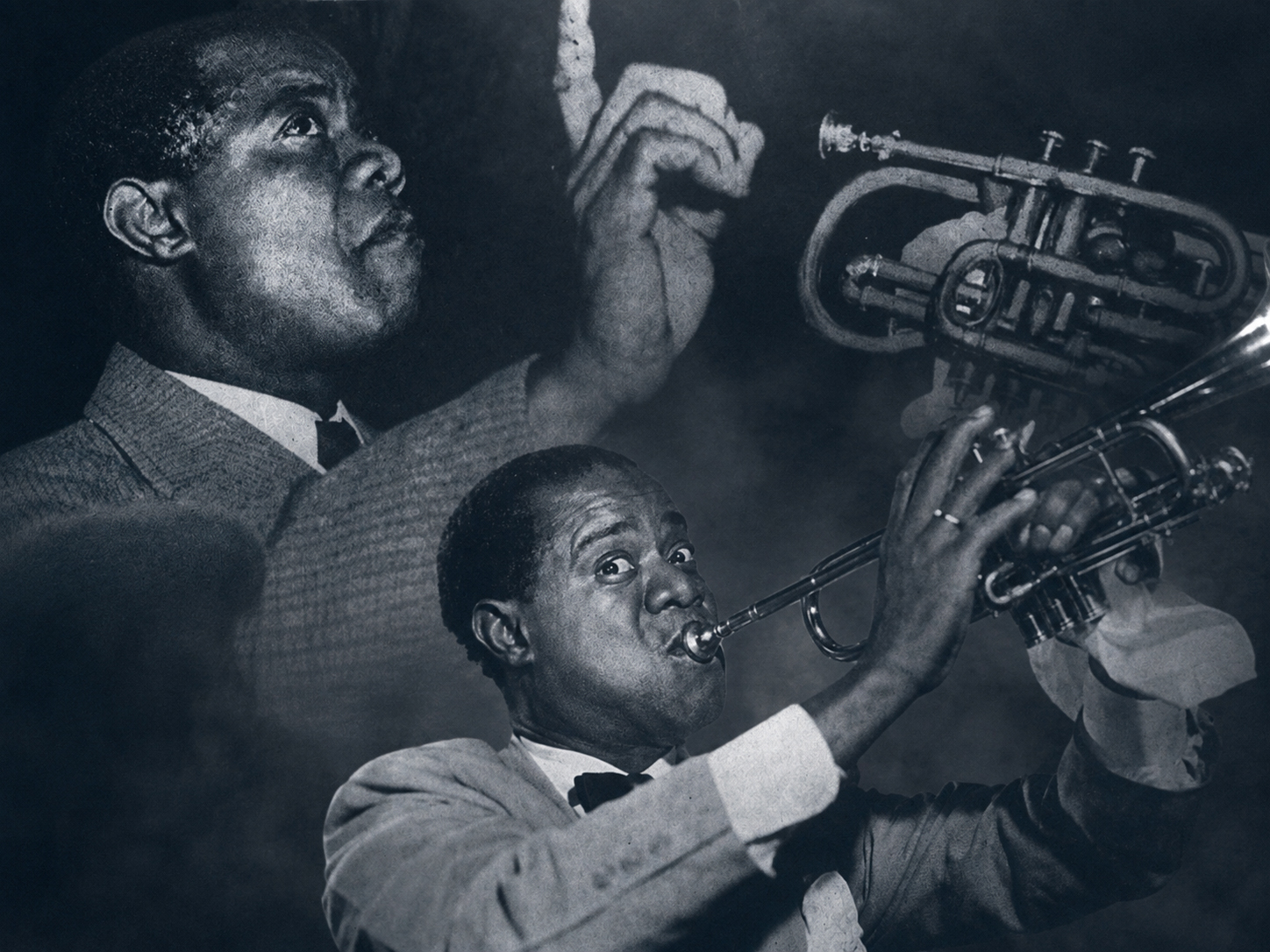
Louis Armstrong (Michel Laplace Collection)
This was a golden age in terms of both instrumental technique and popularity.
Agamemnon, seeing that one of his sons possessed wisdom, bought for him a golden trumpet and said to him, ‘Go now, go over all the world sounding peace and joy […]’ Louis felt that he was bringing peace and joy to the whole world. He filled his lungs and blew a melting note which climbed so high in the clear blue sky that it froze and stayed suspended there like a stellar diamond […]
(Henry Miller: “Louis Armstrong”)
Only heroes have their praises sung by poets; Louis Armstrong (1900-1971) changed the course of the evolution of jazz so that it ran through him alone. In New Orleans the cornet was usually the main melodic instrument: it almost always “sang” the first “part” while remaining involved in a collective effort. A unique artist whose surprising physical capabilities measured up to his exceptional inspiration, Armstrong evolved from the sedate New Orleans style towards a new conception of the virtuoso soloist, with brilliant excursions into the high register. His first step was to abandon the cornet in favour of the trumpet in 1926; his second was to use a heavier instrumentation in order to underline his musical language better.
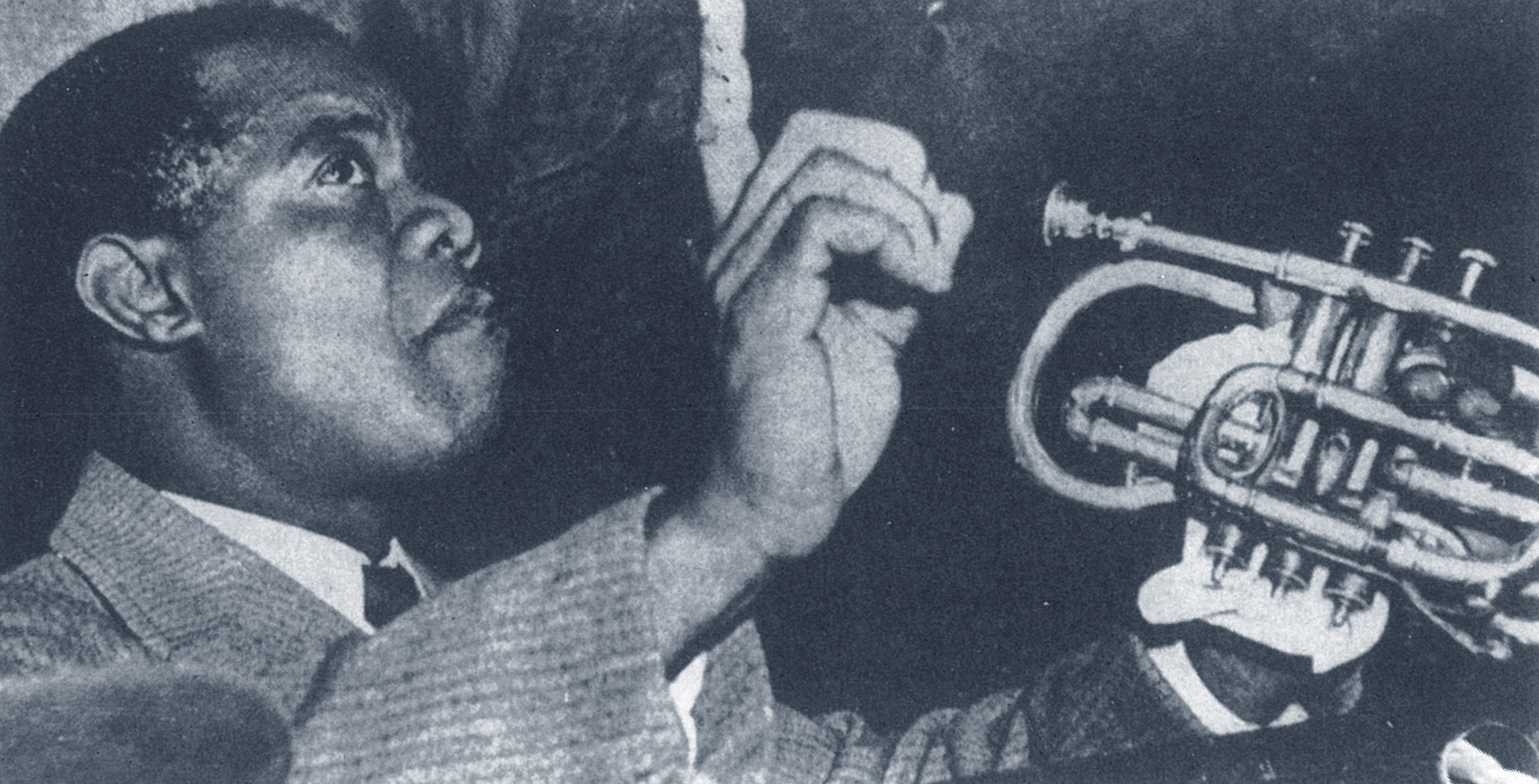
Louis Armstrong on cornet (Coll. Michel Laplace)
From then on, as long as big bands were in fashion (approximately 1928-1940) the trumpet made its mark with its dynamism, its brilliance, its impressive riffs and its unequalled punch; it was also entrusted with the majority of the solos (as long as the bandleader was not a big trumpet star); its only serious rival was the saxophone. Amid all the attractions of the big band these trumpet flourishes were the most irresistible and dashing and they made the trumpet the “king of instruments” (and they often made the trumpet player the band’s “big noise” in both senses). It seems clear that the person mainly responsible for jazz taking this course was Louis Armstrong, whose amazing gifts could not be accommodated within “collective means of expression”.
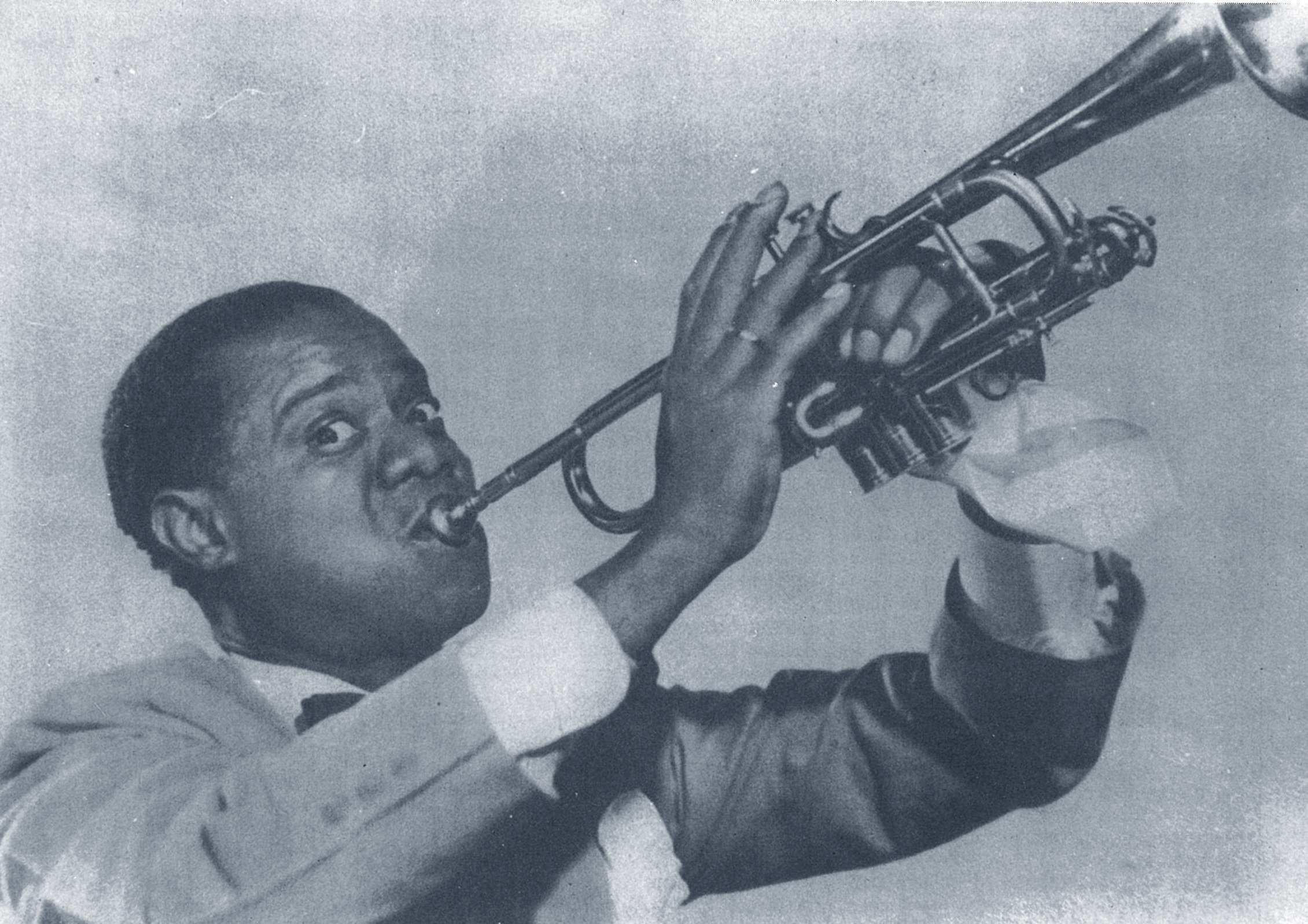
Louis Armostrong on trumpet (Coll. Michel Laplace)
Normal forms are no longer necessary here if the player has further reserves. He was born with very unusual muscles and lungs.”
(Jean Greffin, in Cahiers du Jazz)
[On Oliver] He gave me lessons and we would do little duets. Joe always told me to play the melody so that folks would know what I was doing. I was crazy — I was doing all kinds of little things, like what you call bop today. I still don’t know what bop is if it’s not that there’s a book of exercices called the “Arban Method” with lots of notes to teach you sight-reading […]
(Louis Armstrong, in “Life”, 1966)
In making his mark as a soloist Louis broke up the New Orleans band. In other words, because his personality was too strong, Louis destroyed the organic equilibrium of a polyphonic music and opened the way to a new, more individualistic music.
(Roger Guérin, in “Jazz Hot”, summer 1970)
Discographers give 28th May 1926, a session with the Erskine Tate band for Vocalion, as Armstrong’s first appearance on record playing trumpet. The sound is more centred and open and there is more vigour in the phrasing. He adapts immediately to the freedom afforded by the progress in trumpet making. While some trumpet-and-piano recordings (especially “Weather Bird Rag” with Earl Hines, December 1928) are trumpet lessons, the big band accompaniment suits this sacred monster really well; from 1927 onwards his extraordinary authority, his inspired improvisations and his lyricism put even his most talented sidemen in the shade. To judge Armstrong’s importance one must, of course, put oneself in that period. Louis was one of the first to use the seventh (E⁷, C⁷) to move from one chord to another; he used a lot of diminished chords and particularly well chosen arpeggios. But
his improvisation does not consist in counting out notes, nor in cramming every bar full of notes at all costs […] he indicates what is essential and, if he takes his time, it is to choose, each time, the most beautiful and expressive of the notes given him by the chord […] his playing seems surprisingly well spaced, of exemplary sobriety, stripped of every unnecessary note
(Roger Guérin) — and this was to become more noticeable with age. In his third period (after 1940) his most remarkable solo from this point of view seems to me to be “Blues turning gray over you” of 21st April 1955 (“he brings out the simplest and most obvious things” — Christian Bellest, in “Jazz Hot”, summer 1970).
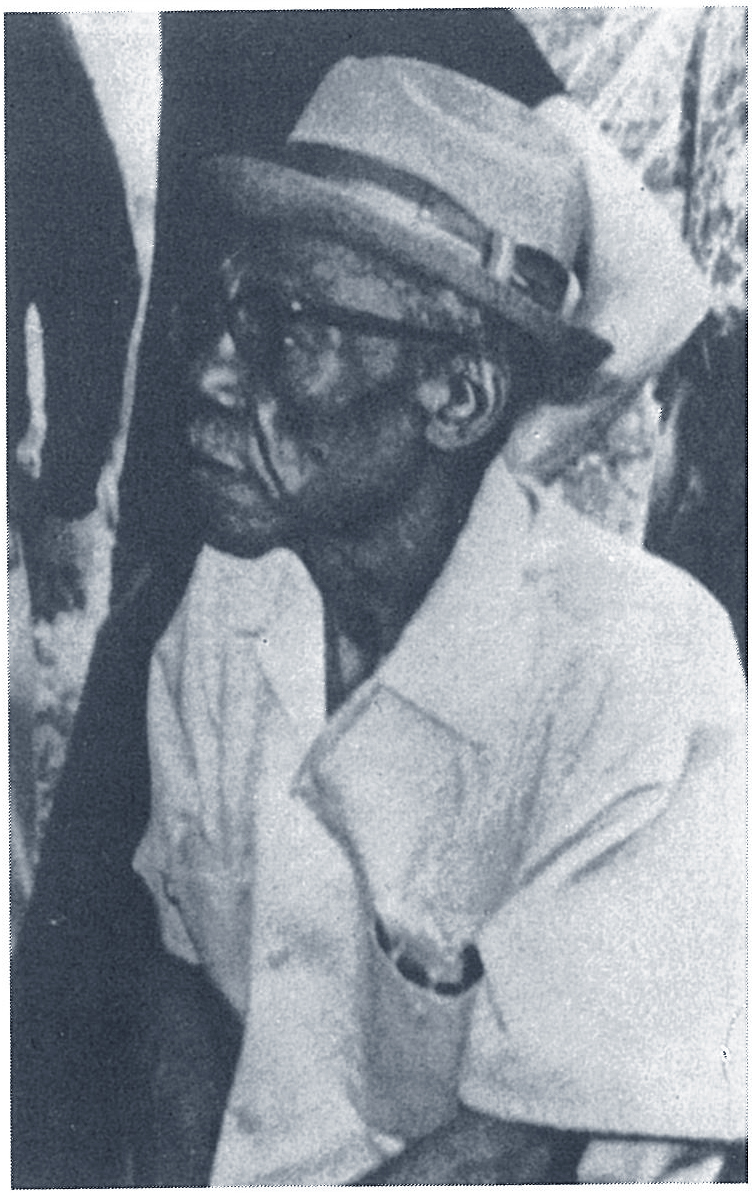
"Punch" Miller c. 1970 (Photo Beverley Harris)
Other artists moved the jazz trumpet towards a more technical conception: Ernest “Punch” Miller (1894-1971) and Henry “Red” Allen (1908-1967), both from New Orleans, and Cladys “Jabbo” Smith (*1908) from Georgia. They used “fast fingering”, sometimes to the detriment of the cohesiveness of their musical language. We should note, however, that in 1929, when they were making their main experiments, the instruments were less manageable than those on the market today. Miller is the least known of the three; he was older than Louis and made many records (frequently using pseudonyms) which give us some idea of his temperament. At the end of his career he took part in a memorial concert for Louis during the annual festival in their native city alongside Gillespie, who was greatly impressed by him. Allen was invited by the Victor company to make a series of recordings to rival Armstrong’s; his way of rushing the bars could be surprising but his digital dexterity was impressive and led to his being presented by critics as a prelude to bop. The experiment of bringing Allen together with a modern rhythm section (1967, Impulse) clinched it; as did his performances (around the same time) with Dizzy Gillespie and Clark Terry. Lastly Jabbo Smith, still playing in 1982, seems to have been influenced by Armstrong’s version of “West End Blues” with its monumental introduction.
Continue reading
Accede a la edición digital completa.
Brass Bulletin 43, III / 1983 páginas 44–65
Todo el contenido está protegido por derechos de autor © Brass Bulletin 1983–2026