14 min. read
Pierre Vilhardin de Belleau
trumpeter to Louis XV
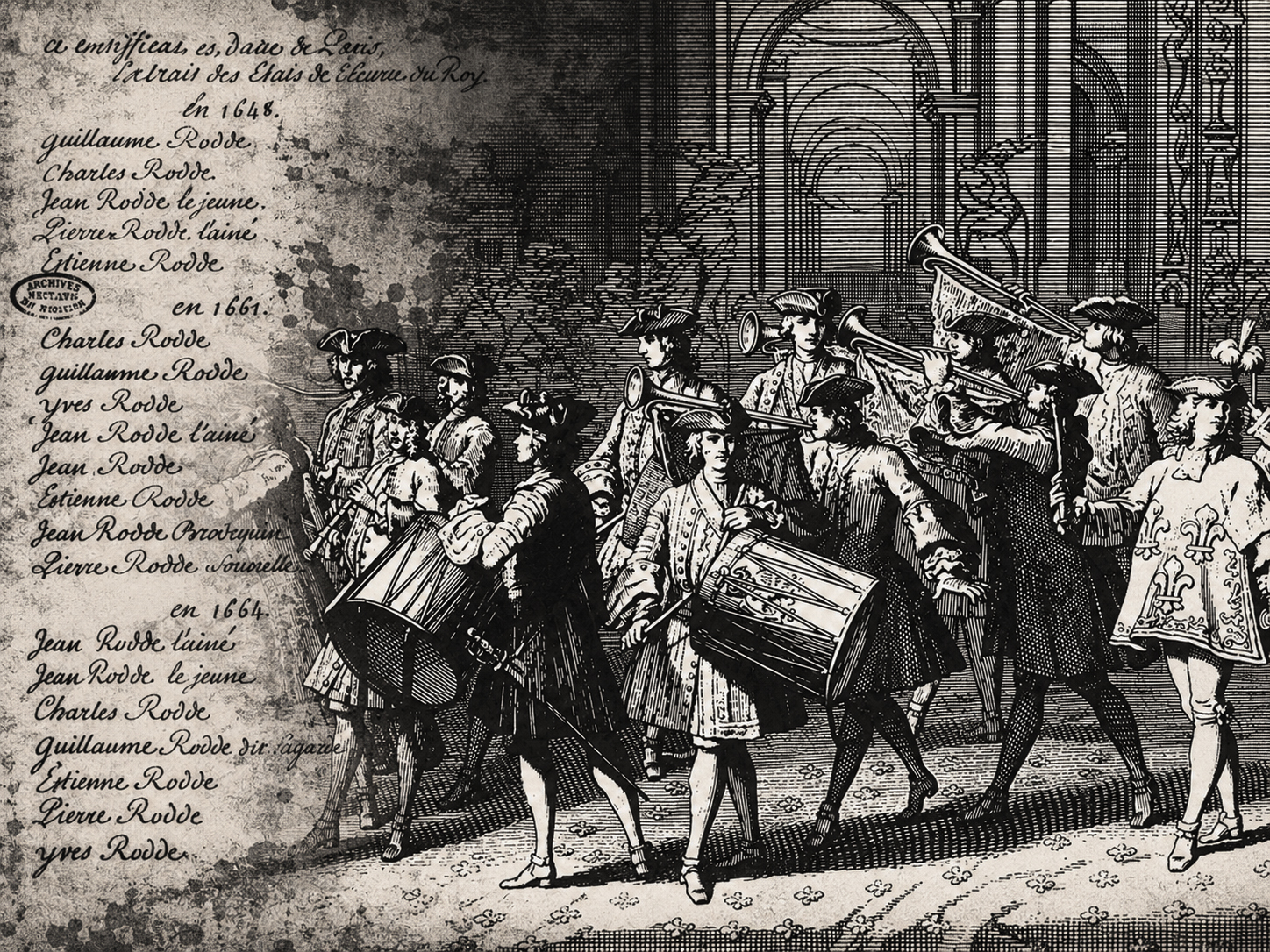
Pierre Vilhardin de Belleau, trumpeter to Louis XV
In the course of personal research in the French Bibliothèque Nationale in Paris and in the departmental archives I discovered the existence of a trumpeter from the Bourbonnais at the court of Louis XV: Pierre Vilhardin de Belleau from Treteau in the electoral district of Moulins. On visiting the place know as “Belleau” I found a small and rather charming castle, of modest proportions but, unfortunately, in a dreadfully neglected state. It seems to be used by the adjoining farm for storage.
It would be nice to think that one day, perhaps, this castle might become a place for brass players to meet and concerts to be held, so as to preserve a dwelling which has survived so long and whose walls still remember the fine royal fanfares which were the glory of France in the 17th and 18th centuries.
To return to our illustrious subject, Pierre Vilhardin de Belleau. We do not know where he was born — perhaps in Belleau. In any case it would have been in 1674 if the age entered on his death certificate is correct, for he is said to have been 69 when he died in Moulins on 2nd May 1743. On 11th July 1701 he married Anne Peret, daughter of Jean Peret of Coudray and Gilberte Jodard, at which time he held the office of Counsellor to the king. It was in 1719 that he acquired the position of officer “Trompette de la Grande Ecurie et la Chambre du Roy” (literally “Trumpeter of the Grand Equerry and the King’s Chamber”).
Originally from a merchant family, his father Pierre Vilhardin left business for the magistrature and acquired the office of Counsellor to the king as criminal law officer in the castellany of Moulins.
How did our musician train as a trumpeter?
Moulins experienced a golden age at the end of the 15th century under the regency of Anne of Beaujeu, wife of Pierre II of Bourbon and sister of Charles VIII, who had made Moulins the capital of France for four years. Two centuries later Moulins still had a certain reputation capable of attracting famous people and artists. Moreover, the fact that the Auvergne is nearby means that Vilhardin de Belleau may have been in touch with the Rivet or Rodde families, which had produced innumerable official trumpeters since 1648. It was a Rivet that he succeeded in office.
The Offices
From 1661 to 1733 the established musical forces remained almost intact. A certain number of musicians’ posts was created by Louis XIV, who could create new ones on the (somewhat rare) occasions when he wanted to offer an “office” to a musician.
These offices conferred the title of King’s Officer. To accede to one it was necessary not only to be from an honourable family (there was often an investigation); it was also necessary to purchase the desired office and indemnify the retiring musician, pay (to the public treasury) the legal fee fixed by royal edict, pay for the rights of enrollment and orgnise the traditional reception for one’s colleagues.
In 1718 the office of Trompette à la Chambre or à la Grande Ecurie was sold for 6000 lt (livres tournois, the French pounds minted in Tours) while that of oboe, violin or drum was worth 3000 lt and those of the 24 “violins of the Chamber” slightly less again, which seems extraordinary nowadays. Violins did not have the status then that they have now.
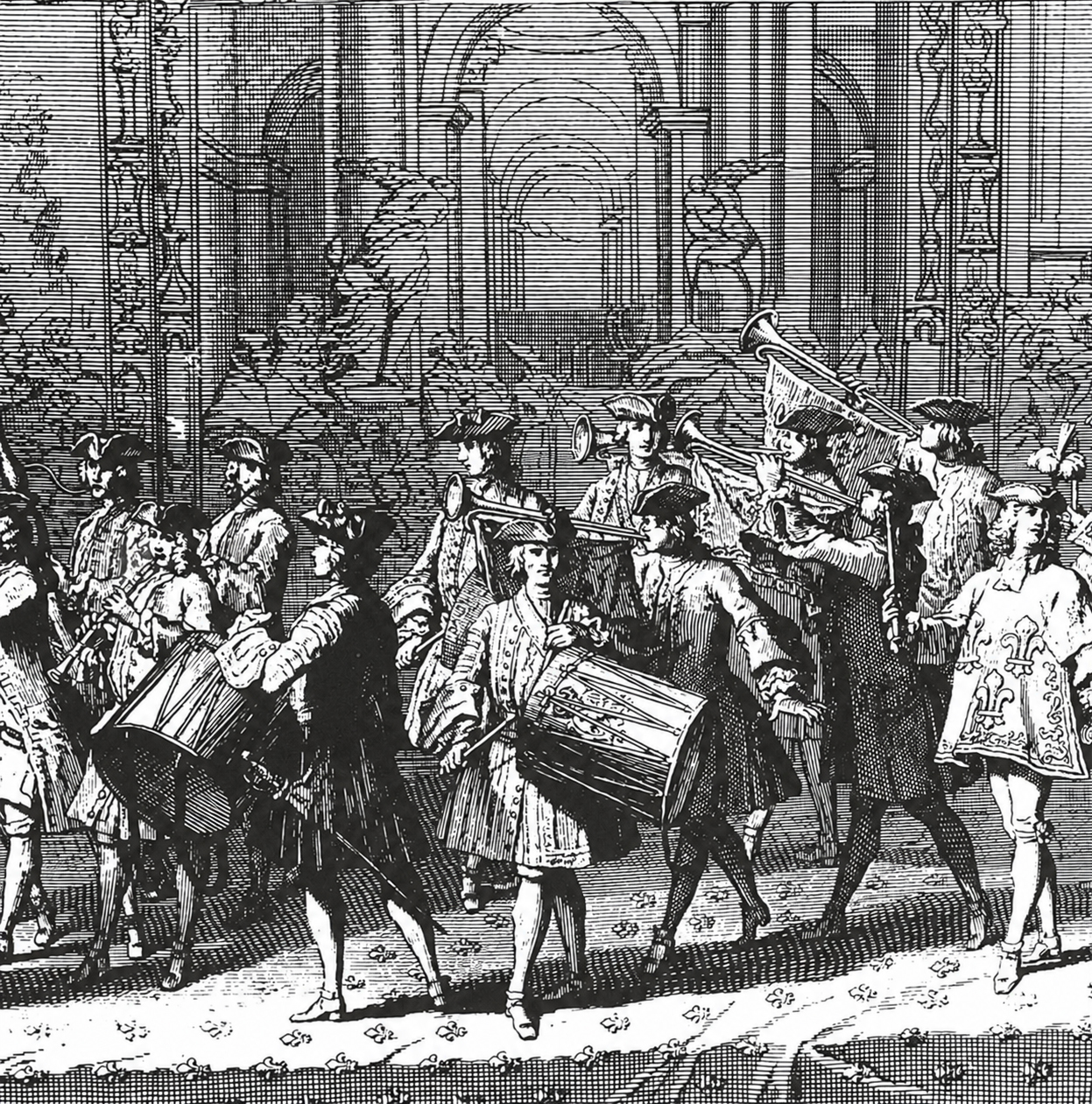
Coronation of Louis XV: “The King going to the Church” (De Larmessin).
For these trumpet posts the officer could only serve occasionally, for great court celebrations, and this was probably the case with Pierre Vilhardin de Belleau.
Armed with his letters of appointment, the King’s Officer then received a royal warrant and finally took an oath; he was then irrevocable and irremovable.
He received fees of about 600 lt and payment in kind (foot and clothing) reckoned to be worth about 500 lt a year. This payment in kind was made on 1st January and 1st May, when each musician received ten loaves of bread, two setiers¹ of table wine, four game animals or birds, sixteen pounds of veal or mutton and two pounds of bacon. On the religious holidays at Easter, Whitsun, All Saints and Christmas: ten loaves, two setiers of table wine, 32 pounds of veal and two pounds of bacon. On the St. Louis and St. Martin holidays: four loaves and 29 quartes² of table wine. At the pains bénits: eight loaves.
Brass Bulletin 59, III / 1987 pages 70–81
All content is protected by copyright © Brass Bulletin 1987–2026