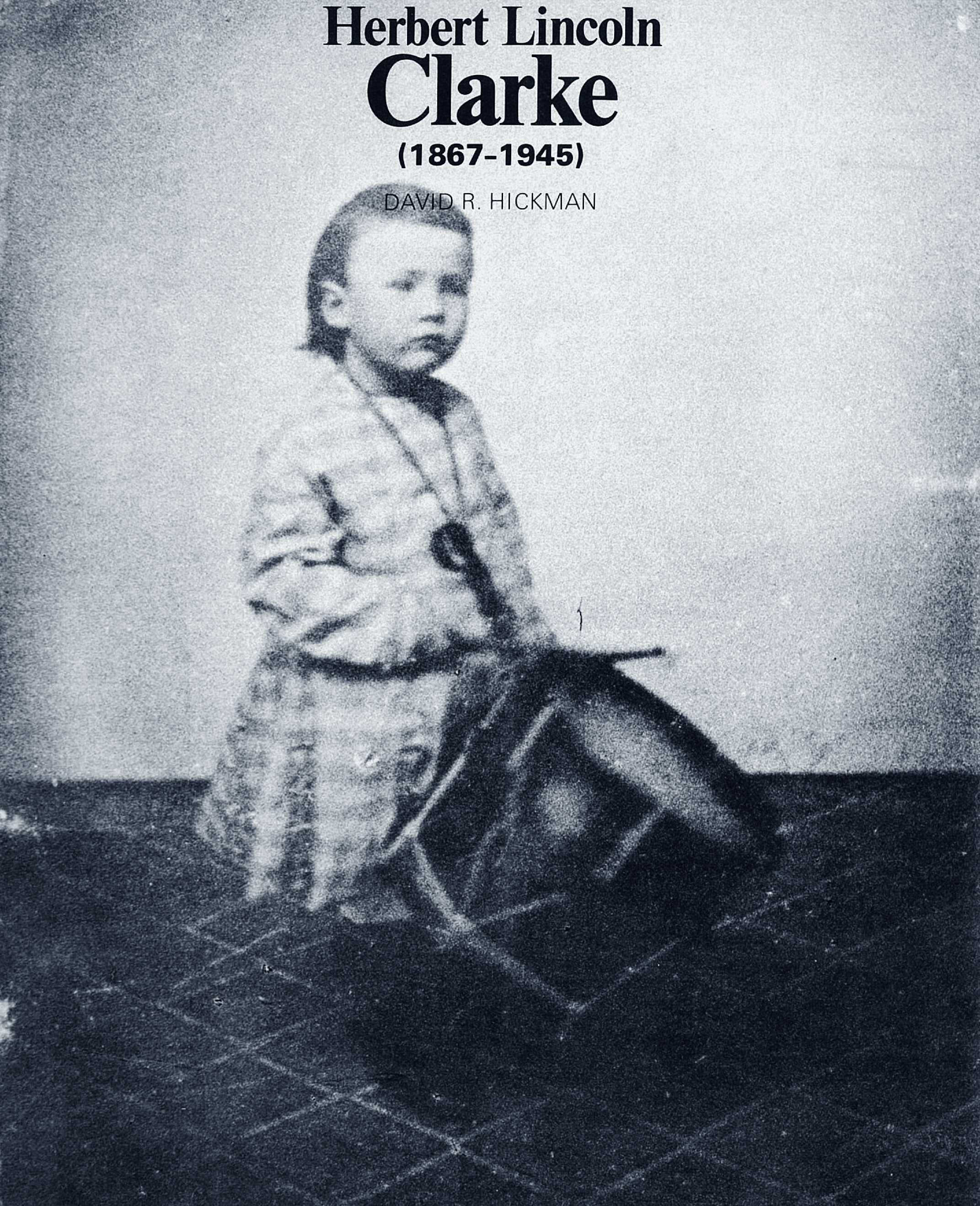
Herbert Clarke with his first band instrument
He was given a drum as his first instrument and he often paraded on the front lawn, drumming and singing, and wishing that he could someday play in a real band. After a while, Herbert was permitted to play some of the wind instruments from the family collection which included an F tuba, keyed bugle, rotary-valved posthorn, cornopean, and baritone ophicleide. After several frustrating sessions with each instrument, Herbert realized that the instruments were in too poor condition to play, even when he plugged the air leaks with beeswax.
Father bought the four older sons miniature-sized violins and began giving them their first musical instruction. They were never permitted to allow the slightest mistake to pass; each mistake was to be corrected immediately as their father felt that negligence in the case of the beginner in music is the same as that of a child who, when beginning the study of the multiplication table, is permitted to guess at results.
Herbert showed very little talent for music with the violin and his primary interests turned to the pleasures of baseball and other sports. Herbert moved to Indianapolis, Indiana where his father was to manufacture church organs and be organist at the Robert's Park Church. Herbert started school there and was often scolded for "drumming" on his desk with his fingers.
He joined a boys' baseball team and, since he was a rather large boy for his age, played most of the games. He once broke a finger on his right hand which hindered his technique all his life.
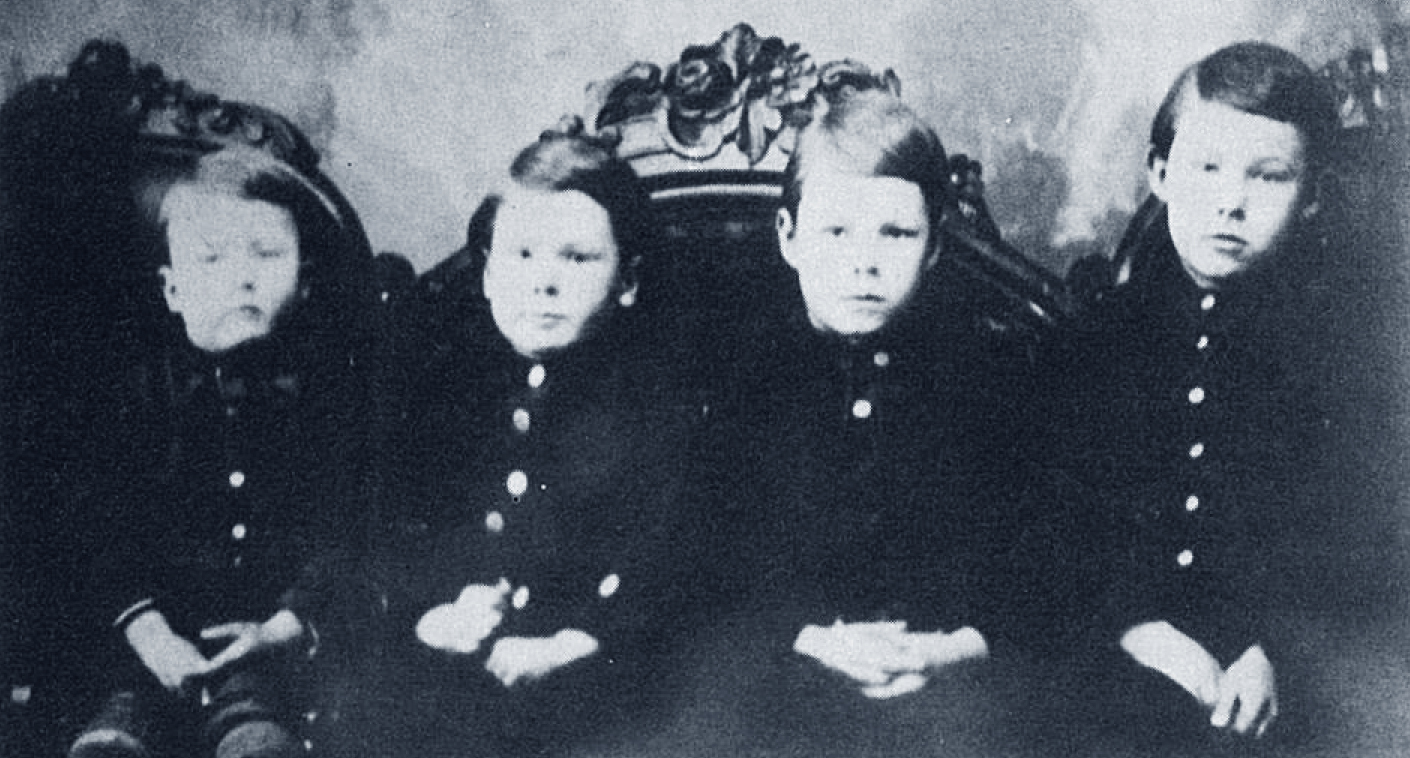
The four older Clarke brothers. Left to right: Herbert, Ernest, Edwin and William.
The Clarke family moved again, this time to Somerville, a suburb of Boston, Massachusetts, where Mr. Clarke was to become organist at the Tremont Temple. Edwin organized a little school orchestra of eight or ten boys and rehearsed after school at home. He also took up the cornet, took a few lessons, and joined the Somerville Brass Band. Ernest, wanting to join Ed's orchestra, took up the family's F tuba.
Herbert, also wanting to be a brass player, had no success with the other family instruments. When Herbert was twelve years old, the family moved to Toronto, Canada when Father became organist at the Jarvis Street Baptist Church. Ernest applied to play tuba in the Queen's Own Rifles Regiment Band and was accepted. Ed also joined as a cornetist and Will later joined as a valved trombonist.
Herbert listened to his brother Ed practice Arban's Cornet Method on his silver cornet which he cherished as it formerly belonged to the noted cornetist "Mat" Arbuckle. Herbert realized that the cornet was the instrument he craved, but he was not allowed to even touch his brother’s cornet.
Herbert organized a boys' orchestra in which he played violin and was the leader. They rehearsed at home and played around town at church and at club meetings after which they were given a free meal. When Herbert was thirteen years old he became a second violinist in the Philharmonic Society Orchestra (amateur) under the direction of Dr. F. H. Torrington. Here he learned to play a great deal of orchestra music and heard several great soloists from New York City and Boston.
Brother Ed became very interested in the violin and organized his own boys' orchestra. This gave Herbert the opportunity to practice on Ed's cornet which was being neglected. Ed gave Herbert cornet lessons and soon Herbert played cornet in Ed's orchestra. Herbert earned fifty cents per evening playing in Ed's orchestra at a new restaurant, and he played "extra" cornet in the Philharmonic Society Orchestra. Herbert began saving his pay for a cornet of his own.
Herbert auditioned for Mr. John Bayley, Director of the Queen's Own Regimental Band and was accepted and placed last chair of twelve cornets. He was issued a cornet by the band, given a uniform, and sworn in at the young age of fourteen because Mr. Bayley said he thought Herbert was eighteen, the minimum age required to join the armed forces.
Herbert began playing the cornet in church and often marched in parades with the Queen's Own Band, which netted him a sum of one dollar per parade. This money would help him earn the cornet of his own which he wanted very much.
In the fall, Herbert joined a boys' football team and worked so hard that he often would lie on the cold ground in order to cool off. He caught a cold which turned into a serious illness and confined him to the house from early December to the following April. He was not permitted to practice the cornet; he was replaced in his position in the Queen’s Own Band and the cornet called in, and his homework had to be brought to him each day so that he would not fall behind in school. The discouragement of being unable to practice the cornet was overwhelming.