10 min. read
The Euphonium in America
A Short History
Dr. Reifsnyder is a member of the faculty at Indiana State University in Terre Haute, Indiana (USA). As a performer on the euphonium, he has been a member of the USMA Band at West Point, and soloist with the Goldman Band in New York City. The following article is taken from his document, The Changing Role of the Euphonium in Contemporary Band Music, written for the Doctor of Music degree at Indiana University, Bloomington, Indiana (USA).
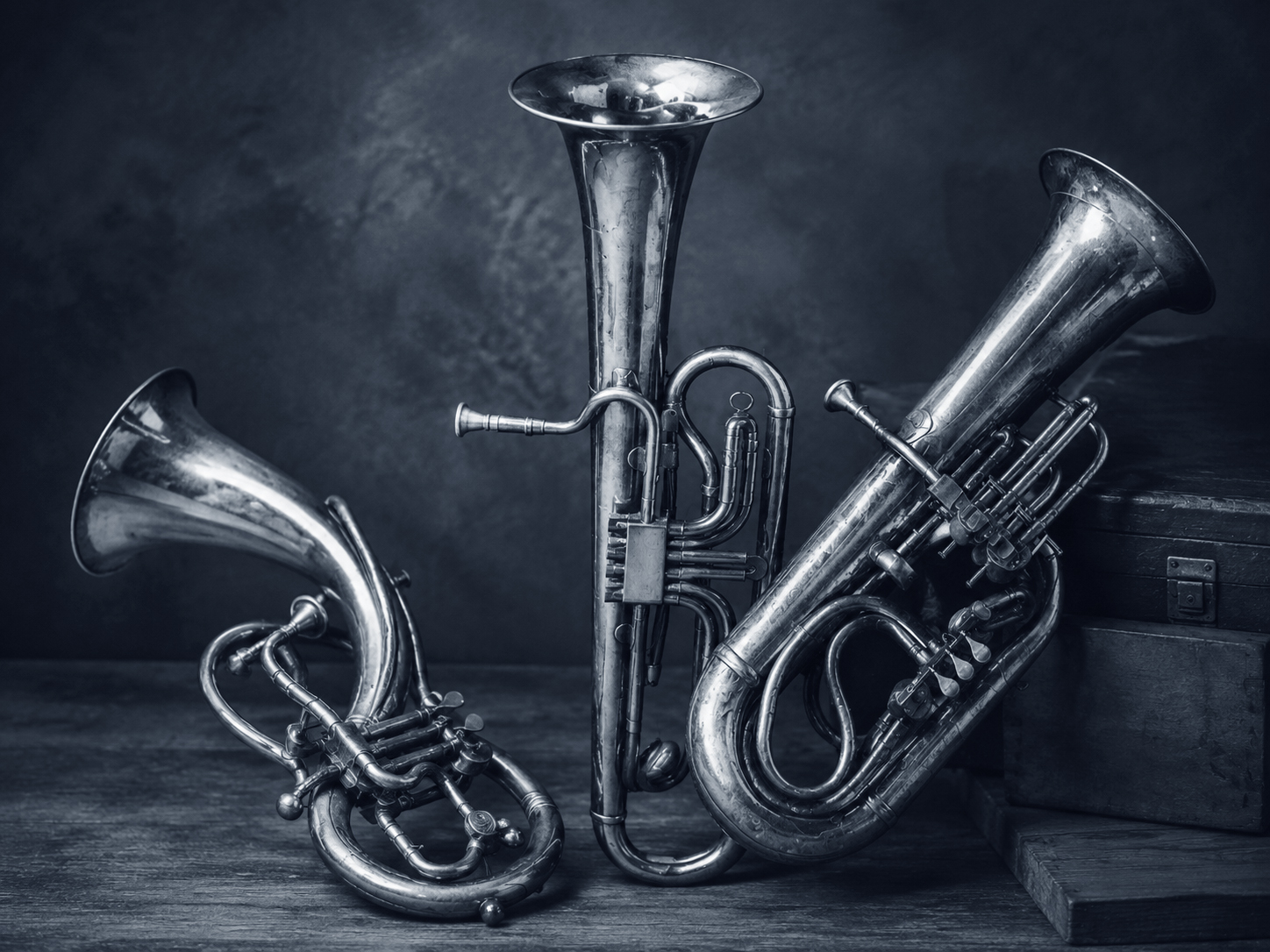
From the beginning of its development, there has been great confusion regarding proper terminology for the euphonium. In this country, for example, the names "tenor", "baritone horn", "euphonium", and "Bb bass" have at different times been applied to instruments in the same range¹. A brief look at the various stages of the euphonium's European history helps explain this confusion.
The first documented ancestor of the modern instrument was the tenor tuba, introduced in 1838 by Moritz of Berlin², a collaborator with Wilhelm Wieprecht (1802–1872), the famous Prussian bandmaster. Moritz designed the instrument to serve as a substitute for the keyed ophicleide in the Bb bass range, thus enabling Wieprecht's ensemble to have a valved instrument in all registers of the brass family.
A more important figure among early brass instrument makers was Adolph Sax, who around 1840 manufactured a complete family of brass instruments. His "saxhorns" consisted of seven conical bore instruments, in six different ranges:³
— petit saxhorn in Eb
— saxhorn soprano in Bb
— saxhorn alto in Eb
— saxhorn baryton in Bb
— saxhorn basse in Bb
— saxhorn contrabasse in Eb
— saxhorn contrabasse in BBb
Of great importance is the fact that he had two instruments in the Bb bass range, which caused much of the confusion in terminology.
In France, Sax was eventually able to obtain an almost complete monopoly on the outfitting of brass sections for the military. All seven saxhorns were part of the French formations by 1854, and with only slight alterations remain there today. The two instruments in the bass range were known as the Bb baryton (smaller bore) and the Bb basse (larger bore), and by 1867, French infantry bands commonly contained two of the former and five of the latter⁴.
In Germany, the idea of two instruments in the bass range was quickly adopted, but most of the instruments were manufactured by German makers, resulting in a different terminology. In this case the larger bore instrument was called the "bariton", whereas the smaller bore instrument was known as the tenorhorn. A typical Prussian ensemble in 1867 consisted of four tenor horns and two baritons⁵.
In England, the small-bore instrument became known as the baritone horn, after the French terminology, but the larger-bore instrument was called the euphonium. This was the result of an appearance in England by Sommer, a German instrument-maker from Weimar, who performed on an instrument he called the euphonium at the English Exposition of 1851⁶. Although Sommer's instrument was never used in England, its name was adopted by English brass instrument makers. The instrument's bore was widened in 1859 by Phasey, Professor of euphonium and baritone horn at Kneller Hall, thus making it closer in size to the present-day English euphonium⁷.
When Americans began to manufacture instruments of this type, the terminology was borrowed from all three countries. No less than four instruments in the Bb bass range were made:
— Bb tenor (German)
— Bb baritone (English and French)
— Bb euphonium (English)
— Bb bass (French)
Brass Bulletin 35, III / 1981 pages 13–21
All content is protected by copyright © Brass Bulletin 1981–2026