Explore institutional access →

2 min. read

Yuriy Andreyevich Bol'shiyanov

A Russian Trumpeter

Yuriy Andreyevich Bol'shiyanov

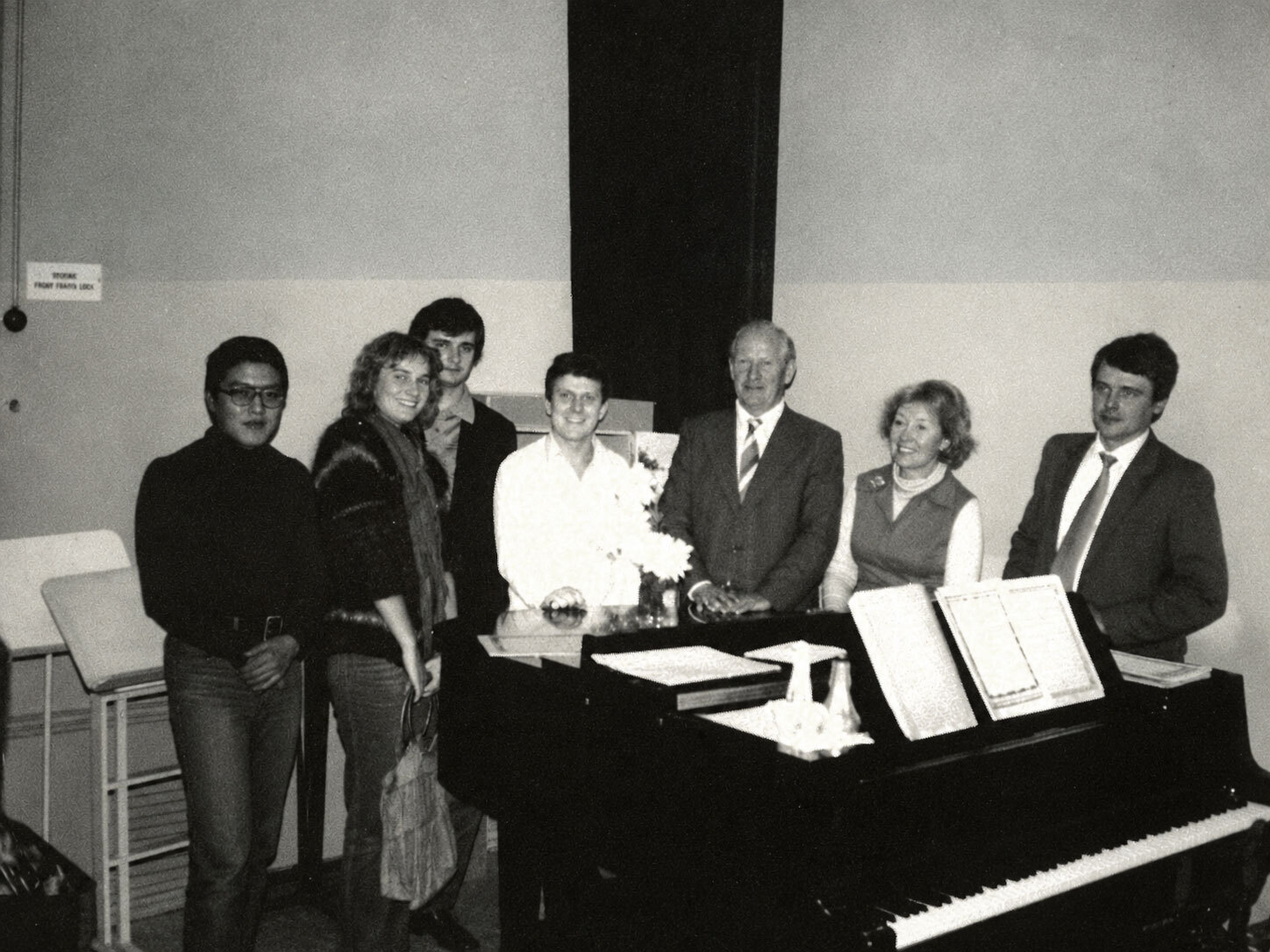
Yuriy Andreyevich Bol'shiyanov, professor at Leningrad Conservatoire together with his students (from S.U. and Norway). Second from the right the permanent piano accompanist of the class.

Yuriy Bol'shiyanov is one of the Soviet Union's greatest trumpeters. His career ranges from being solo trumpet at the Leningrad Philharmonic Orchestra, which he joined forty years ago, to being Rector of the Leningrad Conservatoire. His is still active in both fields.

Bol'shiyanov was born into a non-musical Moscow family in 1922. He became interested in the trumpet at an early age and, when the family moved to Leningrad in 1934, he took lessons with Aleksandr Nikolaevich Schmidt, who was then solo trumpet at the Leningrad Philharmonic and whom Bol'shiyanov would later succeed. His musical studies were interrupted by World War II, during which he played in a military wind band and joined the Communist Party. Upon his demob he joined the Leningrad Philharmonic during its 25th anniversary season, continuing his undergraduate, and later post-graduate, studies with Schmidt at the Leningrad Conservatoire. His master's thesis, "The Soviet trumpet concerto", was published in Leningrad in 1956. In it he examines what he considers to be the most characteristically Soviet works: those of Goedicke (B♭ minor), Sholokhov (no. 2 in E♭) and Arutyunyan for trumpet and orchestra and of Peskin (C minor) for trumpet and piano. He expresses the view that the "coming of age" of the Soviet trumpet concerto as a form was due not only to the genius of composers and the artistry of performers but also to ideological factors in the Soviet Union at that time.

The orchestral years saw several foreign tours, encounters with many internationally famous conductors, Bol'shiyanov's 1st prize at the 1953 Bucharest competition and the founding of his quintet. His chamber music activities included a performance of the Stravinsky "Octet" under the composer's direction. Although he left the Leningrad Philharmonic for health reasons in 1968 (he was made an Honoured Artist of the RSFSR for his work there), he still plays and tours abroad with the orchestra. The quintet, too, still performs. The present members are Messrs. Chirskov (trumpet), Buyanovskiy (horn), Venglovskiy (trombone) and Galuzin (tuba).

From his first teaching job in the secondary school attached to the Conservatoire Bol'shiyanov rose swiftly through the ranks of the Conservatoire's teaching staff, becoming head first of trumpet and chamber music, then of the orchestral and then of the wind department. In 1976 he was appointed Vice-Rector and in 1978 Rector, the first wind player to hold this post, although in 1980, again for health reasons, he had to return to less strenuous teaching activities on the Conservatoire's two campuses in Leningrad and Petrozavodsk. The fruits of this work are twofold. On the one hand, most of the members of the Leningrad Philharmonic (both orchestras!) and the Kirov Theatre trumpet sections are Bol'shiyanov pupils. On the other hand, a collection of teaching material written during his tenure of office is to be published soon and will be of great interest to teachers and students alike.

Brass Bulletin 56, IV / 1986 pages 51–53

All content is protected by copyright © Brass Bulletin 1986–2026

Share this article

Facebook LinkedIn
Loading…

Questions & Answers

How the Digital Edition works

What does the Digital Edition include?

The Digital Edition brings together the articles already digitized as searchable online texts—not simply as scans or PDF files—along with their original illustrations, notes, authorship, issue information, and available translations. Related-article suggestions currently include only this digitized material.

Are the digital articles identical to the originals?

We preserve the original text, language, illustrations, captions, footnotes, and editorial context as faithfully as possible. The presentation is adapted for comfortable online reading, and obvious transcription or scanning errors may be corrected. The substance and character of the published article remain unchanged.

Which languages are available?

Brass Bulletin was published in English, French, and German throughout its history. Italian and Spanish translations were added from issue No. 60 onward.

On the Italian and Spanish sites, articles from issues 1–59 are therefore shown in English by default.

How often are new articles added?

New articles are added almost daily, with approximately one complete issue digitized each week. The pace may vary depending on the preparation, image work, and editorial checking required.

Why aren’t all articles available digitally?

The complete Brass Bulletin collection contains 1,246 articles published between 1971 and 2003. The full index is already available online, allowing readers to discover every article in the collection, including those whose complete text has not yet been digitized.

Digitization began in February 2026. Each article is carefully prepared for online reading, checked, and connected to its issue, authors, subjects, and illustrations. At the current pace of digitization, the complete collection is expected to be available online by February 2028.

Why do some references mention articles that are not available yet?

References in the original articles are preserved even when the material they point to has not yet been digitized. This keeps the historical and editorial record intact. As more issues are added to the Digital Edition, an increasing number of these references will lead to articles that can be read online.

Can I suggest an article or report a transcription error?

Yes. If there is an article you would particularly like to see digitized, or if you notice a possible transcription error or missing detail, please contact us. Reader feedback helps us improve the Digital Edition and prioritize useful connections within the archive.

How can I support Brass Bulletin?

Your support helps fund the preparation, verification, and online publication of the complete collection.

Subscribe to the Digital Edition

Prefer to support us without subscribing?

Make a donation

How is the digitization progressing?

We’re gradually making the Brass Bulletin available online, article by article. You can read newly digitized articles as soon as they’re ready, even before an entire issue is complete.

Visit our Digitization Roadmap to browse recent additions and see estimated availability for upcoming issues. These estimates follow our recent pace and may change.

Search Brass Bulletin.