Ofrezca Brass Bulletin en su universidad, conservatorio o biblioteca Descubra el acceso institucional

2 min de lectura

Yuriy Andreyevich Bol'shiyanov

A Russian Trumpeter

Yuriy Andreyevich Bol'shiyanov

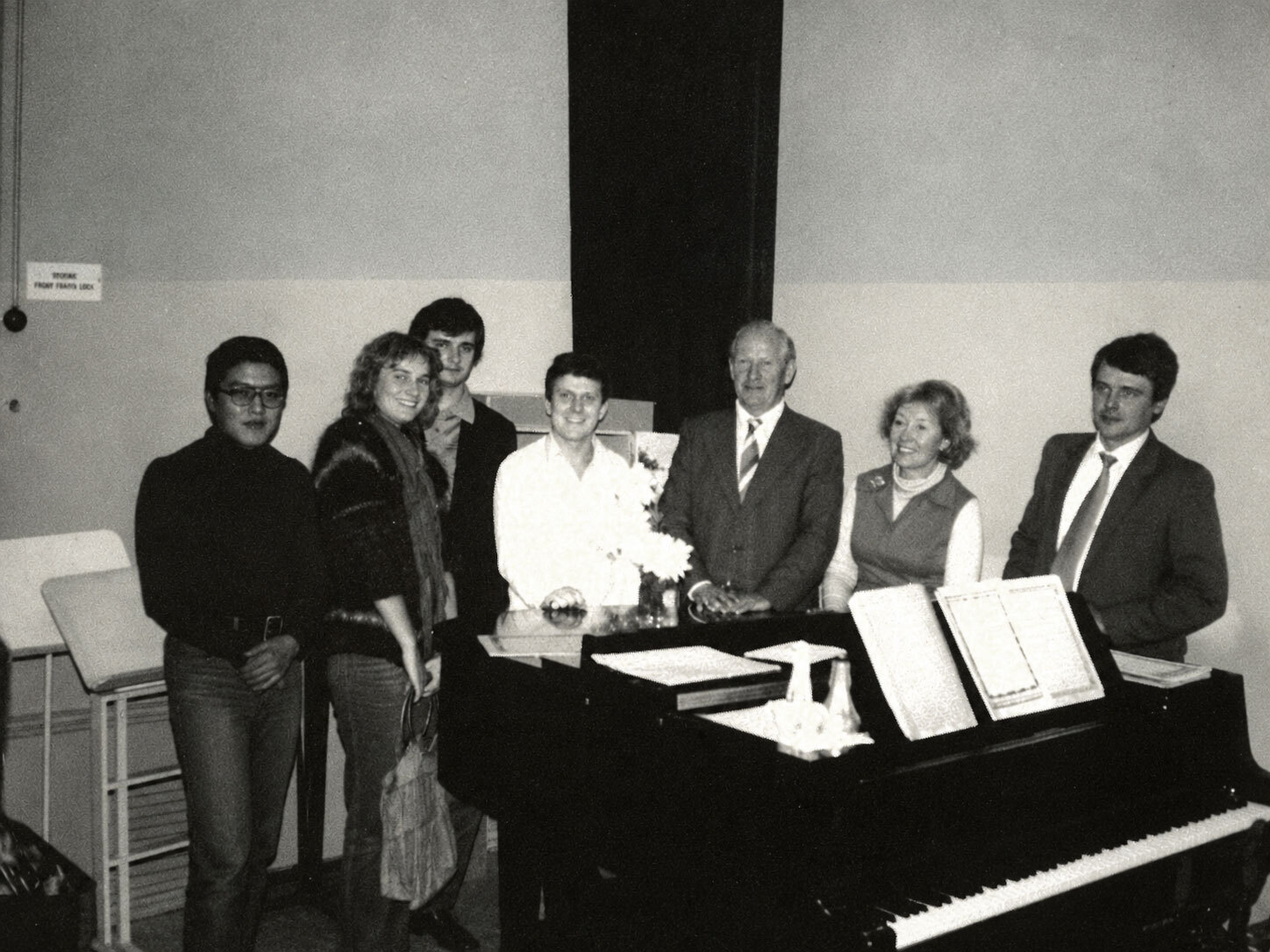
Yuriy Andreyevich Bol'shiyanov, professor at Leningrad Conservatoire together with his students (from S.U. and Norway). Second from the right the permanent piano accompanist of the class.

Yuriy Bol'shiyanov is one of the Soviet Union's greatest trumpeters. His career ranges from being solo trumpet at the Leningrad Philharmonic Orchestra, which he joined forty years ago, to being Rector of the Leningrad Conservatoire. His is still active in both fields.

Bol'shiyanov was born into a non-musical Moscow family in 1922. He became interested in the trumpet at an early age and, when the family moved to Leningrad in 1934, he took lessons with Aleksandr Nikolaevich Schmidt, who was then solo trumpet at the Leningrad Philharmonic and whom Bol'shiyanov would later succeed. His musical studies were interrupted by World War II, during which he played in a military wind band and joined the Communist Party. Upon his demob he joined the Leningrad Philharmonic during its 25th anniversary season, continuing his undergraduate, and later post-graduate, studies with Schmidt at the Leningrad Conservatoire. His master's thesis, "The Soviet trumpet concerto", was published in Leningrad in 1956. In it he examines what he considers to be the most characteristically Soviet works: those of Goedicke (B♭ minor), Sholokhov (no. 2 in E♭) and Arutyunyan for trumpet and orchestra and of Peskin (C minor) for trumpet and piano. He expresses the view that the "coming of age" of the Soviet trumpet concerto as a form was due not only to the genius of composers and the artistry of performers but also to ideological factors in the Soviet Union at that time.

The orchestral years saw several foreign tours, encounters with many internationally famous conductors, Bol'shiyanov's 1st prize at the 1953 Bucharest competition and the founding of his quintet. His chamber music activities included a performance of the Stravinsky "Octet" under the composer's direction. Although he left the Leningrad Philharmonic for health reasons in 1968 (he was made an Honoured Artist of the RSFSR for his work there), he still plays and tours abroad with the orchestra. The quintet, too, still performs. The present members are Messrs. Chirskov (trumpet), Buyanovskiy (horn), Venglovskiy (trombone) and Galuzin (tuba).

From his first teaching job in the secondary school attached to the Conservatoire Bol'shiyanov rose swiftly through the ranks of the Conservatoire's teaching staff, becoming head first of trumpet and chamber music, then of the orchestral and then of the wind department. In 1976 he was appointed Vice-Rector and in 1978 Rector, the first wind player to hold this post, although in 1980, again for health reasons, he had to return to less strenuous teaching activities on the Conservatoire's two campuses in Leningrad and Petrozavodsk. The fruits of this work are twofold. On the one hand, most of the members of the Leningrad Philharmonic (both orchestras!) and the Kirov Theatre trumpet sections are Bol'shiyanov pupils. On the other hand, a collection of teaching material written during his tenure of office is to be published soon and will be of great interest to teachers and students alike.

Brass Bulletin 56, IV / 1986 páginas 51–53

Todo el contenido está protegido por derechos de autor © Brass Bulletin 1986–2026

Compartir este artículo

Facebook LinkedIn
Cargando…

Preguntas y respuestas

Cómo funciona la edición digital

¿Qué incluye la edición digital?

La edición digital reúne los artículos ya digitalizados como textos legibles y consultables en línea —no simplemente como escaneos o archivos PDF— junto con sus ilustraciones originales, notas, autoría, información del número y traducciones disponibles. Las sugerencias de artículos relacionados incluyen actualmente solo este material digitalizado.

¿Los artículos digitales son idénticos a los originales?

Conservamos con la mayor fidelidad posible el texto original, el idioma, las ilustraciones, los pies de imagen, las notas y el contexto editorial. La presentación se adapta para facilitar la lectura en línea y pueden corregirse errores evidentes de transcripción o escaneado. El contenido y el carácter del artículo publicado permanecen inalterados.

¿Qué idiomas están disponibles?

Brass Bulletin se publicó en inglés, francés y alemán a lo largo de toda su historia. Las traducciones al italiano y al español se añadieron a partir del número 60. Por este motivo, en los sitios italiano y español los artículos de los números 1 a 59 se muestran en inglés de forma predeterminada.

¿Con qué frecuencia se añaden nuevos artículos?

Se añaden nuevos artículos casi a diario, con aproximadamente un número completo digitalizado cada semana. El ritmo puede variar según el trabajo de preparación, tratamiento de imágenes y revisión editorial necesario.

¿Por qué no están disponibles todos los artículos en formato digital?

La colección completa de Brass Bulletin contiene 1.246 artículos publicados entre 1971 y 2003. El índice completo ya está disponible en línea y permite descubrir todos los artículos de la colección, incluidos aquellos cuyo texto íntegro todavía no ha sido digitalizado.

La digitalización comenzó en febrero de 2026. Cada artículo se prepara cuidadosamente para la lectura en línea, se revisa y se vincula con su número, sus autores, sus temas y sus ilustraciones. Al ritmo actual de digitalización, se prevé que la colección completa esté disponible en línea en febrero de 2028.

¿Por qué algunas referencias mencionan artículos que todavía no están disponibles?

Las referencias de los artículos originales se conservan aunque el material al que remiten aún no haya sido digitalizado. De este modo se mantiene intacto el contexto histórico y editorial. A medida que se incorporen más números a la edición digital, un número creciente de estas referencias conducirá a artículos que podrán leerse en línea.

¿Puedo sugerir un artículo o informar de un error de transcripción?

Sí. Si hay algún artículo que le gustaría especialmente ver digitalizado, o si detecta un posible error de transcripción o algún dato que falta, póngase en contacto con nosotros. Los comentarios de los lectores nos ayudan a mejorar la edición digital y a establecer prioridades útiles dentro del archivo.

¿Cómo puedo apoyar a Brass Bulletin?

Su apoyo ayuda a financiar la preparación, verificación y publicación en línea de la colección completa.

Suscríbase a la Edición Digital

¿Prefiere apoyarnos sin suscribirse?

Haga una donación

¿Cómo avanza la digitalización?

Estamos poniendo Brass Bulletin a disposición de los lectores en línea, artículo por artículo. Pueden leer los artículos recién digitalizados en cuanto estén listos, incluso antes de que se complete un número entero.

Consulten nuestro calendario de digitalización para descubrir las últimas novedades y las fechas estimadas de disponibilidad de los próximos números. Estas estimaciones se basan en nuestro ritmo reciente y pueden cambiar.

Busca en Brass Bulletin.