Explore institutional access →

4 min. read

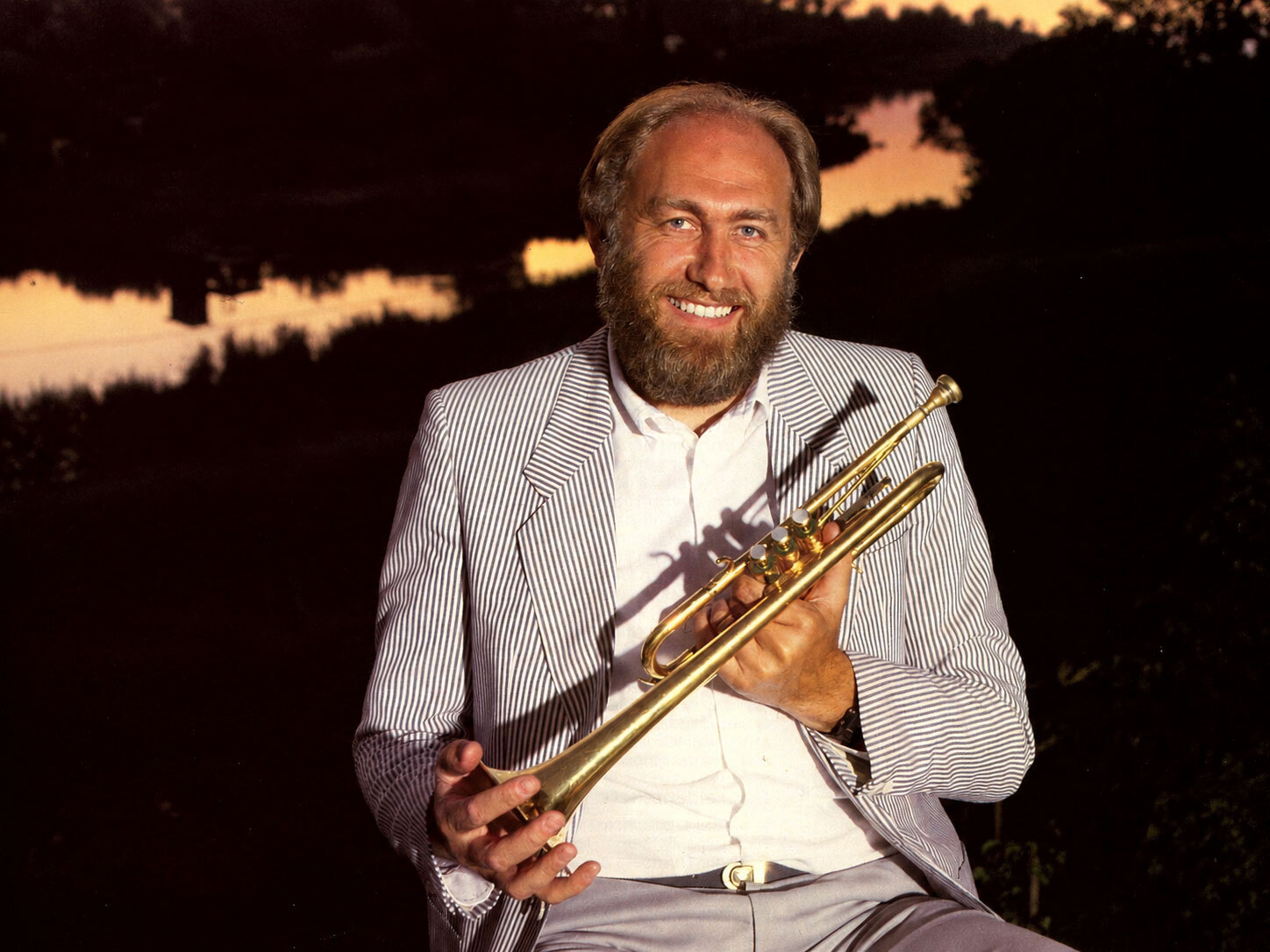
György Geiger

A Giant of a trumpeter

György Geiger

György Geiger

Over the past ten years or so much to the surprise of the, uninitiated, Hungary has produced some brass soloists of outstanding talent.

Ever since the 1950s, we have boasted remarkable woodwind players who both in their own right and in quintets have been in the limelight. For some reason or other, however, their colleagues in the brass section seemed to be lagging behind.

Perhaps I am not far wrong in claiming that it was the Modern Brass Ensemble, (now "Hungary Brass Ensemble") founded and directed by György Geiger, that broke the ice. It was probably the first chamber ensemble of its kind in Hungary to be accepted as equal in musicianship and technical standards to the best representatives of such classical genres as the string quartet. Ever since winning the Ancona International Competition in 1979, the Modern Brass Ensemble has had a flourishing career, making regular tours of Europe and paying a return visit to the United States in 1985, after a wildly successful debut at the International Brass Congress in Bloomington, Indiana, in 1984.

His unique stature

It is a measure of his unique stature as a trumpeter that György Geiger was singled out at Bloomington to give a lecture at the International Trumpet Guild’s annual conference in 1985, in Albuquerque, New Mexico. In this connection I would like to record here an episode that also goes to demonstrate the effect Geiger’s artistry makes on people in the know.

The noted British music critic, William Mann, who for several decades reviewed concerts for The Times, came to Budapest in March 1984 to audition Hungarian soloists and groups for possible engagement at the Bath Festival which he was then directing. Mr. Mann was invited to listen to the Modern Brass Ensemble in a largish room at Hungarian Radio. It was blatantly unsuited for listening to brass instruments: its hollow, echoing acoustic made the performance rather difficult to appreciate. But in the middle of the second piece, Mr. Mann turned to me and whispered into my ear: "The trumpeter is a top virtuoso!" Even in those unfavourable conditions, Geiger attracted the experienced critic’s attention.

No fight for recognition

Coming from a village just outside the traditional boundaries of the Hungarian capital — but now a part of Budapest — famed for its brass players, Geiger has never had to fight for recognition. While still a student at the Academy of Music, he auditioned for and won the position of first trumpet in the Budapest Philharmonic, that is, the orchestra of the State Opera House. This is a story he is fond of relating with an air of amused incredulity:

"The audition was a fluke: I played better than I had expected. It resulted in the rather peculiar situation where I played first trumpet next to my professor who was second trumpet... He would teach me at the Academy in the mornings and in the evenings I would take over the leadership from him. Well, in life you do have situations like that where it is hard to decide who is teaching and who is being taught."

One occasion where Geiger cited this anecdote was at his lecture in Albuquerque: he was very much aware of talking to American brass players whose superior skills, indeed, superiority, have traditionally been acknowledged in Hungary just as in many other parts of the world. Geiger — described in the ITG Journal as "a six and a half foot giant" after his ensemble’s Bloomington appearance — recalled the incident in the Budapest opera pit to calm his nerves and to reassure himself that he might, after all, be able to teach something to all these American "professors" sitting in the audience.

Passionate love of the trumpet

In the event, he carried the day. For one thing, I should imagine, his fanaticism, his passionate love of the trumpet, his avowed bias for that instrument must have struck a chord in his listeners. This addiction and dedication to the instrument must also be familiar for the readers of BRASS BULLETIN. Clearly, in Geiger’s eyes and ears, the trumpet is the equal of any other instrument, vying with the violin in lyricism and in legato playing, challenging even the human voice. His listeners surely loved him for telling them how unjust he thought it was that the trumpet — along with the rest of the orchestra — should be banished to the pit, out of sight of the audience as if it was anything to be ashamed of and the stage was monopolised by the singers. He dreamed of a theatre, he said, where the situation was reversed: singers in the pit, the trumpet in all its glory on stage... And while he has not been able to realise this dream, he has done the next best thing: he has asked a friend to arrange a "Toccata" by Martini for voices and percussion providing accompaniment for the soaring solo of the trumpet.

His audience must have loved Geiger also for his catholic tastes and for his adventurous spirit, too. Noted for his advocacy of contemporary music (he has played just about every trumpet composition written in Hungary today, and has premiered a fair number) he is just as at home in pre-classical music as in jazzed-up arrangements and, indeed, straight pop music.

The list of Geiger’s assets includes his perseverance. He is never one to give up after a few setbacks once he has set his mind on something. For example: he recorded for Hungarian Radio one of his long-time favourites, Beethoven’s "Romance" in F major. The tape was eventually rejected by the committee apparently because the chairman, a violinist, found such an arrangement distasteful. No match for the violin. Geiger, having invested much of his time in preparing the piece, refused to admit defeat. He persuaded one of his friends to change the style and the instrumentation — and, with this newly fashioned accompaniment, Geiger recorded the piece once again. It was submitted to a different jury, responsible for recordings of light music, and was passed. Geiger got his way.

He decided to challenge the violin

The incident must have irked him no end for he decided to challenge the violin in close combat. This time, his vehicle was an old war horse of violin literature: Wieniawsky’s "Kurowiak". The solo is played alternately by the violin and the trumpet and much to the credit of Geiger, the duel ends in a draw... For the present writer anyway.

For sixteen years now, Geiger has been first trumpet of the Hungarian Radio Symphony Orchestra. He has left the opera pit for the radio studio — but then the orchestra does give many public concerts and so, of course, does the Modern Brass Ensemble. What with concerto appearances, tours in Hungary and abroad, György Geiger has enough on his hands to keep him busy.

A remarkably modest person

If you talk him face to face (which is difficult, strictly speaking, because of his enormous height), he strikes you as a remarkably modest person. If he is conscious of what he is worth, he keeps it to himself. If anything, he is shy rather than conceited and his shyness is devoid of aloofness or unapproachability. You may easily embarrass him by quoting to him reviews like the one in the September 1984 issue of the I.T.G. Journal: «Geiger, after settling on to two stacked chairs, proceeded to dazzle his listeners with Mendez-like facility, Severinesque range and a lyricism that alluded to Maurice André».

Brass Bulletin 56, IV / 1986 pages 44–48

All content is protected by copyright © Brass Bulletin 1986–2026

Share this article

Facebook LinkedIn
Loading…

Questions & Answers

How the Digital Edition works

What does the Digital Edition include?

The Digital Edition brings together the articles already digitized as searchable online texts—not simply as scans or PDF files—along with their original illustrations, notes, authorship, issue information, and available translations. Related-article suggestions currently include only this digitized material.

Are the digital articles identical to the originals?

We preserve the original text, language, illustrations, captions, footnotes, and editorial context as faithfully as possible. The presentation is adapted for comfortable online reading, and obvious transcription or scanning errors may be corrected. The substance and character of the published article remain unchanged.

Which languages are available?

Brass Bulletin was published in English, French, and German throughout its history. Italian and Spanish translations were added from issue No. 60 onward.

On the Italian and Spanish sites, articles from issues 1–59 are therefore shown in English by default.

How often are new articles added?

New articles are added almost daily, with approximately one complete issue digitized each week. The pace may vary depending on the preparation, image work, and editorial checking required.

Why aren’t all articles available digitally?

The complete Brass Bulletin collection contains 1,246 articles published between 1971 and 2003. The full index is already available online, allowing readers to discover every article in the collection, including those whose complete text has not yet been digitized.

Digitization began in February 2026. Each article is carefully prepared for online reading, checked, and connected to its issue, authors, subjects, and illustrations. At the current pace of digitization, the complete collection is expected to be available online by February 2028.

Why do some references mention articles that are not available yet?

References in the original articles are preserved even when the material they point to has not yet been digitized. This keeps the historical and editorial record intact. As more issues are added to the Digital Edition, an increasing number of these references will lead to articles that can be read online.

Can I suggest an article or report a transcription error?

Yes. If there is an article you would particularly like to see digitized, or if you notice a possible transcription error or missing detail, please contact us. Reader feedback helps us improve the Digital Edition and prioritize useful connections within the archive.

How can I support Brass Bulletin?

Your support helps fund the preparation, verification, and online publication of the complete collection.

Subscribe to the Digital Edition

Prefer to support us without subscribing?

Make a donation

How is the digitization progressing?

We’re gradually making the Brass Bulletin available online, article by article. You can read newly digitized articles as soon as they’re ready, even before an entire issue is complete.

Visit our Digitization Roadmap to browse recent additions and see estimated availability for upcoming issues. These estimates follow our recent pace and may change.

Search Brass Bulletin.