10 min. read
Part 1
Trombone and Organ — a Dialog
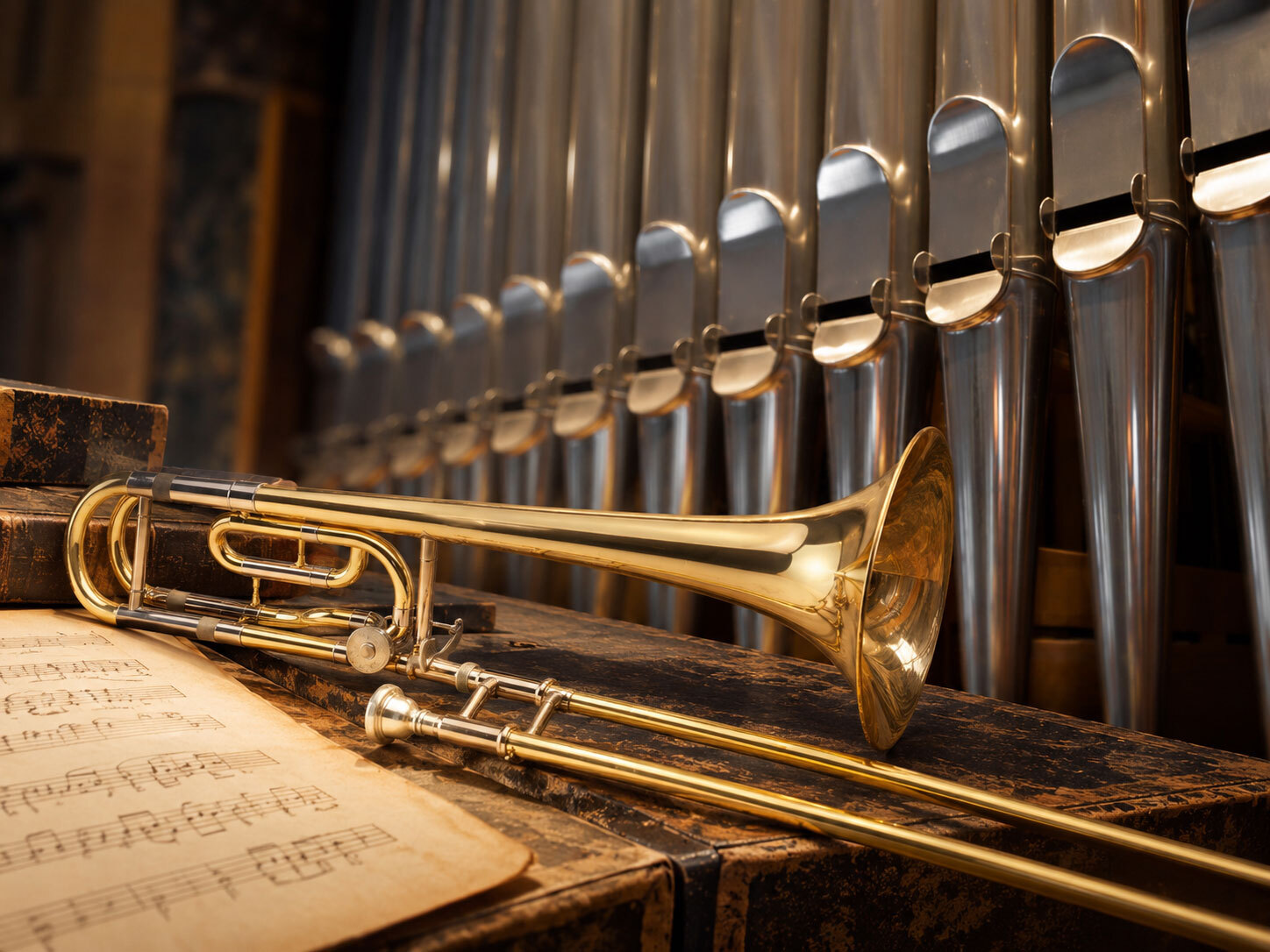
The dialogue between modern compositions and the musical traditions of the past *
Part 1
I. Background and assumptions
Since about 1970, especially in Germany, many works have been written for trombone and organ. “Dialog” by Magdalene Schauss-Flake, first performed in Munich in 1971, was the work that triggered this development. To that extent it may be said that the title of the work acquired significance for the new combination.
This development was promoted by several factors which complemented and reinforced each other:
- Many trombonists were looking for opportunities for solo playing outside and independent of the orchestra.
- The combination of trumpet and organ, which thanks to some famous soloists had been famous for longer, served as an acoustic example, one which was now extended by the addition of this new variant.
- The existing repertoire for this new instrumental combination consists primarily of transcriptions of Baroque solo sonatas with basso continuo. The few original works written since 1970 are little known¹ or difficult to obtain², with the result that the demand for additions to the repertoire grew. Many of these works were written on the initiative of trombone soloists³ and most are dedicated to them.
This apparently new combination has early predecessors and the association of the sound of both instruments with ritual and liturgical events has been rooted in the consciousness of audiences, musicians and composers for centuries. The trombone, developed at the Burgundian court during the second half of the 15th century⁴, spread quickly throughout Europe because of its chromatic nature and consequent versatility. The former minstrel’s instrument, which had provided the bass in the dance music of the wind alta musica at the end of the 15th century, soon found its way into ritual and liturgical music because of its dark tone colour.⁶
In his translations of the Bible into German Martin Luther rendered the various wind instruments of the Old and New Testaments (horn, shofar, trumpet) by the word Posaune (in modern German = “trombone”) as that instrument was already widely known (cf. “trumpets of Jericho”, “trumpet of the Day of Judgment” both Posaune in German). The “angel with the trumpet”, announcing the Day of Judgment, whose instrument is legitimated in the Bible⁷, was represented with the normal familiar instruments⁸ — but with a trombone from the 15th century. “The pictorial tradition seems so firmly established that no notice is taken of the historical replacement of the buisine by the trumpet and trombone in the 15th century.”⁹
In the succeeding centuries the main function of the trombone in the church setting was to accompany and support voices after the art of the Stadtpfeifer started to decline and before the uninterrupted predominance of strings began in the 17th century. Although quite different influences were also involved, notably from jazz, the concept of a ceremonial sound often associated with liturgy has persisted in people’s consciousness and many of the compositions to be considered here bear witness to this.
Few trombonists and music researchers must be aware that the first solo composition for trombone was planned with an organ accompaniment. In the collection Musicali Melodie, printed in 1621, by Giovanni Martino Cesare, a cornetto player from Udine working at the Munich court, is to be found the canzona “La Hieronyma”¹⁰ for trombone or viola, dedicated to Hieronymus Fugger (1584-1633)¹¹, third son of Jakob Fugger the elder¹².
II. Musical form and formation — Dialogue with tradition
1. Forms
The works can be divided into two groups title:
a. titles with a set form
b. titles with no strict form
In the second group are titles of an associational or programmatic nature. “Dialog”, “Meditation” and “Reflections” are understandable and seem to indicate no specific direction for the content whereas “Church Music”, “Dies irae”, “Jericho” and “Invocation” refer to the connotative sound of the instrumental combination. While these titles give some idea of the composer’s intention, this is not the case with “Metanoia”, “Lituus”, “Audiens exaudieris” or “Am Ende des Kanons”. These works are based on a philosophical (in the widest sense) idea which we will look at more closely later.
The first group contains strict forms such as concerto, sonata, sonata da chiesa and partita as well as less strict ones such as fantasia, rhapsody and chorale arrangement; even here, however, are points which bear on the liturgical.
We find multi-movement works by Bausznern, Borg, Callhoff, Erdmann-Abele, Genzmer, Haller, Hildemann, von Kameke, Koetsier and Kraus, and single-movement ones whose various sections are played without a break.
Bausznern’s Concerto and Genzmer’s Sonata use the three-movement form: two fast outer movements are grouped around a slow middle one. Genzmer uses verbal tempo indications, Bausznern only metronome markings. The three-movement form is found also in Hans Studer’s “Tres laudes”, Borg’s “Church Music” and Erdmann’s “Epilog”.
Brass Bulletin 56, IV / 1986 pages 75–89
All content is protected by copyright © Brass Bulletin 1986–2026