Explore institutional access →

17 min. read

Modern editions of original 17th-century brass ensemble music
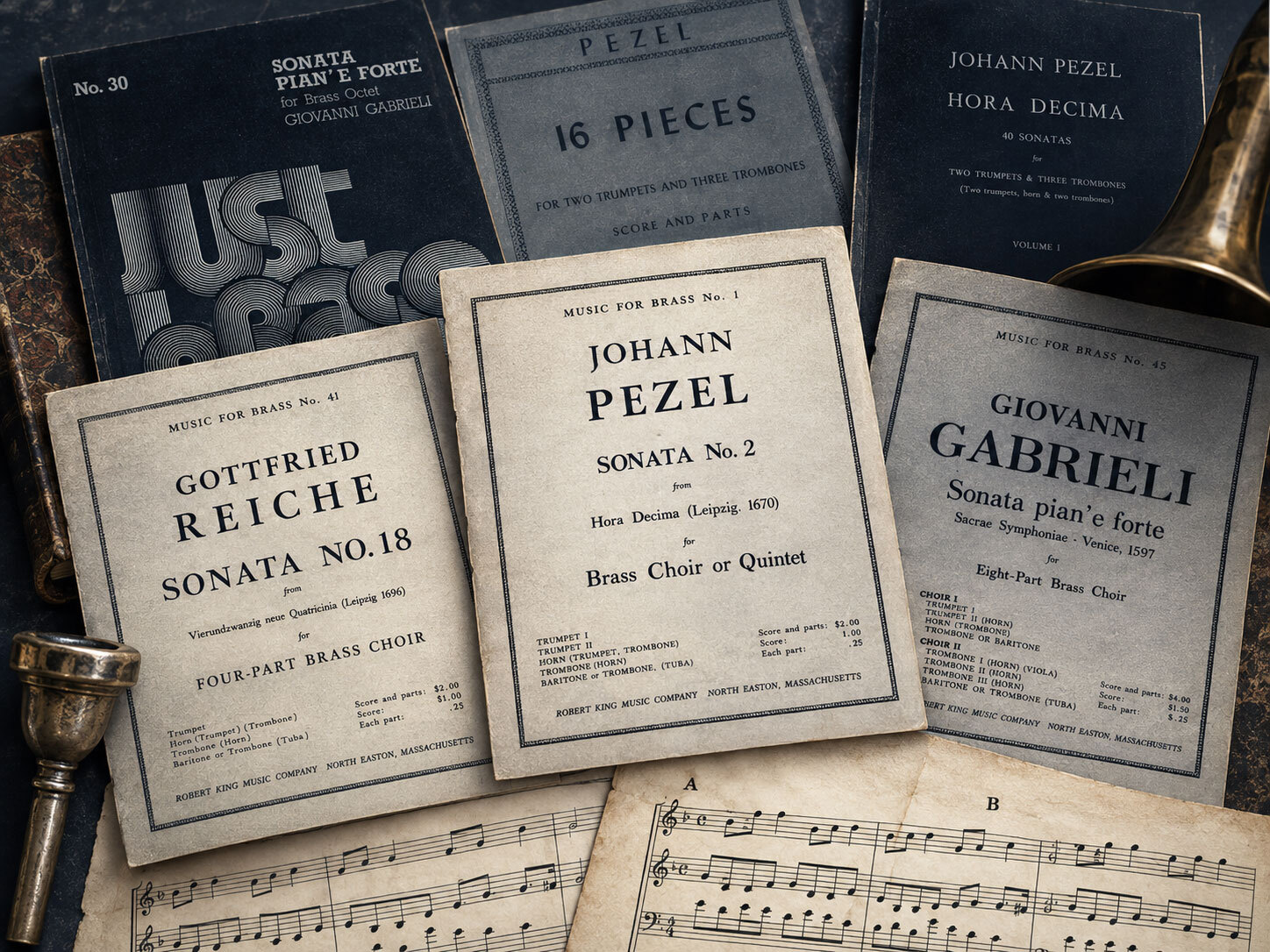
Seventeenth-century brass music regained its place in the repertoire, but modern editions often altered the original keys, instrumentation and balance between voices.
Modern editions of original 17th-century brass ensemble music

I. The tradition of original brass music

The art of the Stadtpfeifer or town musicians, who were grouped together in guilds, reached its highest point in the second half of the 17th century.¹ Over the years they had developed a repertoire which was tailored to the instruments available — primarily cornettos and sackbuts.

The majority of the works have probably not survived. Three large collections appeared in print: Hora Decima (1670) and Fünfstimmig blasende Musik ("Five-part wind music", 1685) by Johann Christoph Pezelius and Vierundzwanzig neue Quatricinien ("24 new quatricinia", 1696) by Gottfried Reiche; other instrumental works intended for wind were published together with vocal music or in compendiums for specific instruments.²

In the 18th century the Stadtpfeifer increasingly lost their importance; their place was taken by popular fiddlers, who had improved their social standing and become "art fiddlers" (in German Bierfiedler and Kunstgeiger respectively);³ local traditions continued into the 19th century.⁴

This development had various consequences:

  1. The few copies of printed editions in libraries disappeared.
  2. Playing techniques for certain instruments were no longer passed on to the next generation.
  3. The cornetto, the treble instrument in the wind groups, became extinct.

The original ensemble music, which had passed into oblivion, was rediscovered in the 1920s as research proceeded into Johann Sebastian Bach's environment. The leader in this effort was the musicologist Arnold Schering, who edited selected works of Pezelius for publication.⁵ Adolf Müller of the Posaunenchor mission of Saxony, who was advised by Schering, had printed the 24 Quatricinia of Bach's trumpeter Gottfried Reiche as well as works by Pezelius. Polychoral canzonas and sonatas by Giovanni Gabrieli appeared at about the same time.⁶ The real breakthrough did not take place until World War II, however.

In the last twenty years the number of brass players has risen constantly. This enormous impetus is due primarily to the fact that in the last few decades the high art of brass playing has been rediscovered, learned and taught afresh. One name deserves special mention in this connection: the French trumpeter Maurice André, who won the important international competitions in Geneva and Munich in the early 1960s, became both model and hero to a new generation which was beginning to study brass instruments intensively. The trumpet was the centre of attention to begin with but soon horn and trombone were also in demand.

Original 17th century music is important basic material for any brass ensemble. This paper is an attempt to examine more closely the modern editions which are so readily accessible today.⁷ In addition to the Pezelius and Reiche collections already mentioned some individual works by Giovanni Martino Cesare and Giovanni Gabrieli which are intended for wind will also be analysed. Criteria for the assessment will be examinations of the musical text, the keys, the markings added for performance and critical notes. The printed modern editions have been compared with the original printings so that comparative and positive conclusions might be reached.

Continue reading

Access the full Digital Edition.

Brass Bulletin 53, I / 1986 pages 69–80

All content is protected by copyright © Brass Bulletin 1986–2026

Share this article

Facebook LinkedIn
Loading…

Questions & Answers

How the Digital Edition works

What does the Digital Edition include?

The Digital Edition brings together the articles already digitized as searchable online texts—not simply as scans or PDF files—along with their original illustrations, notes, authorship, issue information, and available translations. Related-article suggestions currently include only this digitized material.

Are the digital articles identical to the originals?

We preserve the original text, language, illustrations, captions, footnotes, and editorial context as faithfully as possible. The presentation is adapted for comfortable online reading, and obvious transcription or scanning errors may be corrected. The substance and character of the published article remain unchanged.

Which languages are available?

Brass Bulletin was published in English, French, and German throughout its history. Italian and Spanish translations were added from issue No. 60 onward.

On the Italian and Spanish sites, articles from issues 1–59 are therefore shown in English by default.

How often are new articles added?

New articles are added almost daily, with approximately one complete issue digitized each week. The pace may vary depending on the preparation, image work, and editorial checking required.

Why aren’t all articles available digitally?

The complete Brass Bulletin collection contains 1,246 articles published between 1971 and 2003. The full index is already available online, allowing readers to discover every article in the collection, including those whose complete text has not yet been digitized.

Digitization began in February 2026. Each article is carefully prepared for online reading, checked, and connected to its issue, authors, subjects, and illustrations. At the current pace of digitization, the complete collection is expected to be available online by February 2028.

Why do some references mention articles that are not available yet?

References in the original articles are preserved even when the material they point to has not yet been digitized. This keeps the historical and editorial record intact. As more issues are added to the Digital Edition, an increasing number of these references will lead to articles that can be read online.

Can I suggest an article or report a transcription error?

Yes. If there is an article you would particularly like to see digitized, or if you notice a possible transcription error or missing detail, please contact us. Reader feedback helps us improve the Digital Edition and prioritize useful connections within the archive.

How can I support Brass Bulletin?

Your support helps fund the preparation, verification, and online publication of the complete collection.

Subscribe to the Digital Edition

Prefer to support us without subscribing?

Make a donation

How is the digitization progressing?

We’re gradually making the Brass Bulletin available online, article by article. You can read newly digitized articles as soon as they’re ready, even before an entire issue is complete.

Visit our Digitization Roadmap to browse recent additions and see estimated availability for upcoming issues. These estimates follow our recent pace and may change.

Search Brass Bulletin.