17 min de lectura
Modern editions of original 17th-century brass ensemble music
Por Klaus Winkler
I. The tradition of original brass music
The art of the Stadtpfeifer or town musicians, who were grouped together in guilds, reached its highest point in the second half of the 17th century.¹ Over the years they had developed a repertoire which was tailored to the instruments available — primarily cornettos and sackbuts.
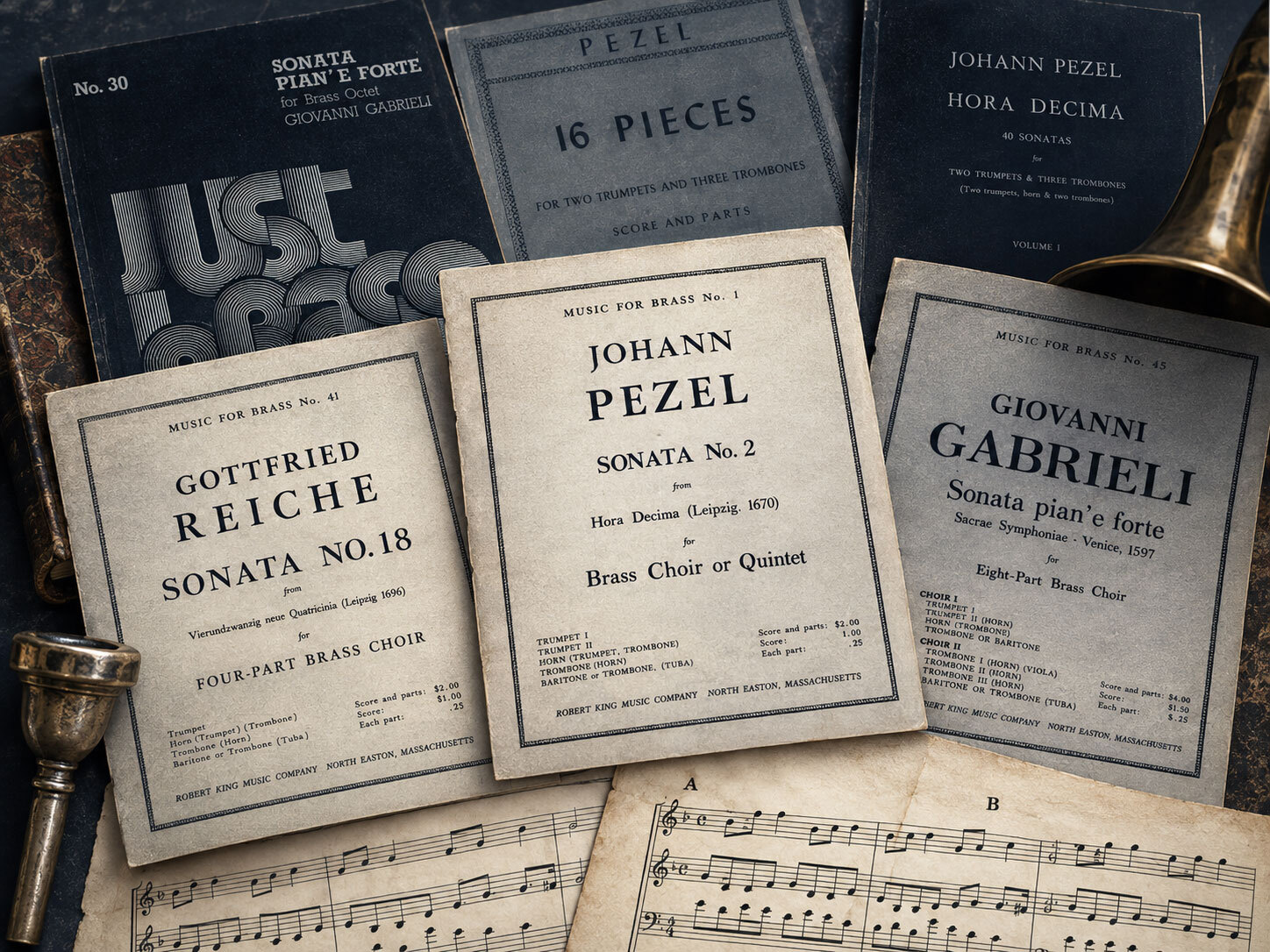
The majority of the works have probably not survived. Three large collections appeared in print: Hora Decima (1670) and Fünfstimmig blasende Musik ("Five-part wind music", 1685) by Johann Christoph Pezelius and Vierundzwanzig neue Quatricinien ("24 new quatricinia", 1696) by Gottfried Reiche; other instrumental works intended for wind were published together with vocal music or in compendiums for specific instruments.²
In the 18th century the Stadtpfeifer increasingly lost their importance; their place was taken by popular fiddlers, who had improved their social standing and become "art fiddlers" (in German Bierfiedler and Kunstgeiger respectively);³ local traditions continued into the 19th century.⁴
This development had various consequences:
- The few copies of printed editions in libraries disappeared.
- Playing techniques for certain instruments were no longer passed on to the next generation.
- The cornetto, the treble instrument in the wind groups, became extinct.
The original ensemble music, which had passed into oblivion, was rediscovered in the 1920s as research proceeded into Johann Sebastian Bach's environment. The leader in this effort was the musicologist Arnold Schering, who edited selected works of Pezelius for publication.⁵ Adolf Müller of the Posaunenchor mission of Saxony, who was advised by Schering, had printed the 24 Quatricinia of Bach's trumpeter Gottfried Reiche as well as works by Pezelius. Polychoral canzonas and sonatas by Giovanni Gabrieli appeared at about the same time.⁶ The real breakthrough did not take place until World War II, however.
In the last twenty years the number of brass players has risen constantly. This enormous impetus is due primarily to the fact that in the last few decades the high art of brass playing has been rediscovered, learned and taught afresh. One name deserves special mention in this connection: the French trumpeter Maurice André, who won the important international competitions in Geneva and Munich in the early 1960s, became both model and hero to a new generation which was beginning to study brass instruments intensively. The trumpet was the centre of attention to begin with but soon horn and trombone were also in demand.
Original 17th century music is important basic material for any brass ensemble. This paper is an attempt to examine more closely the modern editions which are so readily accessible today.⁷ In addition to the Pezelius and Reiche collections already mentioned some individual works by Giovanni Martino Cesare and Giovanni Gabrieli which are intended for wind will also be analysed. Criteria for the assessment will be examinations of the musical text, the keys, the markings added for performance and critical notes. The printed modern editions have been compared with the original printings so that comparative and positive conclusions might be reached.
Continue reading
Accede a la edición digital completa.
Brass Bulletin 53, I / 1986 páginas 69–80
Todo el contenido está protegido por derechos de autor © Brass Bulletin 1986–2026