Ofrezca Brass Bulletin en su universidad, conservatorio o biblioteca Descubra el acceso institucional

6 min de lectura

The posthorn of the 19th-century Royal Post Office in the service of folk music

Once a tool of postal signalling, the posthorn became part of Bavaria’s popular musical life, caught between official regulation, practical invention and folk tradition.
The posthorn of the 19th-century Royal Post Office in the service of folk music

When postilions drive their charges
Safely over hill and dale,
Hours and miles fly sweetly by
With the horn call’s merry note.

C. Hildebrandt
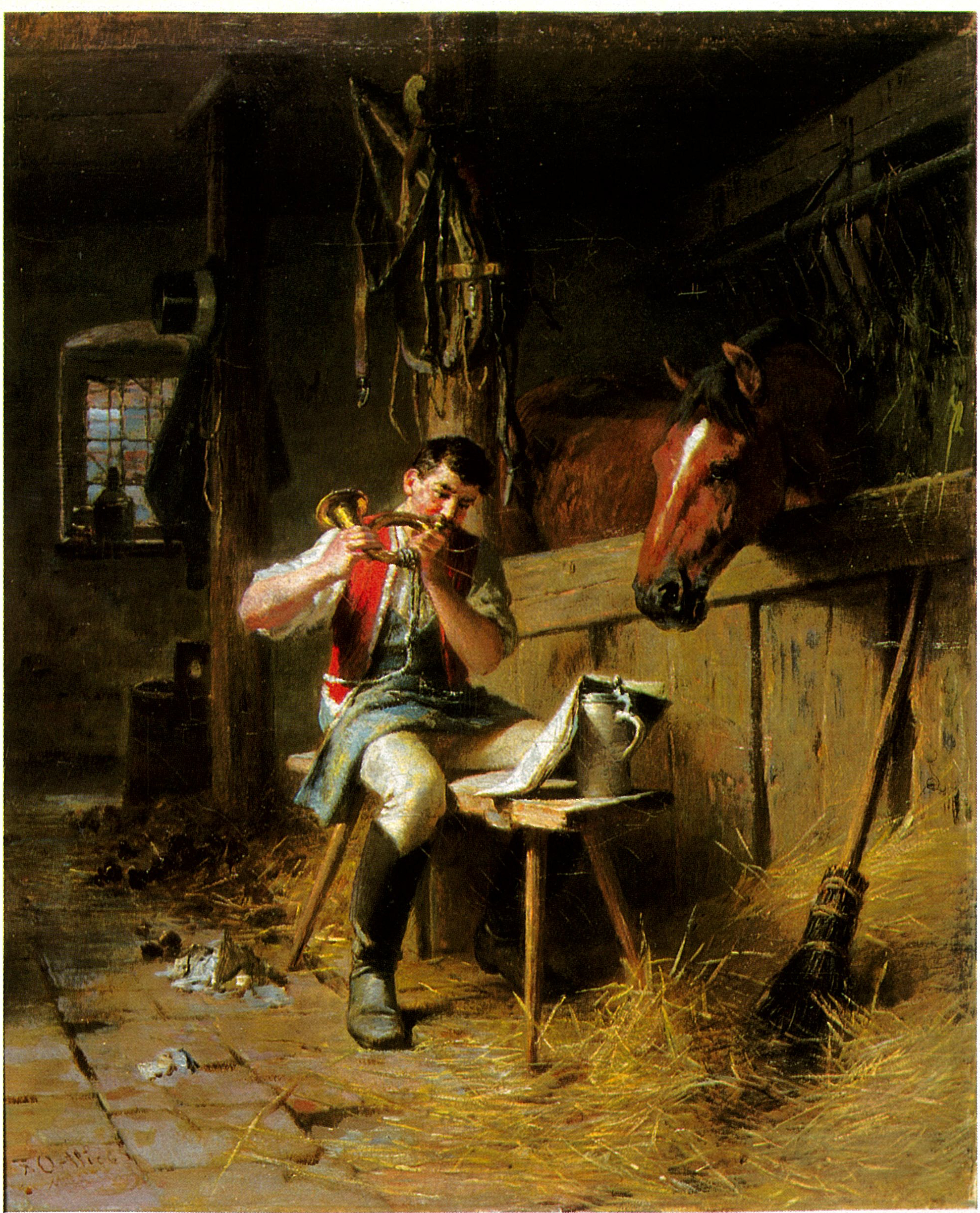
“Posthornklänge” (Bavarian postilion practising). Painted in oils (1890) by Friedrich Ortlieb. In the possession of the Bundespostmuseum, Frankfurt-am-Main.
“Posthornklänge” (Bavarian postilion practising). Painted in oils (1890) by Friedrich Ortlieb. In the possession of the Bundespostmuseum, Frankfurt-am-Main.

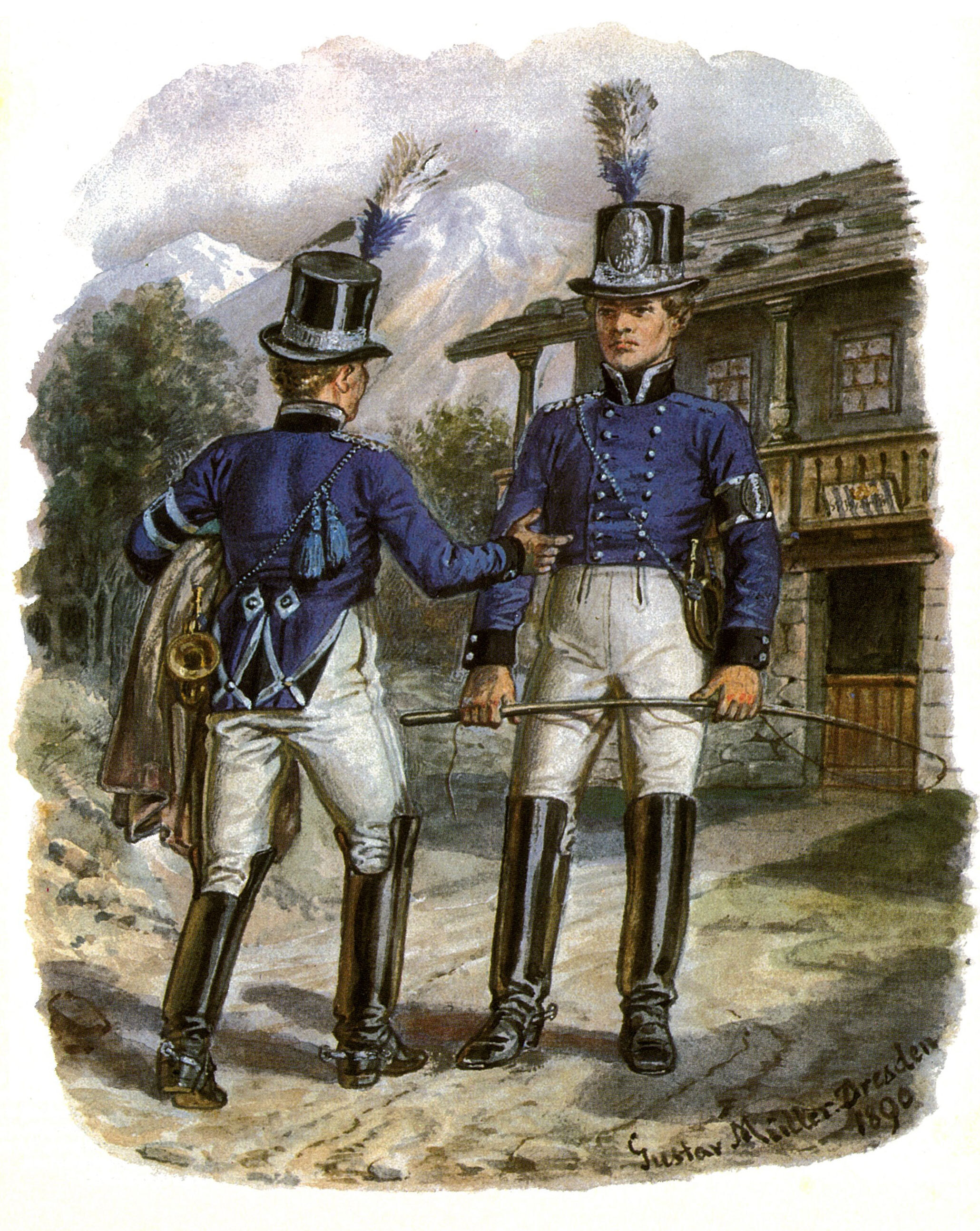
“Bavarian postilions around 1850”. Watercolour (1890) by Gustav Müller. Original in Bundespostmuseum, Frankfurt-am-Main, FRG.

“Bavarian postilions around 1850”. Watercolour (1890) by Gustav Müller. Original in Bundespostmuseum, Frankfurt-am-Main, FRG.

The main purpose of the posthorn, we read in the “Instruction of the use of the posthorn for the Royal Hanover Postilions” of 1832, is to signal the approach of postal conveyances and thus secure them unhindered and speedy attention... The posthorn also serves to increase the amenities of postal traffic in that it is most appropriate to the performance of attractive melodies. In the age of Romanticism, therefore, the posthorn was seen as no longer simply a signalling instrument, but also as a significant melodic instrument; this — the 1820’s — was the golden age of the art of the posthorn.

Until about 1830 two or three-coil posthorns in C or B♭ with a cup mouthpiece were in use in Bavaria; these had only a limited range:

As written in C

As written in C

After 1830 the Bavarian postilions were equipped with lower-pitched four-coil posthorns in F with a more funnel-shaped mouthpiece; these were in use until the present century. On these instruments the following notes were available:

As written in C

As written in C

Actual sounds in F

Actual sounds in F

This made the following calls, used between 1839 and 1903, easy to play:

No. 1 - Call before departure

No. 1 - Call before departure

No. 2 - Call on giving way

No. 2 - Call on giving way

No. 3 - Call before arrival at the station / Lively

No. 3 - Call before arrival at the station / Lively

In order to increase the range of notes available on the basic signalling posthorn, the service instrument was equipped with a tone hole situated two thirds of the way along the length of the tube, which, by shortening the tube when opened, raised the natural notes of the horn by a fourth:

° = tone hole open

° = tone hole open

This gives us the following fingering chart for a posthorn with one tone hole:

As written in C

As written in C

Even though the notes produced by using the tone hole did not match the principal notes in sound quality, this innovation constituted a substantial improvement in the Bavarian posthorn. From around 1830 there were even — for use in salon orchestras and wind bands (then known in German as Harmoniemusik) — fully chromatic posthorns with four or five tone holes closed by keys or with the still very expensive valves. Apart from their cost these instruments were too delicate for service use and had to be bought privately by posthorn virtuosos. Many postilions also used a cornet (then called in German Piston) for their musical performances.

Continue reading

Accede a la edición digital completa.

Brass Bulletin 50, II / 1985 páginas 52–65

Todo el contenido está protegido por derechos de autor © Brass Bulletin 1985–2026

Compartir este artículo

Facebook LinkedIn
Cargando…

Preguntas y respuestas

Cómo funciona la edición digital

¿Qué incluye la edición digital?

La edición digital reúne los artículos ya digitalizados como textos legibles y consultables en línea —no simplemente como escaneos o archivos PDF— junto con sus ilustraciones originales, notas, autoría, información del número y traducciones disponibles. Las sugerencias de artículos relacionados incluyen actualmente solo este material digitalizado.

¿Los artículos digitales son idénticos a los originales?

Conservamos con la mayor fidelidad posible el texto original, el idioma, las ilustraciones, los pies de imagen, las notas y el contexto editorial. La presentación se adapta para facilitar la lectura en línea y pueden corregirse errores evidentes de transcripción o escaneado. El contenido y el carácter del artículo publicado permanecen inalterados.

¿Qué idiomas están disponibles?

Brass Bulletin se publicó en inglés, francés y alemán a lo largo de toda su historia. Las traducciones al italiano y al español se añadieron a partir del número 60. Por este motivo, en los sitios italiano y español los artículos de los números 1 a 59 se muestran en inglés de forma predeterminada.

¿Con qué frecuencia se añaden nuevos artículos?

Se añaden nuevos artículos casi a diario, con aproximadamente un número completo digitalizado cada semana. El ritmo puede variar según el trabajo de preparación, tratamiento de imágenes y revisión editorial necesario.

¿Por qué no están disponibles todos los artículos en formato digital?

La colección completa de Brass Bulletin contiene 1.246 artículos publicados entre 1971 y 2003. El índice completo ya está disponible en línea y permite descubrir todos los artículos de la colección, incluidos aquellos cuyo texto íntegro todavía no ha sido digitalizado.

La digitalización comenzó en febrero de 2026. Cada artículo se prepara cuidadosamente para la lectura en línea, se revisa y se vincula con su número, sus autores, sus temas y sus ilustraciones. Al ritmo actual de digitalización, se prevé que la colección completa esté disponible en línea en febrero de 2028.

¿Por qué algunas referencias mencionan artículos que todavía no están disponibles?

Las referencias de los artículos originales se conservan aunque el material al que remiten aún no haya sido digitalizado. De este modo se mantiene intacto el contexto histórico y editorial. A medida que se incorporen más números a la edición digital, un número creciente de estas referencias conducirá a artículos que podrán leerse en línea.

¿Puedo sugerir un artículo o informar de un error de transcripción?

Sí. Si hay algún artículo que le gustaría especialmente ver digitalizado, o si detecta un posible error de transcripción o algún dato que falta, póngase en contacto con nosotros. Los comentarios de los lectores nos ayudan a mejorar la edición digital y a establecer prioridades útiles dentro del archivo.

¿Cómo puedo apoyar a Brass Bulletin?

Su apoyo ayuda a financiar la preparación, verificación y publicación en línea de la colección completa.

Suscríbase a la Edición Digital

¿Prefiere apoyarnos sin suscribirse?

Haga una donación

Busca en Brass Bulletin.