BrassBulletin

International Magazine for Brass Players

Brass Bulletin 33, I / 1981 (page 27–28) · 1 min. read
All content is protected by copyright © Brass Bulletin 1981–2026

Empire Brass Quintet

Portrait in brief

Search in this article
Empire Brass Quintet

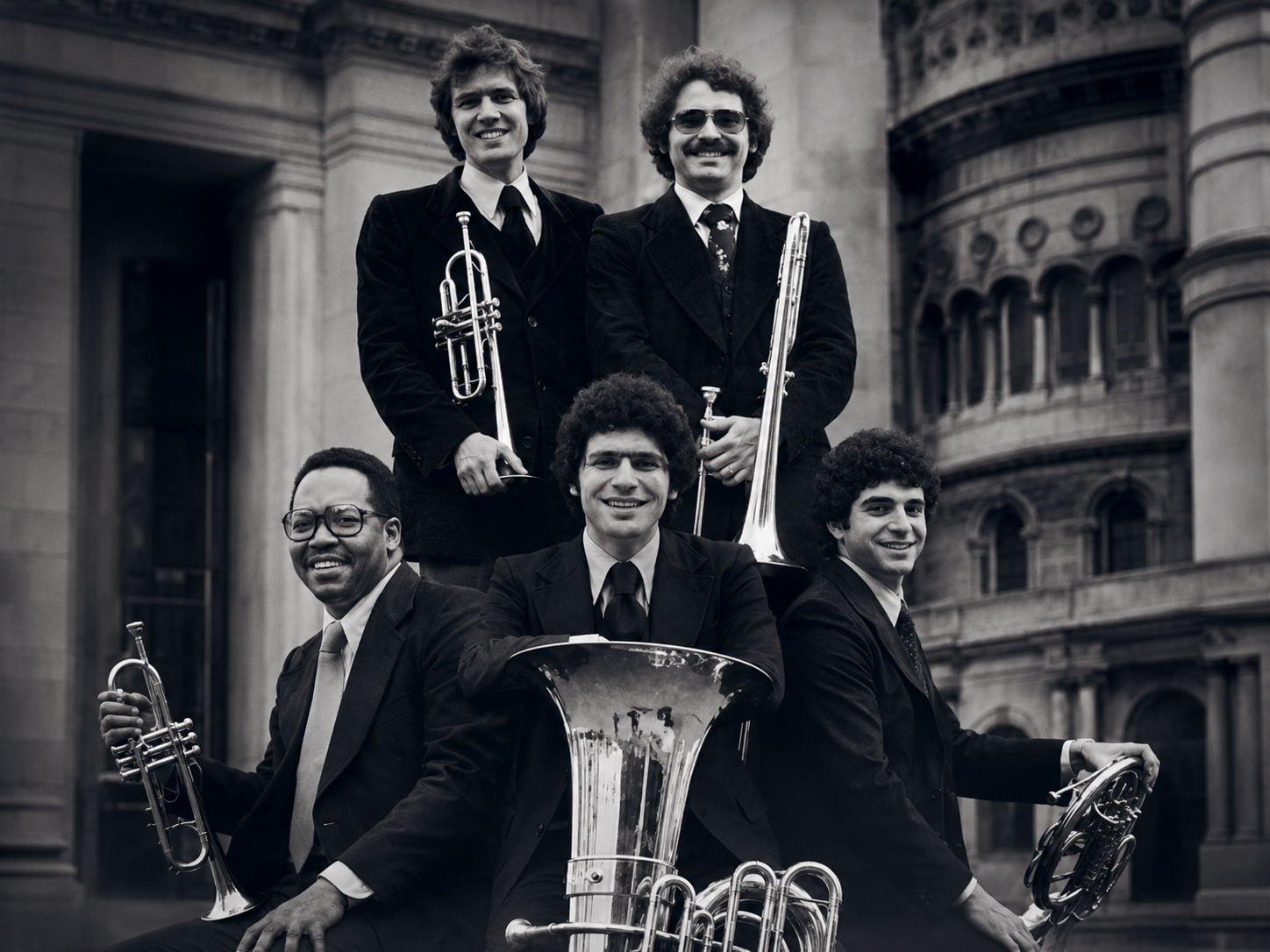
Empire Brass Quintet in 1981

Nowadays the Empire Brass Quintet needs an introduction only outside the United States (although it has visited Europe several times since 1976, appearing in West Germany, France, Belgium, Holland, Austria and Switzerland).

The five ambitious young men are recognised in their own country, certainly since 1976, when they were the first brass ensemble to win the revered Naumburg prize, the most coveted trophy for chamber music groups. This honour, previously associated with more intimate sounds, seems to have become a duty for the Empire players: "We try to play like a string quartet", says trumpeter Rolf Smedvig, "and we have always taken advice from string players."

It seems to have paid dividends, as the comparison with string quartets crops up several times in the invariably glowing press reports — always in favour of the velvet sound of the Empire players.

As far as repertoire is concerned, however, the EBQ uses a minimum of gimmicks. Its greatest hits have come from original 19th century brass writing — previously disregarded gems like the three quintets by the Tchaikovsky pupil Victor Ewald (LP Sine Qua Non 2012), but especially the American Brass Band Journal (Columbia M 34192 and Sine Qua Non 2017), a real "find": a curious collection of marches, dances and songs arranged for brass by the German bandmaster G.W.E. Friedrich who emigrated to America around 1850.

Of course the EBQ does not leave out early music (Sine Qua Non DIGI 102 and 2014, Renaissance Brass and Baroque Brass) and it has commissioned and given the first performances of works by leading present-day American composers (Bernstein, Schuller, Fennelly and others).

The five New Englanders call themselves the "Empire Brass Quintet" not because they had the honour of sounding a welcome for Queen Elizabeth II and President Jimmy Carter, but because they got together in 1972 in New York (the "Empire State") while three of them were working there for Leonard Bernstein.

Today they are based at Boston University, where they all also teach, as well as the Tanglewood Institute, where they were brought together for the first time ten years ago by Michael Tilson Thomas when they were themselves still students.

The "super virtuosos", as Thomas calls them now, are Rolf Smedvig, former solo trumpet at the Boston Symphony Orchestra; Charles A. Lewis Jr., all-round trumpeter and teacher at the New England Conservatory of Music; David Ohanian (horn) and Norman Bolter (trombone), both members of the Boston Symphony; and Samuel Pilafian, a widely-travelled tuba player much in demand, and a member of the American Ballet Theatre Orchestra.

Share this article

Loading…